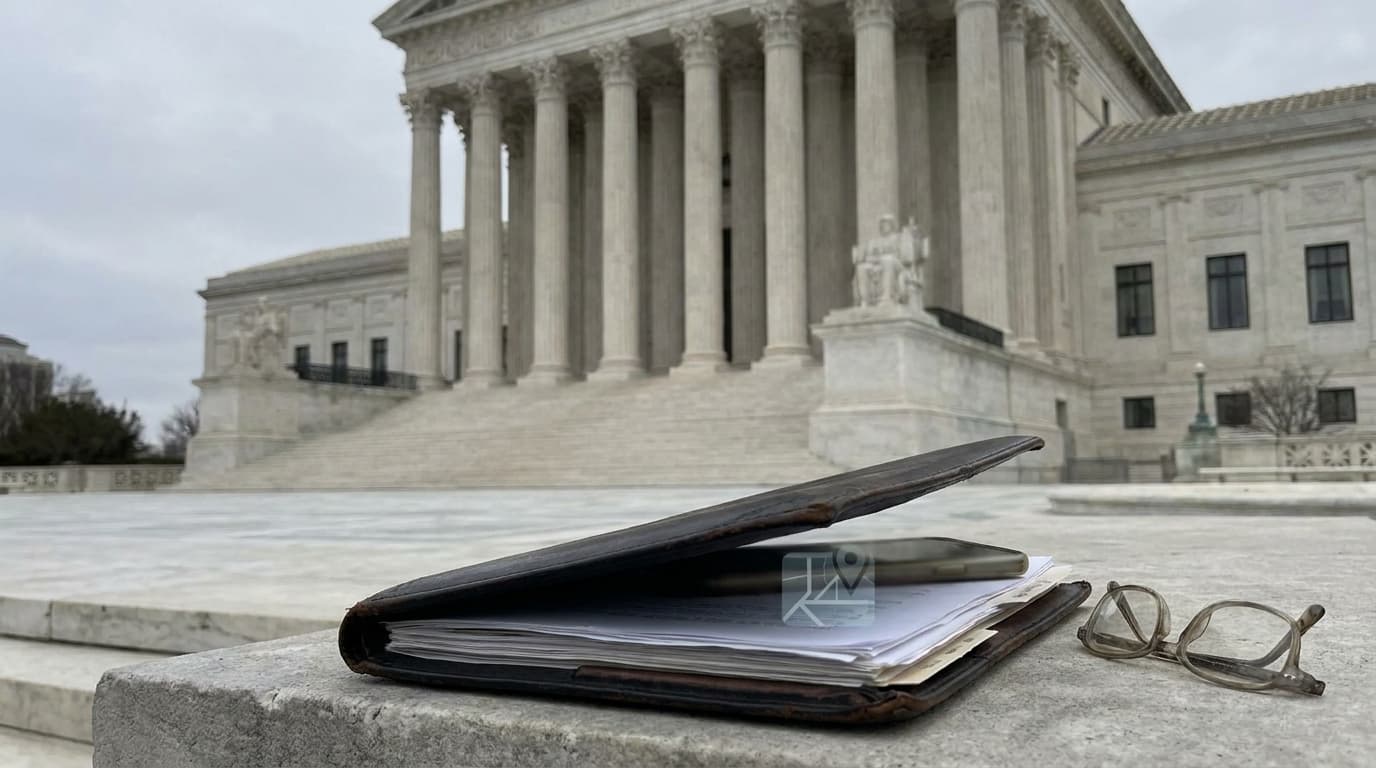
Imagine your phone placed you within a few hundred feet of a robbery you had nothing to do with, and police got a court order forcing Google to hand over your location. That is the reality of a geofence warrant, also called a reverse-location warrant, and for the first time the Supreme Court is deciding whether it survives the Fourth Amendment.
The case is Chatrie v. United States, docket No. 25-112. The justices granted review on January 16, 2026, limited to a single question: whether the execution of a geofence warrant violated the Fourth Amendment. The Court heard oral argument on April 27, 2026, and a decision is expected before the term closes in late June 2026.
What a geofence warrant actually does
A traditional warrant names a suspect and a place, supported by probable cause that evidence will be found there. A geofence warrant inverts that logic. Instead of starting with a suspect, police draw a circle on a map around a crime scene, pick a time window, and ask a company like Google to identify every device that was inside it. The technique searches everyone in an area first and identifies suspects second. That inversion is the heart of the constitutional fight.
How Okello Chatrie got here
On May 20, 2019, a robber armed with a firearm took roughly $195,000 from a federal credit union in Chesterfield County, Virginia, in the Richmond area. The robber was also carrying a cellphone. After conventional leads stalled, Detective Joshua Hylton of the Chesterfield County Police obtained a geofence warrant directed at Google's Location History service.
The warrant covered a 150-meter radius and a one-hour window, 30 minutes before and after the robbery. Through that process, investigators ultimately identified the defendant, Okello Chatrie, from anonymized location data.
Google's three-step process, in plain English
Google responds to these warrants in stages, and the numbers from this case show how wide the net is cast before any single person is named:
-
Step 1: Google returned 209 anonymized location points from 19 accounts within the 150-meter radius and one-hour window.
-
Step 2: Police selected 9 of those accounts, and Google expanded the time window for them, yielding 608 more data points.
-
Step 3: Police narrowed further, and Google unmasked identifying subscriber information for 3 accounts. One belonged to Chatrie.
Critics describe this as a "search first, suspects later" model. Everyone in the zone is swept into step one, including people who were merely passing by, before investigators work backward toward a name.
One technical clarification matters for understanding the case. "Sensorvault" is the internal name of Google's broad location database. The service actually queried here is formally called Location History.
The Fourth Amendment stakes
The Fourth Amendment requires that warrants be supported by probable cause and describe with particularity the place to be searched and the things to be seized. Those requirements exist because the Framers wanted to stop general warrants, the broad authorizations that let agents search anyone and everyone in pursuit of evidence.
The central question is whether a reverse-location warrant can ever satisfy probable cause and particularity when, by design, it searches every device in an area first. The defense argument treats that design as the modern descendant of the general warrant the amendment was written to forbid.
The Carpenter question
Much of the doctrinal battle turns on Carpenter v. United States (2018), in which the Supreme Court recognized a reasonable expectation of privacy in cell-site location data. The unresolved question is whether that reasoning extends to Google Location History. If it does, accessing that data is a search that ordinarily requires a warrant meeting full Fourth Amendment standards. If it does not, the government has more room to argue the data falls outside constitutional protection.
The circuit split driving the case
The Supreme Court often steps in when federal appeals courts disagree, and here they sharply disagree.
The Fourth Circuit, sitting en banc, decided Chatrie's appeal on April 30, 2025. A one-sentence per curiam opinion affirmed the district court's denial of suppression, but it was accompanied by roughly 126 pages of concurrences and dissents. The court split 7-7 on whether a Fourth Amendment search even occurred. Chief Judge Albert Diaz cast the controlling vote, and he rested it solely on the good-faith exception rather than resolving the search question. An earlier July 2024 panel had held there was no search under the third-party doctrine before the full court reheard the case.
The Fifth Circuit went the other way. In United States v. Smith, No. 23-60321 (5th Cir. Aug. 9, 2024), that court held geofence warrants are categorically unconstitutional general warrants and constitute a search under Carpenter. Even so, it still affirmed on the good-faith exception, citing the novelty of the technique.
The defense angle, and its limits
For people whose cases relied on geofence evidence, a defendant-friendly merits ruling could reopen suppression motions nationwide. But there is a significant catch. Both the Fourth and Fifth Circuits declined to suppress the evidence even after finding or assuming a constitutional problem, because the technique was novel and the law was unsettled. That is the good-faith exception at work, and it means a ruling that geofence warrants are unconstitutional may not automatically throw out evidence already collected under them.
If you believe a geofence warrant touched your case, this is a development to raise with a criminal defense attorney, because the timing and strength of any suppression argument will depend heavily on exactly how the Court rules.
What it means for ordinary people
The privacy implications reach far beyond people charged with crimes. A geofence warrant does not distinguish between a suspect and a commuter, a delivery driver, or someone visiting a nearby business. Anyone whose phone was logging Location History in the zone can be pulled into step one of the process. The case asks how much constitutional protection that everyday digital trail deserves.
What to watch for in the opinion
When the decision lands, expect one of a few paths. The Court could take a narrow off-ramp and resolve the case on good-faith grounds without deciding the bigger question. It could issue a search or no-search holding that clarifies whether accessing this data triggers the Fourth Amendment at all. Or it could announce a categorical rule on particularity that either permits or forbids reverse-location dragnets going forward.
At argument, Adam G. Unikowsky represented petitioner Chatrie, and Deputy Solicitor General Eric J. Feigin argued for the United States. With a decision due by late June 2026, the rules governing one of law enforcement's most powerful digital tools could change within weeks.
Related reading
-
Case v. Montana Hands Police a New Way Into Your Home Without a Warrant or Probable Cause
-
Culley v. Marshall Said No Prompt Hearing Required. State Legislatures Are Saying Otherwise in 2026.
Sources
-
Chatrie v. United States, Supreme Court Bulletin, Cornell LII
-
Update: Fourth Circuit Dodges Constitutionality of Geofence Warrants, Venable LLP
-
United States v. Smith, No. 23-60321 (5th Cir. 2024), Justia
-
Geofence Warrants and the Fourth Amendment, Congressional Research Service (LSB11274)
-
Supreme Court weighs constitutionality of geofence warrants, Brookings
-
Okello Chatrie v. United States of America, Brennan Center for Justice
Note: This article contains AI-assisted content and has been reviewed by our editorial team.
IMPORTANT NOTICE: GavelDaily.com is an advertising and information service, not a law firm. Submitting this form does not create an attorney-client relationship. The information you provide will be shared with licensed criminal defense attorneys in your area who may contact you about your inquiry. All submissions are treated as confidential by our service, but attorney-client privilege does not attach until you formally retain an attorney. Any attorney you connect with through this service is independently responsible for their legal advice and representation. Free consultations are subject to individual attorney availability. If you are facing an immediate legal emergency, contact your local public defender's office or call 911.