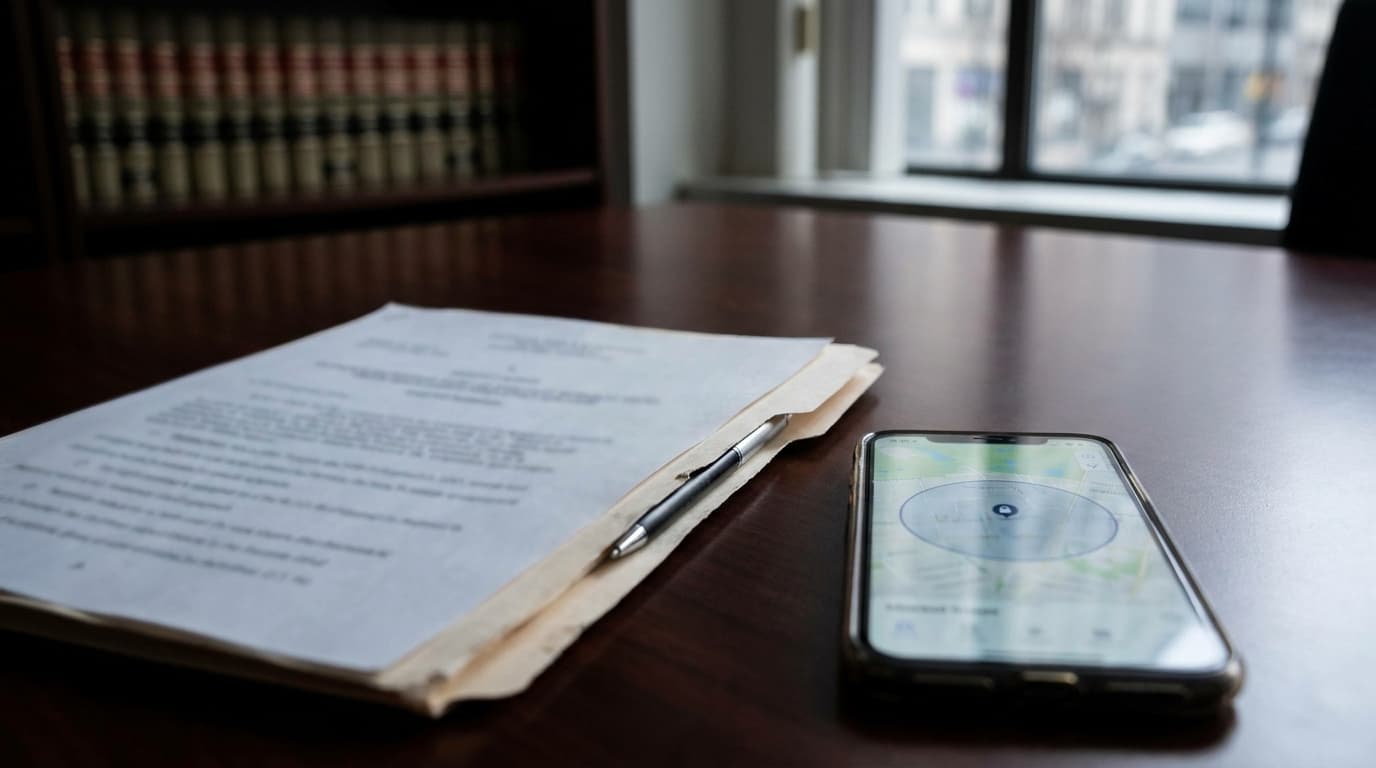
If your case was built on a Google location dragnet, the ground shifted on June 29, 2026. That day the Supreme Court decided Chatrie v. United States, No. 25-112, holding 6-3 that when police compel a person's cell-phone Location History through a geofence warrant, that is a Fourth Amendment 'search.' The vote matters because before Chatrie, prosecutors could argue there was no search at all, so there was nothing to challenge. Now there is. The warrant, and its defects, are on the table in a way they were not before.
Read the holding carefully before you get your hopes up. The Court did not ban geofence warrants. It did not decide whether the warrant in this case had probable cause or was specific enough. And it left standing a doctrine, the good-faith exception, that can keep evidence in front of a jury even after you prove a search occurred. Chatrie opens a door. It does not walk you through it.
What a geofence warrant actually is
A geofence warrant does not name a suspect. It names a place and a window of time. Police draw a circle on a map, hand it to Google, and demand a list of every device whose Location History put it inside that circle during those minutes. Google then runs a step-by-step process: it produces an anonymized list of devices, police narrow it, and Google deanonymizes the phones that remain. Everyone inside the zone gets swept in, whether they are a suspect, a bystander, a churchgoer, or someone asleep in a nearby home.
The facts behind the case
The underlying crime was a credit union robbery in Midlothian, Virginia, on May 20, 2019. Note that detail, because early coverage often called it a bank. It was a credit union. A robber was seen approaching from a corner of an adjacent church and appeared to be talking on a phone. After other leads dried up, police applied for a geofence warrant on June 14, 2019.
The geofence covered a 150-meter radius around the credit union. That circle works out to roughly 70,700 square meters, or about 17.5 acres. It did not just cover the crime scene. It swept in nearby homes and a church. Google then ran its multi-step reveal process, moving from an anonymized list of every phone in the zone, to a narrowed set, to deanonymized identities. Timothy Chatrie's device was among those the process surfaced.
The holding in plain terms
Justice Kagan wrote for the majority, joined by Chief Justice Roberts and Justices Sotomayor, Kavanaugh, and Jackson. The core of the ruling, in Kagan's words: 'An individual has a reasonable expectation of privacy in records about his cell phone's location, and police intrude on that constitutionally protected interest when they demand the information, even though for only a limited time, and from a third-party tech company.'
Two things in that sentence do the heavy lifting. First, it does not matter that the data covered only a limited stretch of time. Second, it does not matter that Google, a third party, held the records. Both of those were the government's main arguments for why no search occurred, and both lost.
The ruling builds directly on Carpenter v. United States (2018), where the Court held that police need a warrant to get historical cell-site location data. Chatrie extends that logic to the geofence context. What the majority did not do is fully explain why location data escapes the older 'third-party doctrine,' the rule that says information you hand to a third party, like bank records or dialed phone numbers, loses Fourth Amendment protection. That tension is left unresolved, which means the third-party doctrine is now unsettled, and that unsettledness is itself something defense lawyers can work with.
The 6-3 lineup, and why the split matters
The vote was 6-3 on the result, but the reasoning splits roughly 5-1-3. Five justices signed Kagan's reasonable-expectation-of-privacy analysis. Justice Gorsuch concurred in the judgment on a different theory: he treated your Location History as your own 'property' or 'effects,' a classic property-rights reading of the Fourth Amendment. That gives future defendants a second, independent path to argue a search occurred, one that does not depend on the reasonable-expectation framework at all. If a court is skeptical of the privacy rationale, the property rationale is there as a backup.
Justice Alito dissented, joined in full by Justice Thomas and mostly by Justice Barrett. Alito warned the ruling would 'unleash' 'upheaval in Fourth Amendment law.' He also made the argument every defendant needs to understand: he said the good-faith exception made the case inconsequential, because the evidence would come in anyway. That is not just a dissenting complaint. It is the exact obstacle standing between a Chatrie argument and an actual suppression order.
What the Court did not decide
This is where realistic expectations start. The Court answered one question, whether a geofence warrant is a search, and deliberately left four others for the Fourth Circuit on remand:
-
Probable cause. The Court did not decide whether this warrant was supported by probable cause.
-
Particularity. It did not decide whether the warrant was specific enough about what it authorized.
-
The multi-step reveal. It did not decide whether Google's anonymize-narrow-deanonymize process was reasonable. Justices Sotomayor and Jackson signaled concern that this three-step expansion was overbroad, but the majority left it for remand.
-
The general-warrant question. It did not decide whether geofence warrants are inherently unconstitutional 'general warrants,' the kind of dragnet the Fourth Amendment was written to stop.
All four questions go back to the Fourth Circuit. So a geofence prosecution is not automatically dead. It now has to survive scrutiny it previously skipped.
The reality check: the good-faith exception
Here is the caveat that decides whether Chatrie helps you or just makes a nice headline. Under United States v. Leon, the good-faith exception lets prosecutors keep evidence even from a defective warrant, as long as officers reasonably relied on a warrant that looked valid on its face. In Chatrie's own case, the federal district court in the Eastern District of Virginia had already denied suppression on good-faith grounds. The Supreme Court did not disturb that avenue.
Translate that into what it means for you: proving a geofence warrant was a search is necessary, but it is not sufficient to get evidence thrown out. If the officers who used the warrant reasonably relied on it at the time, a court can still let the evidence in. As one detailed analysis of the decision put it, Chatrie may not directly help the very defendant whose name is on it.
Good faith is not unbeatable, though. It tends to fail where a warrant is bare-bones or facially deficient, where no reasonable officer should have relied on it. And critically, good-faith reliance gets much harder to claim for geofence warrants issued after June 29, 2026. Once the Supreme Court has said this is a search subject to full Fourth Amendment scrutiny, officers can no longer plausibly say they did not know better.
How a defense lawyer actually raises this
The vehicle is a motion to suppress. Chatrie hands defense counsel the threshold win, a search occurred, and then the fight moves to the questions the Supreme Court left open. In practice, a suppression motion built on Chatrie will typically attack the warrant on several fronts at once:
-
Probable cause. Did the affidavit actually establish reason to believe the suspect's phone would be in that circle at that time, or was it a hopeful sweep of everyone present?
-
Particularity. Did the warrant describe what it authorized with enough precision, or did it authorize an open-ended dragnet over homes, a church, and every passing device?
-
The general-warrant argument. Counsel can press the point the Court left unresolved: that a geofence over 17.5 acres of homes and a church, deanonymizing everyone inside, is the modern version of the general warrant the Fourth Amendment forbids.
-
Distinguishing good faith. This is often the decisive battleground. For older warrants, counsel argues the defect was so obvious that no reasonable officer could rely on it. For warrants issued after June 29, 2026, counsel argues that reliance is no longer reasonable at all, because Chatrie put law enforcement on notice.
The practical reach is broad. The search holding applies to any prosecution built on a geofence dragnet, robbery, burglary, drug distribution, and beyond. It is most useful in cases with weak or overbroad warrants, and in cases where good faith can actually be overcome.
Bottom line
Chatrie is a real change, not a symbolic one. For the first time, a Google geofence warrant is a Fourth Amendment search, which means its probable cause, its particularity, and its dragnet scope can all be challenged in court. That is a genuine new avenue for people charged in cases built on location data, and mainstream coverage from NPR and CNN to civil-liberties outlets like Reason treated it as a significant win for privacy.
But it is case-specific, and it guarantees no dismissals. Whether it helps you turns on the strength of the warrant in your file and whether the good-faith exception can be beaten. If you are facing charges tied to a geofence warrant, this is a live issue worth raising, and the way to raise it correctly is with a defense attorney who can review the warrant, file the motion, and preserve the issue for appeal. Do not assume the argument is automatic, and do not let the deadline to raise it pass.
Related reading
-
[The .05 Blood-Alcohol Line Is Spreading: Washington Eyed a July Cutover, and Utah Is No Longer the Only Bill on the Table](/news/05-bac-limit-spreading-washington-utah)
-
[The Meth 'Purity Loophole' That Doubles Federal Sentences Survives: The Reform the Sentencing Commission Proposed, Then Quietly Shelved](/news/meth-actual-vs-mixture-purity-sentencing-reform-shelved-2026)
Sources
-
Chatrie v. United States, No. 25-112 (slip opinion, June 29, 2026)
-
Court rules that law enforcement's use of 'geofence warrant' was a 'search' (SCOTUSblog)
-
Fencing with the Fourth Amendment: Unpacking the Supreme Court's Chatrie Decision (Just Security)
Note: This article contains AI-assisted content and has been reviewed by our editorial team.
IMPORTANT NOTICE: GavelDaily.com is an advertising and information service, not a law firm. Submitting this form does not create an attorney-client relationship. The information you provide will be shared with licensed criminal defense attorneys in your area who may contact you about your inquiry. All submissions are treated as confidential by our service, but attorney-client privilege does not attach until you formally retain an attorney. Any attorney you connect with through this service is independently responsible for their legal advice and representation. Free consultations are subject to individual attorney availability. If you are facing an immediate legal emergency, contact your local public defender's office or call 911.