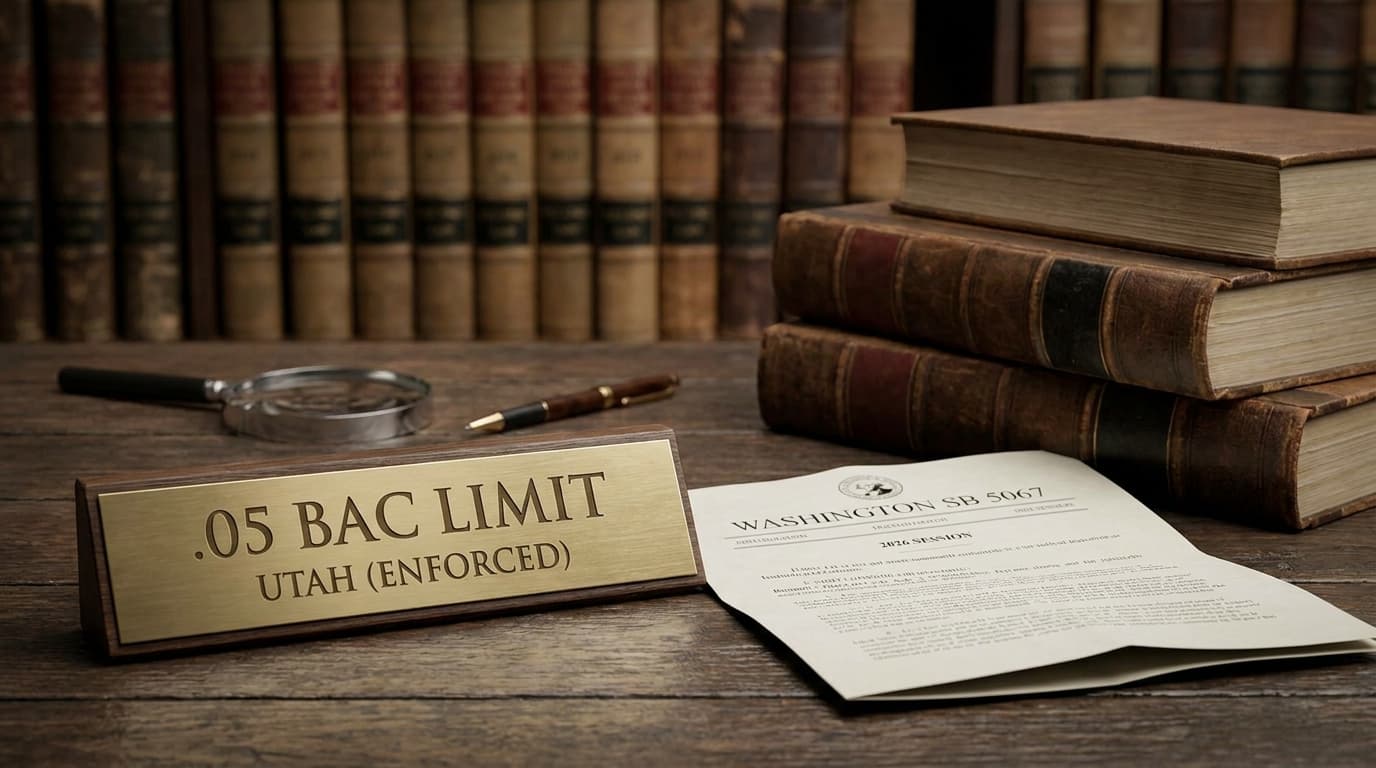
The .08 blood-alcohol standard that every driver in the country has lived under for two decades is starting to crack. In the 2026 legislative session, Washington's Senate voted to lower the state's driving threshold to .05, and safety regulators kept pressing states to follow. Before you recalculate your own margin at the bar, one fact needs to lead this story: as of the 2026 sessions, Utah remains the only state that actually enforces a .05 per se limit. Washington's bill passed the Senate and then died in the House. The number is spreading as a legislative idea, not yet as law.
For anyone who drives after a drink or two, the distinction between a trend and a statute is the whole ballgame. This is what the .05 push looks like right now, where it stands state by state, and how a lower threshold reshapes both the traffic stop and the courtroom fight that can follow.
What a .05 Limit Actually Means Behind the Wheel
A per se limit is a bright line. At or above the number, the reading itself is the offense; the state does not have to prove your driving was impaired. Drop the line from .08 to .05 and you have not just lowered a threshold, you have pulled a large group of drivers who would never have been charged into the zone where a breath reading alone can support a conviction.
The practical math is tighter than most people expect. Near the .05 mark, a driver can cross the line after roughly two standard drinks, with the exact point depending on body weight, sex, and how quickly the drinks were consumed. That is not a haze-of-intoxication scenario. It is a person who feels functionally sober but registers over the limit, which is precisely why borderline readings matter so much under a .05 regime.
It is worth separating two things a .05 law does at once. It creates a new per se number, and it leaves the older impairment-based charge fully intact. A driver under .05 can still be charged if an officer builds a case for actual impairment. A .05 law does not replace that path. It adds a second, lower tripwire on top of it.
Utah: The Proving Ground for .05
Every argument for and against a .05 limit runs through Utah. The state's HB 155 was signed in March 2017 and took effect on December 30, 2018, making Utah the first state in the nation to enforce a .05 per se limit. Years later, it is still the only one.
The reason .05 keeps resurfacing in other legislatures is the outcome data Utah produced. A 2022 NHTSA study found that Utah's fatal crash rate fell 19.8% and its fatality rate fell 18.3% between 2016 and 2019, well ahead of the 5.9% decline across the rest of the country over the same period. The Utah Highway Safety Office points to those numbers as the core case that a lower threshold changes driver behavior rather than simply generating more arrests. The negative effects opponents predicted, chiefly a collapse in restaurant and hospitality business, did not show up in the way critics had warned.
Washington 2026: A July Cutover That Never Came
Washington is the clearest recent test of whether the Utah model would spread. On January 28, 2026, the state Senate passed SB 5067 by a 26-23 vote. Sponsored by Sen. John Lovick, the bill would have lowered the state's limit from .08 to .05 with a July 1, 2026 effective date. For a few weeks, Washington looked like it might become the second state to draw the .05 line.
It did not happen. The bill stalled in the House Community Safety Committee, chaired by Rep. Roger Goodman, never reached a House floor vote, and died. Washington's limit remains .08. The July cutover that headlines pointed to was never triggered, and any driver planning around a lower Washington threshold this summer would be planning around a law that does not exist.
One drafting detail deserves attention from anyone tracking liability, not just criminal exposure. As written, SB 5067 specified that it did not change existing dram-shop or commercial alcohol vendor civil liability law, according to the official Senate bill report. That carve-out is a point advocates and defense attorneys flagged, because it means a lower per se number for drivers would not have automatically shifted the civil responsibility of the bars and restaurants serving them.
The Federal Safety Case Behind the Number
The .05 figure is not something states invented. The National Transportation Safety Board has recommended a .05 BAC limit for all 50 states, the District of Columbia, and Puerto Rico since 2013, as part of its "Reaching Zero" campaign against impaired driving. That recommendation is the federal anchor that state sponsors cite when they introduce these bills.
The 2022 NHTSA study of Utah gave the NTSB fresh evidence to point to. In a February 2022 statement, the board treated Utah's 19.8% fatal-crash-rate drop as validation of its long-standing position and tied a national .05 standard to an estimate of roughly 1,800 lives saved per year. That combination, a federal recommendation plus real-state results, is what keeps the number moving from one statehouse to the next.
The Spreading Map: Where .05 Bills Stand
Washington is the headline, but it is not alone in trying. Hawaii has become the most persistent example. Its alcohol policy coalition backed SB 2463 and HB 1827 in what advocates described as a fifth consecutive year of attempts, and national safety groups have continued to push Hawaii toward .05 in 2026. New York introduced a .05 measure, S53, in 2025. Legislators in Michigan and California have put forward their own versions as well.
None of these has been enacted. The pattern is consistent: a bill gains traction, often clears a committee or even a chamber, then stalls short of final passage. That is the honest shape of the trend. The .05 line is spreading as a proposal in many states while remaining law in exactly one.
How a Lower Threshold Compounds Other DUI Penalties
A .05 limit does not sit in isolation. It plugs into the machinery of implied-consent and ignition-interlock rules that already govern DUI cases. Lower the number, and more drivers reach the point where refusing a breath test triggers automatic license consequences under implied-consent law, and more drivers land in the range where an ignition-interlock requirement can attach. A change that looks like a single decimal adjustment on paper widens the funnel into every downstream penalty a DUI carries.
What .05 Changes for the Defense
For defense attorneys, a lower per se limit shifts where cases are won and lost. When the legal line sits at .08, a .09 reading leaves some cushion above the margin of error. When the line drops to .05, the fight moves to the edges, and small measurement questions carry outsized weight.
Several defense angles gain leverage under a .05 regime:
-
Margin-of-error challenges. The closer a reading sits to the threshold, the more a device's inherent tolerance matters. A result that reads .05 or .06 invites scrutiny of whether the true value could fall below the line.
-
Breath-test calibration. Machine maintenance, calibration logs, and operator certification become central when a conviction rests on a reading near the limit rather than well above it.
-
Rising-BAC arguments. Alcohol absorbed after a stop can push a later station reading over the line even if the driver was under it behind the wheel. That timing gap becomes more decisive when the threshold itself is lower.
-
Plea-negotiation leverage. Borderline readings and defensible measurement questions give the defense more room to negotiate reductions than a case sitting comfortably above the limit.
The through-line is that a .05 law does not just catch more drivers. It concentrates more cases in the zone where the science, the machine, and the timing are genuinely contestable.
A Note on Volatility: Verify Before You Rely
Effective dates and passage status change from session to session. Washington's SB 5067 is the cleanest reminder: a bill can clear a full chamber, carry a specific July 1 effective date, and still fail to become law. If you are making a decision based on your state's threshold, confirm the current statute for that state rather than the headline about a bill. As of the 2026 sessions, the enforceable per se .05 line exists in Utah and nowhere else.
Related reading
-
[The Meth 'Purity Loophole' That Doubles Federal Sentences Survives: The Reform the Sentencing Commission Proposed, Then Quietly Shelved](/news/meth-actual-vs-mixture-purity-sentencing-reform-shelved-2026)
-
[Half of Sober Drivers Fail the Roadside Marijuana Test: Why Courts Are Starting to Throw Out Cannabis DUI Field Evidence](/news/sober-drivers-fail-roadside-marijuana-test-cannabis-dui-field-evidence)
-
[The Broken Taillight Stop Is Dying: Los Angeles Moves to Ban Pretextual Traffic Stops, and It Changes How Drug and Gun Cases Begin](/news/los-angeles-pretextual-traffic-stops-ban-drug-gun-cases)
Sources
-
Lovick Bill to Reduce Legal BAC Limit to .05 Passes Senate — Washington Senate Democrats
-
Senate Bill Report SSB 5067, As Passed Senate — Washington State Legislature
-
Washington DUI BAC Limit: 0.05 Didn't Pass (2026 Update) — Adler Giersch
-
Utah First In The Nation To Lower Its DUI Limit To .05 Percent — NPR
-
NTSB Recommendation of .05 BAC Further Proved by NHTSA Study — NTSB
-
Hawaii Alcohol Policy Alliance Pushes to Lower BAC Limit — Maui Now
-
HI: Lower BAC Limit to .05 — Advocates for Highway and Auto Safety
Note: This article contains AI-assisted content and has been reviewed by our editorial team.
IMPORTANT NOTICE: GavelDaily.com is an advertising and information service, not a law firm. Submitting this form does not create an attorney-client relationship. The information you provide will be shared with licensed criminal defense attorneys in your area who may contact you about your inquiry. All submissions are treated as confidential by our service, but attorney-client privilege does not attach until you formally retain an attorney. Any attorney you connect with through this service is independently responsible for their legal advice and representation. Free consultations are subject to individual attorney availability. If you are facing an immediate legal emergency, contact your local public defender's office or call 911.