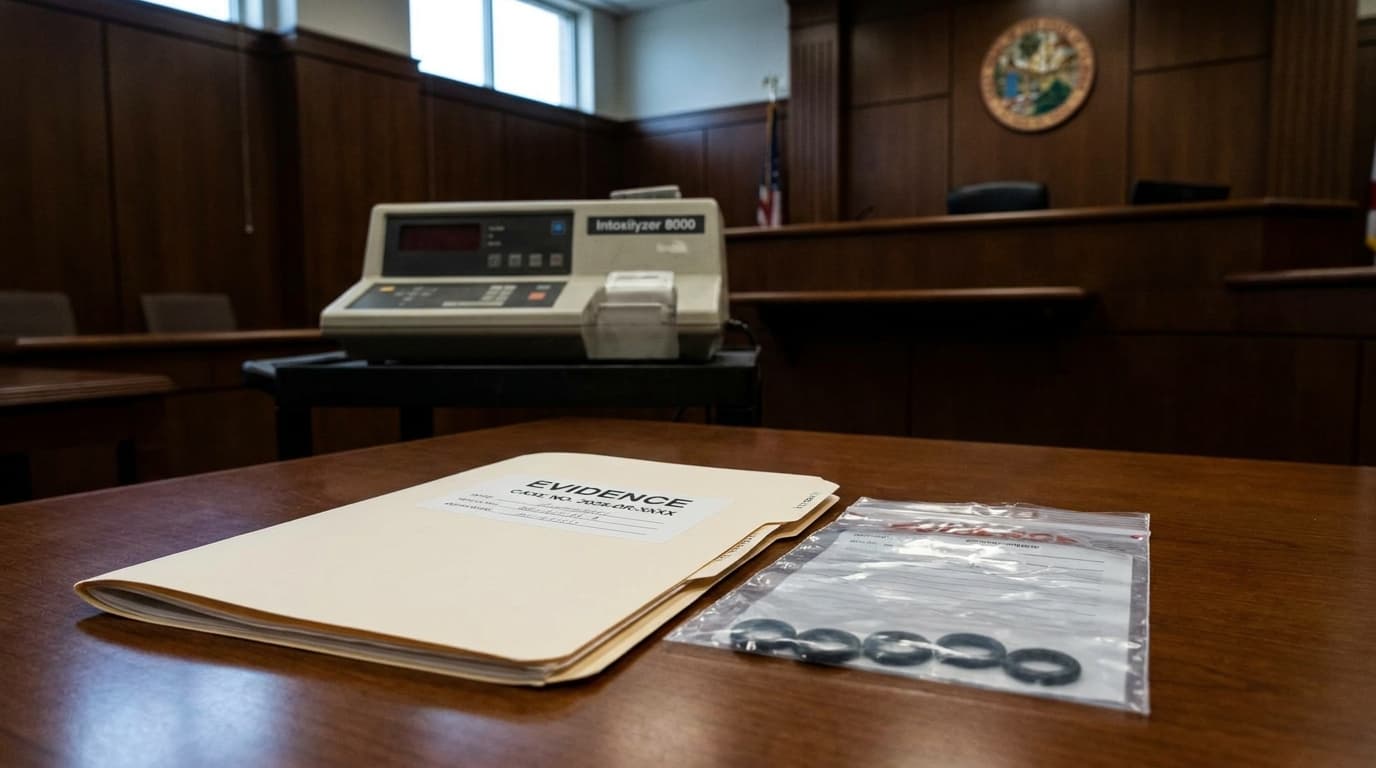
In August 2026, a three judge panel in Duval County threw out the breath test result against Sergio Rosario Cruz Lopez, who was arrested for DUI on Beach Boulevard in Jacksonville in 2025. The reason was five rubber O-rings inside the Intoxilyzer 8000, the breath test instrument Florida agencies use for evidentiary testing. Action News Jax, which reported the order, put the price of one of those rings at about a dollar.
Most of the coverage has framed this as a novel ruling that could unsettle thousands of pending cases. That framing is wrong in both directions. It understates what happened, because the panel was not inventing a theory. It was applying a binding appellate decision from 2025 that almost none of the coverage mentions. And it overstates what happens next, because Florida's Department of Law Enforcement amended the rule at the center of the argument effective July 1, 2026. This is not an open door. It is a closing window, and which side of it your test falls on is the question that actually matters.
What the panel found
The dispute is about who is allowed to put their hands inside the machine.
According to the reporting on the hearing, FDLE testimony established that the agency replaces four of the Intoxilyzer 8000's five O-rings during annual maintenance. Four of those rings are external. The fifth is internal, and whether it gets replaced is left to the individual inspector's discretion. The Jacksonville Sheriff's Office conceded that it also replaced O-rings, that it kept no records showing when it did so, and that replacing them could affect the accuracy of a result.
Then came the concession that decided the motion. The State agreed that neither FDLE nor JSO is an authorized repair facility under Florida's implied consent rules.
That matters because of what Chapter 11D-8 requires. Rule 11D-8.004(2) states that "[a]ny evidentiary breath test instrument returned from an authorized repair facility shall be inspected by the Department prior to being placed in evidentiary use." Rule 11D-8.004(4) assigns Department Inspectors responsibility for "inspections and maintenance." The entire fight lives in the space between those two words, maintenance and repair. Maintenance is what FDLE says it performs. Repair triggers an authorization requirement and a follow up Department inspection. You can read the current chapter text yourself at FLRules.
The precedent almost nobody reported
A year before the Duval order, Florida's Second District Court of Appeal decided State v. Kilburn, 418 So. 3d 275 (Fla. 2d DCA Aug. 15, 2025), a consolidated case carrying case numbers 2D2024-0649, 2D2024-0652 and 2D2024-0722.
The component in Kilburn was a breath tube rather than an O-ring, but the mechanics were the same. An FDLE inspector removed the instrument's top cover, disconnected an O-ring and wires, and replaced the part. The court held that this was a repair, not maintenance, and that it had been performed by an entity that was not an authorized repair facility. The trial court had suppressed the results. The State petitioned for certiorari. The Second DCA denied the petition and left suppression standing, describing unauthorized repair as something that "is not a minor deviation from the Department's rules."
That sentence is the whole ballgame. Florida DUI litigation is full of arguments about small procedural imperfections that courts wave through. Kilburn draws a line between a technical slip and a categorical failure, and puts unauthorized repair on the categorical side.
The Duval panel, in other words, was not going out on a limb. It was following a district court of appeal.
Who is actually bound by this
Here the distinction between the two decisions becomes practical.
A county court order in one defendant's case is not precedent. It does not bind other judges, not even other judges in the same courthouse. A defense lawyer can hand it to a judge as persuasive material, and that is all.
Kilburn is different. It is a decision of a district court of appeal. Under the rule stated in Pardo v. State, 596 So. 2d 665 (Fla. 1992), a district court of appeal decision binds all Florida trial courts in the absence of contrary authority from another district. Duval County sits in the First District, not the Second, but that does not exempt it. Unless and until a First DCA decision says otherwise, Kilburn is authority a Duval judge is expected to follow. We did not locate contrary First DCA authority, but that is exactly the kind of question a lawyer should run down in your specific case rather than take from a news article.
So the honest answer to "does this bind anyone" is that the county order binds no one and the appellate case behind it binds a great deal.
The closing window
Now the part the celebratory coverage skipped.
Rule 11D-8.002, the definitions rule, currently defines an "Authorized Repair Facility" as "The Department, the breath test instrument manufacturer, an entity authorized by the breath test instrument manufacturer to service and repair such breath test instrument." Note the first three words. The Department, meaning FDLE, is inside the definition.
That version of the rule took effect July 1, 2026. The official FLRules entry shows the amendment history running from 1993 through 7-17-25 and then 7-1-26, and the chapter directory shows six rules carrying that same July 1, 2026 date, including 11D-8.004. This was a coordinated chapter amendment, not a stray edit.
When Kilburn quoted the definition in August 2025, it did not include the Department. The court quoted a definition covering the manufacturer and manufacturer authorized entities, and observed that FDLE had been removed from it because the agency "only performs maintenance ... and does not perform repairs." That self removal took effect July 29, 2015, and it came alongside a shift in FDLE's own terminology from repair to maintenance. Defense commentary, including this account from Sammis Law Firm, describes that 2015 change as eliminating the post repair agency inspection requirement. Treat the motive characterization as advocacy. The date and the text change are documented.
The irony is complete. FDLE wrote itself out of the definition in 2015. That is precisely what let Kilburn and the O-ring cases argue that FDLE's own work on the instruments was unauthorized repair. As of July 1, 2026, FDLE is back inside the definition, and an agency that is an authorized repair facility cannot be an unauthorized one.
We are not asserting that the amendment was written in response to Kilburn. We did not obtain the Florida Administrative Register notice showing the redline, and without it the causal claim is speculation. What the rule text supports, and what a second firm's analysis independently describes as broadening who may perform authorized repairs, is the effect: going forward, this argument is far harder to make.
Cruz Lopez was arrested in 2025. His test is governed by the older rule. If you are reading this because you have a Florida breath test result you want to challenge, the first question is not whether O-rings are a magic defense. It is which version of Chapter 11D-8 governed the maintenance performed on the specific instrument that tested you.
What the State will argue
Prosecutors do not concede that every rule deviation kills a breath test. Florida's implied consent framework, at sections 316.1932 and 316.1934(3) of the Florida Statutes, has long been read to require substantial compliance with FDLE's rules rather than perfection. The State's position is that a replaced ring is a maintenance detail, that the instrument still produced a reliable reading, and that the deviation is too minor to justify excluding evidence.
Kilburn is the answer to that, and it is why the case matters more than the county order does. The Second DCA did not weigh how much the breath tube swap affected accuracy. It treated performing an unauthorized repair as a failure of a different kind than a technical lapse, and said plainly that it is not a minor deviation. Substantial compliance has limits when the deviation is categorical.
If you have a pending Florida DUI
This is a discovery fight before it is anything else. The argument only exists if the records exist, and in the Duval case part of what helped the defense was that JSO's records did not exist. Ask your attorney about requesting the following for the specific serial numbered instrument used in your case:
-
Department Inspection Reports, the FDLE Alcohol Testing Program paperwork generated on Form 41. FDLE posts per instrument records through its Intoxilyzer 8000 Records portal, and a sample filing shows what these reports do and do not document.
-
Agency inspection records maintained by the local law enforcement agency, which are separate from FDLE's.
-
Affidavits and testimony from the inspectors who worked on the instrument.
-
Any repair authorization, and any record of O-ring or component replacement, including who performed it.
-
The dates of that work, measured against July 1, 2026.
That last item is the one people will overlook. Two otherwise identical cases can come out differently depending on when the wrench touched the machine.
What suppression does not do
Say this part plainly, because it is the most common misunderstanding about breath test rulings.
Throwing out a breath result does not end a DUI prosecution. It removes one piece of evidence. Prosecutors routinely proceed on the officer's observations, driving pattern, field sobriety exercise performance, body camera footage, statements made at the scene, and any other evidence of impairment. Losing the number can change the leverage in a case significantly, and in some cases it is decisive. It is not an automatic dismissal, and anyone telling you otherwise is selling something.
What to watch
Three things will determine whether this stays a Jacksonville story. Whether the State seeks review of the Duval order. Whether judges in other circuits apply Kilburn the same way to O-rings rather than breath tubes. And whether the amended Chapter 11D-8 draws its own challenge, on the theory that the new definition is inconsistent with the implied consent statutes it is supposed to implement. A NewsRadio WIOD report dates the Duval order to roughly August 13, 2026, which places it about six weeks after the rule change took effect.
What we could not verify
In the interest of not passing along details we cannot stand behind: no public source we reviewed supplies the case number, the names of the three judges on the panel, or the division. The secondary coverage omits all three. Those details are obtainable from the Duval County Clerk, and we are not printing them until we have the order in hand. We have likewise held off on the frequently repeated figure for annual Florida DUI arrests, which circulates through aggregators without a clean citation. The authoritative count comes from FDLE's UCR arrest data, and it should be quoted with the year attached.
Related reading
-
[Two Circuits Have Now Used the Supreme Court's New Appeal-Waiver Escape Hatch. Both Dismissed the Appeal Anyway.](/news/two-circuits-hunter-appeal-waiver-escape-hatch-dismissed-anyway)
Sources
-
State v. Kilburn, 418 So. 3d 275 (Fla. 2d DCA Aug. 15, 2025)
-
Fla. Admin. Code r. 11D-8.004, Department Inspection and Registration of Breath Test Instruments
-
NewsRadio WIOD, "Florida DUI Cases Face Challenge Over Breathalyzer Maintenance"
-
Sammis Law Firm on the July 29, 2015 amendment (defense commentary)
Note: This article contains AI-assisted content and has been reviewed by our editorial team.
IMPORTANT NOTICE: GavelDaily.com is an advertising and information service, not a law firm. Submitting this form does not create an attorney-client relationship. The information you provide will be shared with licensed criminal defense attorneys in your area who may contact you about your inquiry. All submissions are treated as confidential by our service, but attorney-client privilege does not attach until you formally retain an attorney. Any attorney you connect with through this service is independently responsible for their legal advice and representation. Free consultations are subject to individual attorney availability. If you are facing an immediate legal emergency, contact your local public defender's office or call 911.