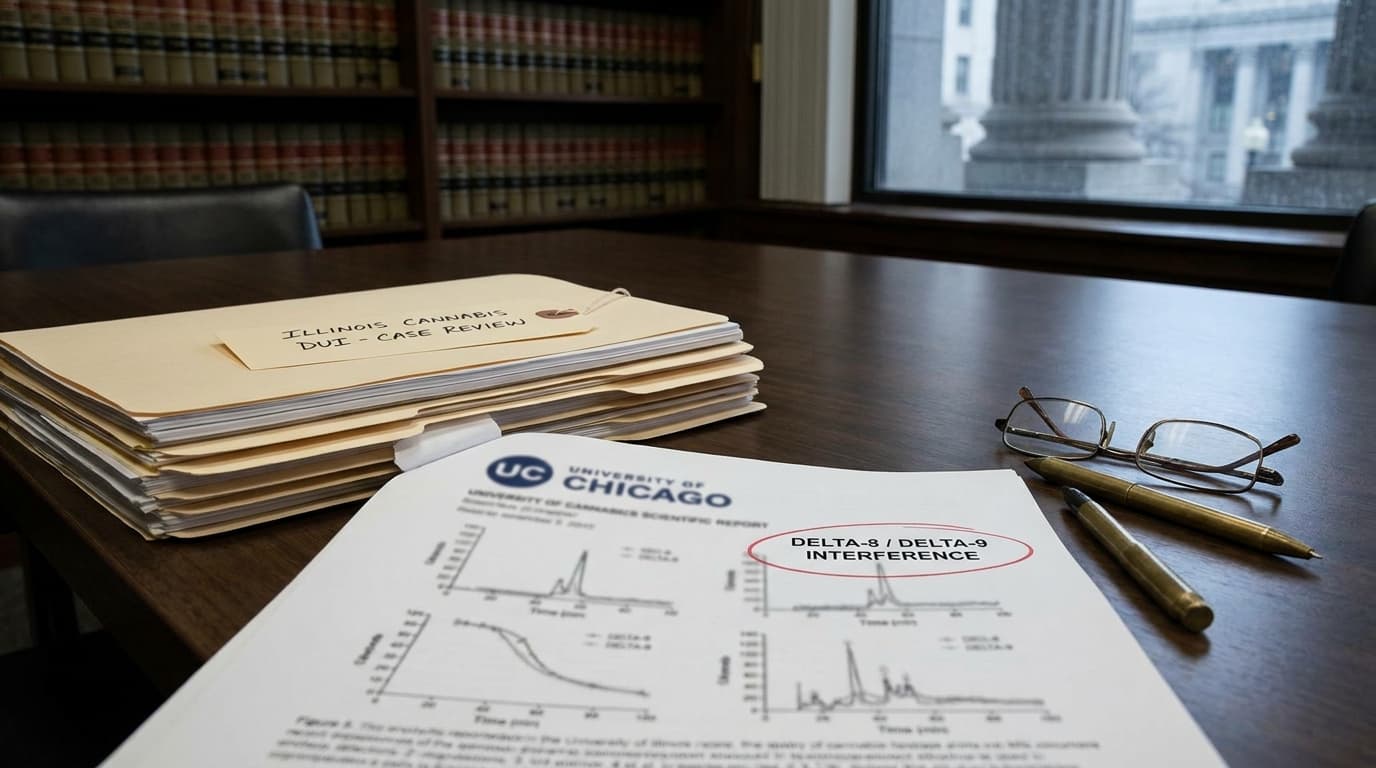
A per se DUI number is only as good as the instrument that produced it. Illinois does not ask a jury whether a driver was impaired when the case is charged under the per se cannabis provision. It asks whether a laboratory reported 5 nanograms or more of delta-9 THC per milliliter of whole blood. The number decides the case.
From 2016 through February 2024, a substantial share of those numbers in Illinois came from the University of Illinois Chicago's Analytical Forensic Testing Laboratory. On March 11, 2026, the Illinois Forensic Science Commission formally rejected the university's own investigation of that lab, calling it "insufficient" and stating that it "is not an authoritative document for criminal justice stakeholders."
Injustice Watch and South Side Weekly identified more than 2,200 human blood and urine samples tested for cannabinoids by the lab between 2016 and 2024. Reporting puts the affected population at roughly 2,000 people. If you were charged with a cannabis DUI in Illinois during those years, the first question is whether your blood or urine went to that lab. The second is what you can still do about it.
What actually broke
Cannabis produces more than one form of THC. Delta-9 THC is the intoxicating compound the Illinois statute names. Delta-8 THC is a chemically similar isomer that became widely available in consumer hemp products after the 2018 Farm Bill. The two molecules differ by the position of a single double bond, which makes them extremely difficult to tell apart on an instrument unless the analytical method is specifically designed to pull them apart.
In liquid chromatography, a sample travels through a column and its components emerge at different times. Two compounds that emerge at the same time are said to co-elute. When that happens, the instrument records one combined peak, and whatever the analyst measures from that peak includes both substances. Separating two compounds "to baseline" means the signal drops back to zero between them, proving they were resolved into two distinct measurements.
The university's outside-counsel report, prepared by Taft Stettinius & Hollister and issued May 28, 2025, concedes the point. It found that the lab's methods "did not allow for the complete separation of the Delta-8 and Delta-9 isomers to baseline," and that "it is possible that AFTL's Delta-9 quantitation results were artificially inflated due to AFTL's failure to rule out the potential interference of Delta-8." The allegation that the isomers were not separated to baseline was found to be, in the report's own word, "founded."
This is not a technicality about methodology preferences. Illinois 625 ILCS 5/11-501.2(a)(6) defines the triggering concentration as "either 5 nanograms or more of delta-9-tetrahydrocannabinol per milliliter of whole blood or 10 nanograms or more of delta-9-tetrahydrocannabinol per milliliter of other bodily substance." The statute names delta-9. It does not say total THC. An unresolved delta-8 peak inflates the exact analyte the legislature made dispositive, and it does so in the direction that hurts the defendant.
The separate problem with urine
The Commission raised a second issue that gets less attention and may matter more for the people who gave urine rather than blood.
The lab hydrolyzed urine samples. Hydrolysis converts conjugated THC metabolites back into measurable parent drug. Those metabolites can persist for weeks after use and say nothing about whether a person was impaired at the wheel. The Commission found the university's report offered "insufficient factual or scientific support" for its conclusion that analysts "appropriately and necessarily utilized the process of hydrolysis in order to detect Delta-9 in urine."
The Commission went further and questioned whether urine belongs in a per se cannabis case at all. It noted that section 11-501(a)(7), the per se provision, refers only to "whole blood or other bodily substance" and, unlike section 11-501(a)(6), does not specifically refer to urine. It stated flatly that "urine is not an appropriate matrix for detecting Delta-9 THC based on how Delta-9 THC is metabolized in the human body," and criticized the university's contrary assertion that the statute "specifically allows for the use of urine" as failing to cite the controlling provision.
If you were charged under (a)(7) on a urine result, you have two independent lines of attack rather than one.
What the lab knew, and when
This is where the sources diverge, and it is worth being precise about which document supports which claim.
The university's own chronology, contained in the Taft report, establishes the following sequence. The lab began testing human blood and urine in 2016. The 2018 Farm Bill passed in December 2018. Under a heading reading "Illinois State Police raise issue of separating Delta-8 and Delta-9 in 2021," the report records that the lab ran a limited test for separation in March 2021, and that internal discussions occurred in 2021 and again in 2023. A corrective and preventive action file on delta-8 and delta-9 separation was opened in March 2024. Lab director A. Karl Larsen issued a letter to law enforcement agencies in May 2024. Human testing had stopped in February of that year.
The Injustice Watch and South Side Weekly investigation reported a March 2021 email from Larsen stating, "Apparently some folks are having problems with the detection and separation of Delta-8 and Delta-9-THC." That reporting notes testing continued for roughly three more years.
The Taft report reaches the opposite conclusion on the knowledge question. It found "no evidence that AFTL knew that it used flawed testing methodologies," "no evidence that AFTL knew that it provided inaccurate laboratory results to law enforcement entities," and "no evidence that AFTL analysts knowingly provided false testimony." It reviewed more than 416,000 documents in reaching those findings.
Both things are in the record. A defense lawyer arguing this case should cite the chronology from the university's own report, cite the reporting on the 2021 email as reporting, and not conflate the two. The Commission, notably, did not adopt the university's exculpatory findings.
Why the Commission rejected the university's report
The Illinois Forensic Science Commission approved its statement on March 11, 2026. It found the university's report "insufficient to address the allegations related to [AFTL's] forensic testing of human blood and urine samples for the presence and quantity of Delta-9 THC for law enforcement agencies from 2016 through February of 2024."
Its criticisms were structural. The report "suggests a fundamental lack of understanding of forensic toxicology principles, forensic laboratory quality systems, and the duties and responsibilities of an accredited forensic testing laboratory to its end users." The Commission observed that the document "is not the result of an audit… conducted by subject matter experts," and that the investigative team "consisted solely of legal professionals." A forensic toxicologist was consulted, but the report contains no references indicating what, if anything, that consultant informed.
The Commission also dismantled the university's timeline defense. The argument that delta-8 products were not widely available in the early years is, in the Commission's assessment, "scientifically irrelevant" to whether the methods could separate the isomers. The methods "admittedly were not fit for purpose… both before and after" delta-8 products proliferated. A method either resolves two compounds or it does not. Market conditions do not change chromatography.
The Commission recommended that the university "initiate a comprehensive audit of the AFTL's forensic toxicology lab operations… posthaste," publicly release the findings, and retain an independent vendor with expertise in forensic toxicology, ISO/IEC accreditation, and forensic laboratory management. It pointed to Colorado's 2025 Forward Resolutions audit of Colorado Bureau of Investigation forensic services as the model.
The two findings every Illinois defense lawyer should highlight
Buried in the Commission's numbered observations are two statements that are more actionable than anything else in the document.
First, no amended reports were ever issued. In paragraph 5, the Commission states that the lab "did not issue amended or supplementary reports" as corrective action for the separation failure. It then adds the sentence that matters: "Criminal justice stakeholders should not assume that a particular case(s) may not have been impacted… based solely on the fact that no amended or supplemental report was issued."
Second, no notifications went to prosecutors about the testimony problem. In paragraph 6, the Commission records that the ANSI National Accreditation Board found merit to allegations of inaccurate or unqualified testimony involving the phrase "scientifically under the influence." The lab told the Commission it could not identify which cases were affected and "did not send notifications to State's Attorneys Offices" about it.
Put together: a court file with no correction notice in it proves nothing. The absence of a red flag is not evidence the case was clean, because no red flags were ever sent. That is the single most important sentence in the record for anyone whose case looks unremarkable on paper.
How to find out whether this lab touched your case
Nobody is going to send you a letter. Start here.
-
Pull the certified court file and the full discovery packet. Your former attorney should have the discovery. If you were represented by a public defender, the office keeps closed files. If you were unrepresented or cannot locate counsel, request the certified record from the circuit clerk in the county of conviction.
-
Look for the letterhead. You are looking for a toxicology report issued by the Analytical Forensic Testing Laboratory or the University of Illinois Chicago, as distinct from an Illinois State Police forensic science laboratory report.
-
Look for the analyst's name on the witness list or in the transcript. Jennifer Bash, the lab's senior analyst and quality manager, is the recurring name. She resigned in January 2024 and, per the Injustice Watch investigation, testified more than 80 times.
-
Note the specimen type and the dates. Blood or urine, date of collection, date of analysis. Anything analyzed between 2016 and February 2024 falls inside the window. Urine cases carry the additional hydrolysis and wrong-matrix arguments.
-
Identify the charging subsection. A charge under 11-501(a)(6) alleges any amount of a controlled substance. A charge under 11-501(a)(7) is the per se THC concentration count. An (a)(7) count rests entirely on the delta-9 number and is the most directly compromised.
-
File a FOIA request with the arresting agency for the lab submission form and the returned result. Agencies often retain this even when the court file is thin.
-
Check the lab's own site. The Commission notes the university report is publicly posted at aftl.lab.uic.edu. The Commission's statement and the underlying non-conformity reports are on the Illinois State Police Forensic Science Commission reports page.
If your case is still pending
You are in the strongest position in this pool, and you should move before the case resolves.
The core motion is a motion in limine to bar the toxicology result, paired where appropriate with a Frye challenge to the methodology. Aim the challenge at whether the method was fit for its stated purpose, which is quantifying delta-9 specifically, and not at whether the individual analyst was competent. The university's own report already concedes the separation failure. That concession is your starting exhibit, not something you have to prove.
Subpoena the underlying material rather than accepting the one-page result. That means the chromatograms, the calibration records, the validation packet for the method used on your sample, the corrective and preventive action file opened in March 2024, and the ANAB audit findings. Reported ANAB deficiencies included missing calibration records, absent measurement-uncertainty evaluations, absent complaint procedures, and unmaintained equipment.
You also have a concrete precedent to put in front of a prosecutor. On January 31, 2025, DuPage County State's Attorney Robert Berlin dismissed 19 cases, 2 felonies and 17 misdemeanors, citing that the lab's methods "may not have been effectively separating" delta-8 and delta-9. His office says it was notified of the testing issues in May 2024 by the lab director. None of the dismissed cases had resulted in an Illinois Department of Corrections sentence. Berlin's stated rationale was that "the integrity of prosecutions must remain, above all else, intact and beyond reproach." A sitting Illinois State's Attorney chose dismissal over defending this science. That is the ask.
A note on the counting, because it comes up. DuPage's own statement describes 19 dismissals. The National Registry of Exonerations logs 18 of those as a 2025 Illinois group exoneration, reflecting vacated convictions rather than every dismissed matter. These are the same event, not two separate ones. Do not cite them as though 37 cases fell.
If your case is closed
Most people in this pool already pled. Illinois offers a ladder of remedies, and the right rung depends on how the case ended and how long ago.
Agreed vacatur. The fastest route, and the one that actually worked in DuPage. It requires a State's Attorney willing to move or agree. Approach with the specific proof that your case ran through this lab, plus the Commission's statement. No litigation timeline can beat a prosecutor who agrees.
Post-Conviction Hearing Act petition, 725 ILCS 5/122-1. The vehicle for a constitutional claim, framed here as a Brady suppression claim. The Act has its own timing rules and a culpable-negligence exception for late filing, which is where the argument that the information was not publicly available until 2024 at the earliest does work.
Petition for relief from judgment, 735 ILCS 5/2-1401. The alternative where the claim is not constitutional or falls outside the Post-Conviction Act. The general limit is two years from judgment, subject to tolling for fraudulent concealment. That tolling argument is directly connected to the Commission's finding that the lab issued no amended or supplemental reports and sent no notifications to prosecutors.
Certificate of innocence, 735 ILCS 5/2-702. Know what this one cannot do for you. It is limited to felony convictions and requires imprisonment. Most cannabis DUIs in this pool are Class A misdemeanors, and DuPage confirmed none of its dismissed cases carried an IDOC sentence. For the typical person in this group, the certificate route is closed.
One procedural wrinkle shapes all of this. Illinois Supreme Court Rule 412 and its companion discovery rules apply to felony cases. Most cannabis DUIs are misdemeanors, where the constitutional disclosure duty still applies with full force but the rule-based machinery for getting documents is thinner. Expect to work harder for the same records if your case was a misdemeanor, and consider FOIA and third-party subpoenas as parallel tracks rather than fallbacks.
Why this is worth doing even if you never went to jail
People assume a disposition without jail time is not worth reopening. The consequences that survive are the ones that keep costing you: the statutory summary suspension and the revocation history that follows you at the Secretary of State, CDL disqualification, insurance rates, immigration consequences that do not care whether you served a day, and the fact that first-offense Illinois DUI supervision cannot be used twice. A vacated conviction restores an option you otherwise spent.
The disclosure argument, stated cleanly
Expect the response that the State's Attorney did not know the lab was broken either. Brady v. Maryland, 373 U.S. 83 (1963) answers it. Suppression of evidence favorable to an accused violates due process where the evidence is material, irrespective of the good faith or bad faith of the prosecution. Good faith is not a defense to a Brady claim; it is the express subject of the holding.
The duty extends to material known to those acting on the government's behalf. A contract laboratory testing specimens for law enforcement is acting on the government's behalf, whether it sits inside a state police building or a university pharmacy college. The lab's non-conformity reports, its corrective and preventive action files, the ANAB findings on testimony and quality systems, and the Commission's March 2026 statement are impeachment material for every conviction built on one of these reports.
And the duty does not expire when the case does.
The counterargument, honestly stated
The university's position is that the underlying detection methods were sound, that there is no evidence anyone knew the results were flawed, and that reliability "should be evaluated on a case-by-case basis." It found the accreditation allegations unfounded.
Applied to individual cases, that framing has real bite in some of them. A defendant whose blood draw came back well above 5 ng/mL, with no plausible delta-8 exposure and corroborating field evidence, may not get relief on an interference theory alone. Nobody should file expecting an automatic vacatur because a date falls inside a window.
That said, the Commission rejected the case-by-case framing as unsupported by the report that offered it, and rejected the report as a whole. This is contested ground, not settled ground, and it will be litigated case by case in Illinois circuit courts for some time.
Who was supposed to catch this
The lab held ANAB accreditation the entire time. Accreditation verifies that a laboratory's procedures are documented and followed. It does not certify that the underlying science is valid. A method can be meticulously documented and still fail to separate two isomers.
The Illinois Forensic Science Commission, created under 20 ILCS 2605/2605-615 and signed into law in August 2021, reviews significant non-conformities self-reported by ISO 17025-accredited public laboratories and issues recommendations. It is advisory. As ABC7 Chicago reported, it is a 14-member board with no enforcement power. It cannot sanction an analyst, compel an audit, or close a laboratory. Its most forceful available action in March 2026 was to publish a statement saying a report was insufficient.
Texas' forensic science commission, by contrast, has statutory investigative and disciplinary authority and an evidence-disclosure portal. Colorado commissioned an independent audit of its state bureau's forensic services in 2025, which is the model the Illinois Commission itself cited. No federal body licenses forensic toxicology laboratories at all.
The lab at the center of this was founded in 1933 to test racehorses for drugs. It spent eight years producing numbers that decided criminal cases, and the structure meant to check that work could recommend, report, and nothing else. The open question is not what happens to these 2,000 Illinois cases. It is what happens in the next state that hands criminal chemistry to a university lab with no one empowered to look.
Where to start
-
The Commission's March 11, 2026 statement, with the full May 28, 2025 university report attached. This is the document to hand your attorney.
-
DuPage County State's Attorney Berlin's dismissal statement, the precedent for asking another county to do the same.
-
Commission meeting materials and minutes, documenting the Quality Systems Subcommittee's page-by-page review across public meetings on August 6, September 4, October 9, and November 13, 2025, and January 7, 2026.
-
The 2024 significant non-conformities report, containing the lab's own self-reported separation failure and the testimony corrective action.
-
The laboratory's own site, where the university report is posted.
-
If you cannot afford counsel, contact the public defender's office in the county where the case was filed. The Illinois State Bar Association operates a lawyer referral service for private counsel.
This article is general information about a developing forensic and legal matter in Illinois. It is not legal advice about any specific case, and deadlines under the statutes discussed here are strict and fact-dependent. Talk to a licensed Illinois criminal defense attorney about your own file.
Related reading
Sources
-
Illinois Forensic Science Commission, Statement and Recommendation in Response to "Investigative Report Regarding the University of Illinois Chicago Analytical Forensic Testing Laboratory," approved March 11, 2026 (with the UIC/Taft report attached)
-
Statement from DuPage County State's Attorney Robert Berlin, Dismissal of Charges Involving UIC Analytical Forensic Testing Laboratory THC Testing
-
625 ILCS 5/11-501.2, Chemical and other tests
-
625 ILCS 5/11-501, Driving while under the influence
-
725 ILCS 5/122-1, Post-Conviction Hearing Act
-
735 ILCS 5/2-1401, Relief from judgments
-
735 ILCS 5/2-702, Certificate of innocence
-
Illinois Supreme Court Rule 412, Disclosure to Accused
-
Brady v. Maryland, 373 U.S. 83 (1963)
-
20 ILCS 2605/2605-615, Illinois Forensic Science Commission
-
Annual Report to the Illinois Forensic Science Commission, Significant Non-Conformities for 2024
-
Illinois State Police, Forensic Sciences Command Reports and Commission meeting materials and minutes
-
UIC Analytical Forensic Testing Laboratory
-
"Fake Science, Faulty Methods, Misleading Testimony," Injustice Watch / South Side Weekly
-
ABC7 Chicago, questions grow over who's holding labs accountable
-
ABC7 Chicago, UIC report doesn't fully address alleged flawed results, Commission says
-
ABC7 Chicago, thousands of marijuana DUI convictions may be in jeopardy
-
ABC7 Chicago, University of Illinois Chicago releases report on faulty AFTL blood tests
-
ABC7 Chicago, DuPage County State's Attorney dismisses marijuana DUI charges
-
National Registry of Exonerations, Illinois 2025 group exoneration (UIC/AFTL THC testing)
Note: This article contains AI-assisted content and has been reviewed by our editorial team.
IMPORTANT NOTICE: GavelDaily.com is an advertising and information service, not a law firm. Submitting this form does not create an attorney-client relationship. The information you provide will be shared with licensed criminal defense attorneys in your area who may contact you about your inquiry. All submissions are treated as confidential by our service, but attorney-client privilege does not attach until you formally retain an attorney. Any attorney you connect with through this service is independently responsible for their legal advice and representation. Free consultations are subject to individual attorney availability. If you are facing an immediate legal emergency, contact your local public defender's office or call 911.