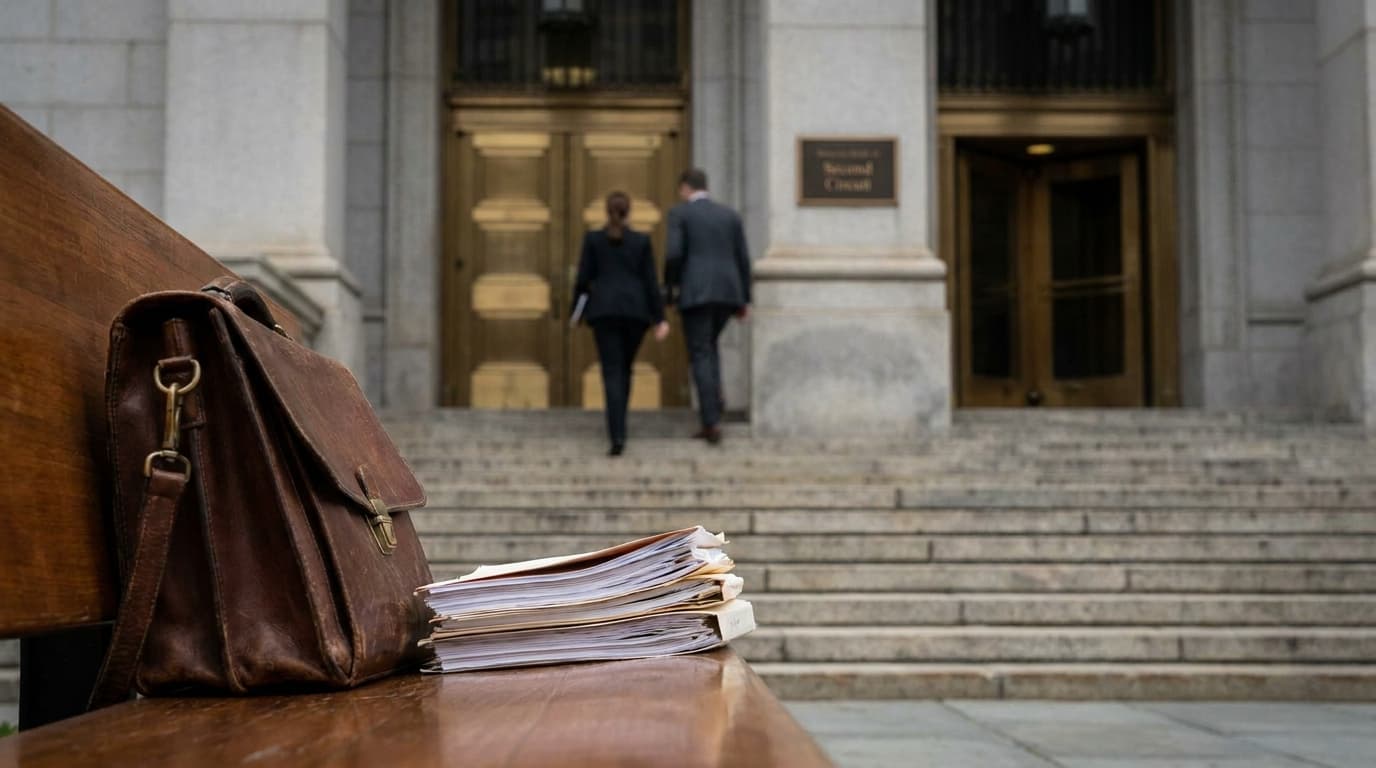
On August 13, 2026, the U.S. Court of Appeals for the Second Circuit decided United States v. Matos, No. 22-1561, and did two things that point in opposite directions. It held that its own long-standing list of exceptions to federal appeal waivers is no longer a closed list. Then it dismissed Jonathan Matos's appeal.
Matos is serving 100 months in federal prison for his role in a drug-trafficking organization in Syracuse, New York. When he signed his plea agreement, he gave up the right to appeal any sentence to a term of imprisonment of 135 months or less. He got 100 months. That is 35 months below the line he agreed not to cross, and as this article explains, that number quietly decided his case.
Matos was not the first defendant to test the Supreme Court's new rule. He was the second. And the score so far is two for two in the government's favor.
What the Supreme Court actually held in Hunter
[Hunter v. United States](https://www.law.cornell.edu/supremecourt/text/24-1063), No. 24-1063, 608 U.S. ___, was decided June 18, 2026, by a vote of 8-1. Justice Kagan wrote for the Court. Justice Thomas dissented alone, arguing that waivers are contracts and should be enforced as written, and that the majority had invented a rule with no grounding in statute or the Constitution.
The holding, verbatim:
An agreement not to appeal a sentence is unenforceable when it would result in a miscarriage of justice—meaning, when it would leave in place the kind of egregious error that would bring the judicial system into disrepute.
That sentence got the headlines. The next one is the one that governs almost every real case:
Standard-fare errors in misapplying sentencing law cannot cancel an appeal waiver.
Kagan gave three illustrations of what qualifies. First, a sentence exceeding what the statute allows, most commonly a term of years above the statutory maximum. Second, a sentence infected with a blatant constitutional error, such as a judge taking account of a constitutionally impermissible factor like race, or imposing a constitutionally infirm condition. Third, a sentence imposed without some minimum of civilized procedure. Per SCOTUSblog's opinion analysis, the Court illustrated that third category with a judge who let an orangutan pick a sentence out of a hat.
The Court described the exception as a high bar and a safety valve for rare, extreme cases, noting that sentencing is a complex affair in which mistakes inevitably occur. The Federal Defenders of New York read it as a genuine crack in a wall that had been solid for decades. On SCOTUSblog, Rory Little called it the most important criminal case of the term and predicted seismic shifts comparable to Apprendi v. New Jersey (2000), the decision Justice O'Connor called a number 10 earthquake in sentencing.
Two months of actual application look considerably smaller than that.
The first application: Hunter himself, and he lost too
Munson P. Hunter III pleaded guilty to one count of bank and wire fraud arising from a scheme that cost financial institutions roughly half a million dollars. Nine counts were dismissed under his plea agreement, which contained a broad appellate waiver. He was sentenced to 51 months plus three years of supervised release, including a condition imposed over his objection requiring him to take all mental-health medications prescribed by his physician. At sentencing the district judge told him "You have a right to appeal." The prosecutor said nothing.
The Supreme Court vacated and remanded. On remand, the Fifth Circuit applied the new standard to the man who created it and dismissed. According to commentary at Legal Information Services Associates, the panel in United States v. Hunter, No. 24-20211, 2026 U.S. App. LEXIS 22637 (5th Cir. July 29, 2026), found "a nexus between the Medication Condition and the government's interests in promoting Hunter's health and reducing his likelihood of re-offending," and held that the condition "does not rise to the level of egregious constitutional error that would bring the judicial system into disrepute." Readers should note that this decision currently carries only a LEXIS citation and is described here through a commentary source, not the court's published slip opinion.
Even so, the Fifth Circuit's doctrine did formally expand. Before Hunter, that circuit had refused to set aside waivers for essentially any error beyond ineffective assistance of counsel or a sentence above the statutory maximum. It now has a broader standard to apply. It just did not find this case met it.
Matos: a near miss, decided by a number nobody argued about
The procedural history in Matos is unusual and worth understanding, because the court went looking for the Hunter question rather than waiting for it.
Matos's appellate counsel filed an Anders v. California motion to withdraw, the filing a lawyer makes when they conclude an appeal has no non-frivolous issues. But counsel flagged something anyway: that 19 criminal history points "grossly overstate[s] the severity of his criminal conduct." The government moved to dismiss based on the waiver. The Second Circuit denied the Anders motion, deferred ruling on the motion to dismiss, and ordered briefing specifically on whether a miscarriage-of-justice exception applied.
The underlying dispute is the kind of thing that happens in federal court every week. At the time of the plea, the government estimated Matos would land in Criminal History Category II, producing a range of roughly 78 to 97 months with acceptance of responsibility. The Presentence Report instead put him in Category VI on 19 criminal history points, producing a range of 100 to 125 months. He objected to how four prior indeterminate sentences were scored under U.S.S.G. § 4A1.2(b)(1)-(2). The district court sentenced him to 100 months, the bottom of the higher range.
Here is where the waiver number matters. Matos had agreed not to appeal any sentence of 135 months or less. Whether his correct category was II or VI, whether the estimate or the PSR was right, he received a sentence 35 months inside the zone he had contracted away. The scoring fight was real. It was also, under the terms of his own agreement, unreviewable unless he could clear the Hunter bar.
He could not. Per the Federal Defenders of New York's analysis of the opinion, the panel (Cabranes, Livingston, and Nardini, with Chief Judge Livingston writing) found that Matos identified no sentence above the statutory maximum, no absence of some minimum of civilized procedure, and no blatant constitutional error. Guidelines criminal-history disputes, the panel said, are "precisely the sort of standard-fare errors contemplated in plea agreements that contain appeal waivers." Matos had "pointed to nothing to undermine the deal he struck with the government" and had not cleared "the high bar a defendant must surmount to overcome an appeal waiver."
The slip opinion is available through CourtListener, though the posted PDF is a scanned image without a text layer.
The half of Matos the headlines missed
Read only the disposition and Matos looks like a defeat for defendants. Read the opinion and it is more complicated.
For years the Second Circuit recognized five enumerated exceptions to appeal waivers: a waiver that was unknowing, involuntary, or entered while incompetent; a sentence based on constitutionally impermissible factors such as bias; a breach of the agreement by the government; a failure by the sentencing court to articulate any rationale; and a sentence resting on unsupported considerations. That list functioned as a ceiling. If your claim was not on it, you lost.
The Matos panel held that the list is "no longer exhaustive," and that "when a miscarriage of justice would result, an appeal waiver is unenforceable, even if none of the five exceptions is implicated." The Federal Defenders of New York call that "a meaningful expansion of the space in which waiver arguments can be made."
The panel also confirmed that the older tools survive. Ambiguities in waiver language are still construed against the government, the party that drafted the agreement. Hunter did not replace the existing contract-interpretation canon. It added a separate route on top of it.
So one opinion did both: it widened the category of arguments a defendant is allowed to make, and it held that this particular defendant's argument, a Guidelines scoring dispute, is not one of them. The opening is real. It is just narrower than the space most appeals actually occupy.
The calibration fight, and the first circuit to pick a side
The most consequential thing in Matos is not its outcome. It is which Supreme Court concurrence it followed.
Hunter produced dueling concurrences that framed the open question. Justice Gorsuch, joined by Justices Sotomayor and Jackson, wrote that "the jury trial has given way to a conveyor belt of plea bargains," and suggested that a failure to correct a plain, non-harmless miscalculation of the advisory Guidelines could itself qualify as a miscarriage of justice. Justice Kavanaugh, joined by Justices Alito and Barrett, responded that this reading "may not be entirely consistent with the Court's opinion" and would set the bar too low. Justice Barrett wrote separately on procedural common law versus the Court's supervisory power.
Whichever reading prevails determines how much of federal sentencing law an appeal waiver actually covers. Under Gorsuch's view, a clear Guidelines error could reopen an appeal. Under Kavanaugh's, it could not.
The Second Circuit sided with Kavanaugh. It supported that choice by surveying pre-Hunter miscarriage-of-justice caselaw from eleven circuits and treating it as persuasive authority, finding what it described as a convincing national consensus that Guidelines errors do not qualify.
That is the first circuit-level vote in the Gorsuch/Kavanaugh split. It is not binding anywhere outside the Second Circuit. Ten circuits have yet to publish on the question, and a defendant in another circuit is free to press the Gorsuch reading. If a circuit accepts it, the split created would be a strong candidate for the Supreme Court's next look at this issue.
What this means if you are weighing a federal plea offer
Based on how the first two circuits have applied Hunter, here is the practical shape of a federal appeal waiver right now.
What the waiver still takes: Guidelines miscalculations. Criminal history scoring, including disputes over how prior sentences are counted. Procedural and substantive reasonableness challenges to a sentence that falls within the range you agreed not to appeal. These are the errors both circuits have now labeled standard-fare.
What survives the waiver: A sentence above the statutory maximum. A sentence infected with blatant constitutional error, such as reliance on race or another constitutionally impermissible factor. A sentence imposed without some minimum of civilized procedure. Plus the pre-existing tools that Hunter did not touch: a waiver that was not knowing, voluntary, and competent, and any genuine ambiguity in the waiver language, which is read against the government.
The number that matters most: In Matos, the waiver's dollar-value equivalent was 135 months. Every argument he had was live only above that line. Reading the specific appeal-waiver threshold in a proposed plea agreement, and understanding how far the realistic sentencing range sits from it, is a concrete thing a defendant can do before signing. The Justice Department's own policy on incorporating appeal and post-conviction waivers into plea agreements is set out in Justice Manual § 626.
How many people this touches
Federal criminal cases are resolved by plea, not by trial. According to the U.S. Sentencing Commission's Annual Report for fiscal year 2025, 98 percent of cases resulted in a guilty plea, across 66,662 individual felony and Class A misdemeanor cases. Trials remain most common in murder cases (25 percent), individual rights cases (23 percent), and kidnapping cases (21 percent). More than 99 percent of immigration cases plead. District-level and circuit-level breakdowns are in the 2025 Sourcebook of Federal Sentencing Statistics.
How many of those pleas include an appeal waiver is harder to state honestly. The only real empirical measurement remains Nancy J. King and Michael E. O'Neill's study, Appeal Waivers and the Future of Sentencing Policy, 55 Duke L.J. 209 (2005), which reviewed 971 randomly selected Guidelines cases and found that in nearly two-thirds of cases settled by plea agreement, defendants waived their rights to review. That data is from 2003. Practitioners today describe waivers as close to universal, but no one has published a current count. Treat two-thirds as a floor of unknown vintage rather than a present-day figure.
The line is still murky, and someone has to draw it
Writing in Sentencing Matters on June 22, 2026, Jonathan J. Wroblewski argued that Kagan "leaves the line defining a miscarriage of justice murky," that lower courts have "real work to do," and that "the precise boundary between a standard-fare guideline error and one so egregious... is... unresolved." His proposed fix is institutional rather than judicial: the Sentencing Commission should amend its Chapter Six policy statements to reduce the inconsistency that will otherwise develop across circuits.
Two months in, the evidence supports his concern. The Supreme Court created an exception described as seismic. The first two courts to apply it agreed it exists, agreed it is broader than what came before, and dismissed both appeals in front of them. The Second Circuit went further and picked a side in the internal fight over how high the bar sits, without any other circuit having weighed in.
For a defendant deciding whether to sign a plea agreement this month, the practical answer has not changed much. The waiver in front of you still gives up nearly everything a federal sentencing appeal is normally about. What Hunter added is a narrow reserve for the extreme case, and so far, no court has found one.
Related reading
-
[The Fine Print That Waives Your Appeal Can Now Be Torn Up: In Hunter v. United States the Supreme Court Says a Plea Deal Can't Lock In a 'Miscarriage of Justice'](/news/hunter-v-united-states-appeal-waiver-miscarriage-of-justice)
Sources
-
Hunter v. United States, No. 24-1063, 608 U.S. ___ (June 18, 2026), full opinion text, Legal Information Institute, Cornell Law School.
-
United States v. Matos, No. 22-1561 (2d Cir. Aug. 13, 2026), slip opinion (scanned PDF, no text layer).
-
Second Circuit Applies Hunter and Expands Its Exceptions to Appellate Waivers, Yuanchung Lee, Federal Defenders of New York Second Circuit Blog, Aug. 14, 2026.
-
Hunter v. United States: Supreme Court Adopts a 'Miscarriage-of-Justice' Limit on Appellate Waivers, Federal Defenders of New York, June 22, 2026.
-
Court determines federal defendants' appellate waivers unenforceable if a miscarriage of justice would result, SCOTUSblog opinion analysis, June 2026.
-
Hunter v. United States: the most important criminal case of the term, Rory Little, SCOTUSblog, June 2026.
-
5th Circuit Emasculates SCOTUS Hunter Decision, Legal Information Services Associates, Aug. 4, 2026 (commentary source for United States v. Hunter, No. 24-20211, 2026 U.S. App. LEXIS 22637 (5th Cir. July 29, 2026)).
-
Annual Report 2025, United States Sentencing Commission.
-
2025 Sourcebook of Federal Sentencing Statistics, United States Sentencing Commission.
-
The Supreme Court Draws a Murky Line; The Sentencing Commission Should Help Clarify It, Jonathan J. Wroblewski, Sentencing Matters, June 22, 2026.
-
Justice Manual § 626, Plea Agreements and Sentencing Appeal Waivers: Discussion of the Law, U.S. Department of Justice.
Note: This article contains AI-assisted content and has been reviewed by our editorial team.
IMPORTANT NOTICE: GavelDaily.com is an advertising and information service, not a law firm. Submitting this form does not create an attorney-client relationship. The information you provide will be shared with licensed criminal defense attorneys in your area who may contact you about your inquiry. All submissions are treated as confidential by our service, but attorney-client privilege does not attach until you formally retain an attorney. Any attorney you connect with through this service is independently responsible for their legal advice and representation. Free consultations are subject to individual attorney availability. If you are facing an immediate legal emergency, contact your local public defender's office or call 911.