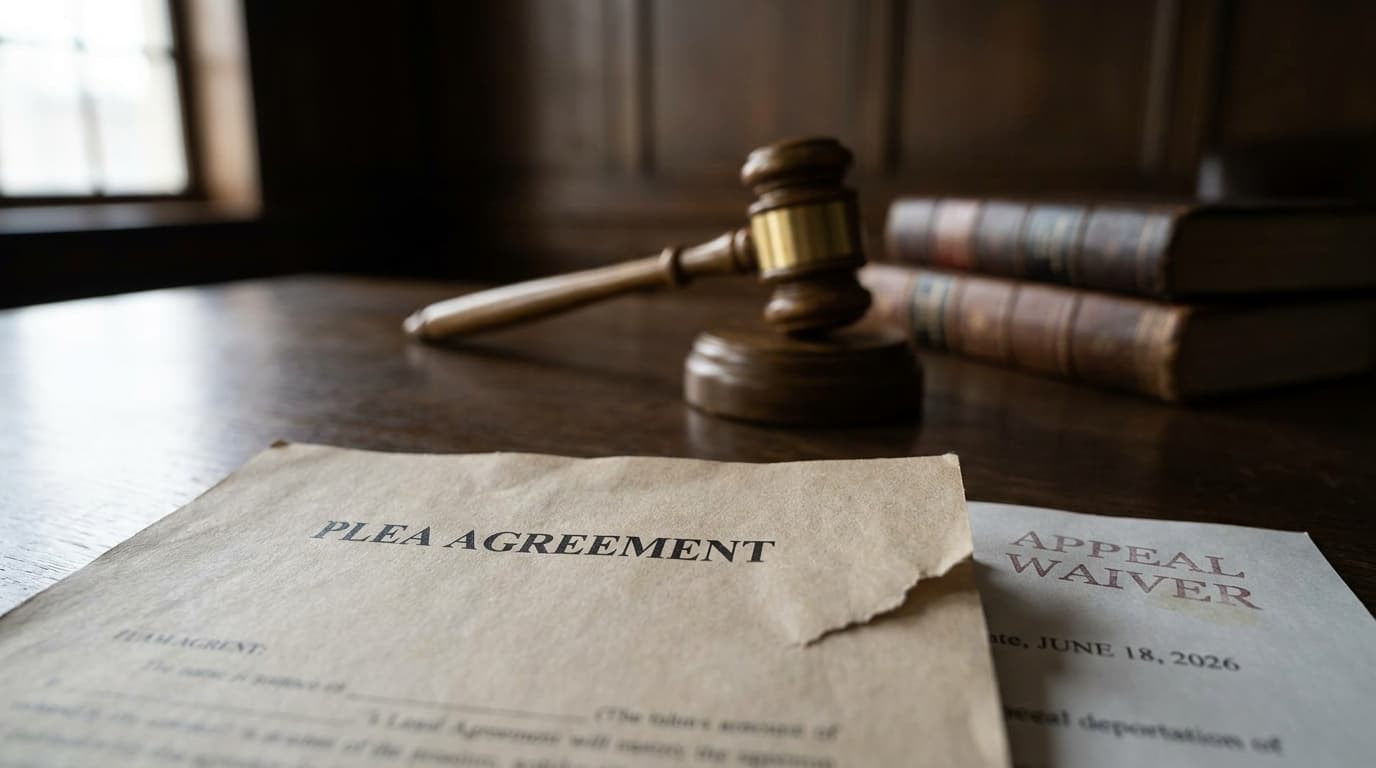
Nearly every federal criminal case ends the same way. The defendant signs a plea agreement, and buried in that agreement is a clause giving up the right to appeal the sentence. For decades those waivers have functioned as a locked door. You take the deal, you take the sentence, and the appeals court never hears from you again. On June 18, 2026, the Supreme Court cut a narrow but real opening in that door.
In Hunter v. United States, No. 24-1063, the Court held by a vote of 8-1 that a federal appeal waiver becomes unenforceable when enforcing it would produce a 'miscarriage of justice,' which the Court defined as 'the kind of egregious error that would bring the judicial system into disrepute.' Justice Kagan wrote for the majority. Justice Thomas dissented alone. The ruling matters because among federal defendants who are sentenced, roughly 97 to 98 percent plead guilty, so the fine print in these agreements governs the outcome for almost everyone in the system.
This is not a decision that tears up plea bargaining or declares appeal waivers unconstitutional. The Court assumed both remain valid. What it created is a safety valve, hard to invoke and reserved for the most extreme errors, grounded not in contract law but in the courts' own duty to stand behind the sentences they hand down.
The case: a wire-fraud plea and a sentencing dispute
Munson Hunter III pleaded guilty to one count of aiding and abetting wire fraud. His written plea agreement waived his right to appeal, with a carve-out that preserved claims of ineffective assistance of counsel. That structure is standard. Prosecutors across the country use nearly identical language.
A dispute at sentencing carried the case up to the Supreme Court. The justices agreed to decide how far these waivers reach, and specifically whether any error can be so serious that a waiver must yield. The Court heard argument on March 3, 2026, and issued its decision a little over three months later.
The holding, stated precisely
The core rule is this. A federal plea-agreement appeal waiver cannot be enforced where enforcing it would leave in place an egregious error that would bring the judicial system into disrepute. The Court's own phrase is 'miscarriage of justice.' Several lower courts had used the phrase 'manifest miscarriage of justice' over the years, but the majority opinion used the shorter formulation.
The basis for the rule is worth understanding, because it shapes how far it extends. The Court did not treat the plea agreement like an ordinary contract that a party can escape on contract grounds. It expressly declined to rest the exception on contract-law principles. Instead, it located the exception in the judiciary's institutional responsibility for the integrity of its own judgments. A sentence is something a court imposes, and the Court reasoned that judges cannot wash their hands of a fundamentally corrupt sentence simply because the defendant signed away the right to complain about it.
What counts, and what still doesn't
The Court offered illustrative categories of the kind of error that can qualify. It stressed that the list is not exhaustive and that truly extreme cases are hard to anticipate in advance. The examples it gave fall into three buckets:
-
Sentences that exceed the statutory maximum or are otherwise not authorized by law.
-
Sentences resting on constitutionally impermissible factors, such as race, or sentences that impose unconstitutional conditions of supervised release.
-
Sentences imposed without a minimum of civilized procedure, such as a refusal to hold a hearing the law requires.
Just as important is what the waiver still blocks. According to defense-practitioner analysis of the ruling, ordinary sentencing disputes remain off limits. That includes routine errors in calculating the Sentencing Guidelines, misapplications of the 18 U.S.C. § 3553(a) factors, challenges arguing that a sentence was substantively unreasonable, and disagreements about how a judge weighed the various factors. If you signed a waiver and your only complaint is that the judge got the Guidelines math wrong or came out too high, the door is still closed. The new exception is for the extraordinary, not the everyday.
Two secondary holdings that narrow the escape hatch
The Court also resolved two smaller questions, and both cut against defendants hoping to slip out of a waiver on a technicality.
First, the Court held that a judge's off-hand oral remark at sentencing, telling Hunter that he 'had a right to appeal,' did not modify the written waiver. The agreement required that any modification be made in a signed writing, and a stray comment from the bench does not clear that bar. Defendants cannot rely on a judge's casual statement to override the document they signed.
Second, the Court held that the government does not give up the waiver by staying silent at sentencing. Prosecutors properly invoke the waiver after the defendant files a notice of appeal. In other words, the government does not have to object in the moment to preserve its right to enforce the waiver later.
An 8-1 vote that hides a divided Court
The lopsided vote count conceals a real split over how broad the new exception should be. The justices agreed on the judgment but fractured on its breadth.
Justice Gorsuch, joined by Justices Sotomayor and Jackson, read the miscarriage standard expansively. Justice Kavanaugh, joined by Justices Alito and Barrett, read it narrowly and objected that Gorsuch's version set the bar too low and swept in more than the majority intended. Justice Barrett also wrote separately. Her concurrence was partly sympathetic to Thomas's position, but she concluded that the courts' procedural common law does permit disregarding a waiver in extreme cases.
The practical upshot is that defense lawyers and prosecutors will now fight over which reading controls. Defendants will cite Gorsuch's broader framing. The government will argue that the narrower Kavanaugh view, closer to the majority's stated limits, is the one that governs.
Gorsuch's bigger swing
Justice Gorsuch's concurrence went further than the case required. Beyond reading the exception broadly, he mounted a historical and constitutional critique of the modern plea-bargaining system, arguing that it is both ahistorical and coercive. He noted that plea bargaining occupies less than a quarter of the history of American criminal justice, and that courts began loosening limits on coercive prosecutorial tactics in the 1970s, pointing to Bordenkircher v. Hayes.
It is important to be precise about what this is. Gorsuch's argument that the waiver-driven plea system rests on shaky constitutional ground is an argument made in a concurrence. It is not the holding of the Court. The majority did not question the constitutionality of plea bargaining or appeal waivers. Read Gorsuch's concurrence as a challenge to the system's legitimacy from three justices, not as a new constitutional rule that lower courts must follow.
Thomas in dissent
Justice Thomas dissented alone. His position was straightforward. Hunter signed his agreement, and he should be bound by it. Thomas argued that the majority created a policy-driven exception with no footing in contract law and no basis in the Court's supervisory authority. In his view, the deal is the deal, and courts should honor the bargain the defendant struck.
What the ruling does not do
Anyone reading headlines about this case should keep the limits in view. The decision does not strike down appeal waivers. It does not declare plea bargaining unconstitutional. It does not automatically reopen anyone's sentence. It creates a narrow, hard-to-invoke exception for egregious errors, and it leaves the vast machinery of plea bargaining intact. For the overwhelming majority of cases, a signed waiver still means what it has always meant.
Who can try to reopen a sentence now
For defense lawyers, Hunter hands over a new argument. If a client is serving a sentence that exceeds the statutory maximum, rests on a constitutionally forbidden factor, or was imposed without required procedure, the appeal waiver is no longer an automatic bar. Counsel can now argue that enforcing the waiver would work a miscarriage of justice and that the court has a duty to correct the error regardless of the signed agreement.
Prosecutors' standard plea language just got weaker at the margins. The clause still holds in ordinary cases, but it can no longer guarantee that a plainly unlawful sentence stays buried. Expect the Department of Justice to argue for the narrowest possible reading, leaning on the Kavanaugh concurrence, and expect a wave of lower-court litigation as judges work out exactly which errors clear the high bar the Court set. The line between an egregious, system-discrediting error and a merely serious one will be drawn case by case in the months and years ahead.
Context: how dominant pleas are in the federal system
Understanding why this ruling matters requires understanding how rare a trial has become. According to the U.S. Sentencing Commission, among federal defendants who were sentenced in fiscal year 2023, 97.2 percent pleased guilty. The commonly cited figure that roughly 90 percent of federal cases end in a plea, drawn from Pew and reported by outlets including NPR, counts guilty pleas as a share of all federal defendants, including those whose cases are dismissed. Either way you measure it, the plea agreement, and the waiver inside it, is the document that decides almost every federal criminal case. That is what makes a narrow crack in the appeal waiver worth watching.
Related reading
-
['They Catch Everybody': A New National Investigation Says Roadside Sobriety Tests Fail Sober Drivers, and Courts Are Listening](/news/field-sobriety-tests-fail-sober-drivers-national-investigation)
-
In Mississippi, a Gun Doesn't Have to Be Fired, or Even Used, to Send a 13-Year-Old to Adult Court
-
[Six Jurors, Not Twelve: The Supreme Court Just Agreed to Decide Whether Florida-Style Juries Are Unconstitutional](/news/kian-v-florida-six-person-jury-supreme-court)
Sources
-
[Hunter v. United States, No. 24-1063, Slip Opinion (June 18, 2026)](https://www.supremecourt.gov/opinions/25pdf/24-1063_5ifl.pdf)
-
Hunter v. United States: the most important criminal case of the term (SCOTUSblog)
-
Justices to consider breadth of a federal defendant's waiver of appeal (SCOTUSblog argument preview)
-
Supreme Court Adopts a 'Miscarriage-of-Justice' Limit on Appellate Waivers (Federal Defenders of NY)
-
Case Summaries, U.S. Supreme Court, June 18 and 25, 2026 (UNC School of Government)
-
Supreme Court analysis: Kagan rules well in plea case, Thomas dissents (Slate)
-
SCOTUS Limits Enforcement of Appeal Waivers in Federal Plea Deals (FindLaw)
-
[2023 Federal Sentencing Statistics (U.S. Sentencing Commission)](https://www.ussc.gov/research/data-reports/geography/2023-federal-sentencing-statistics)
-
The vast majority of criminal cases end in plea bargains, a new report finds (NPR)
Note: This article contains AI-assisted content and has been reviewed by our editorial team.
IMPORTANT NOTICE: GavelDaily.com is an advertising and information service, not a law firm. Submitting this form does not create an attorney-client relationship. The information you provide will be shared with licensed criminal defense attorneys in your area who may contact you about your inquiry. All submissions are treated as confidential by our service, but attorney-client privilege does not attach until you formally retain an attorney. Any attorney you connect with through this service is independently responsible for their legal advice and representation. Free consultations are subject to individual attorney availability. If you are facing an immediate legal emergency, contact your local public defender's office or call 911.