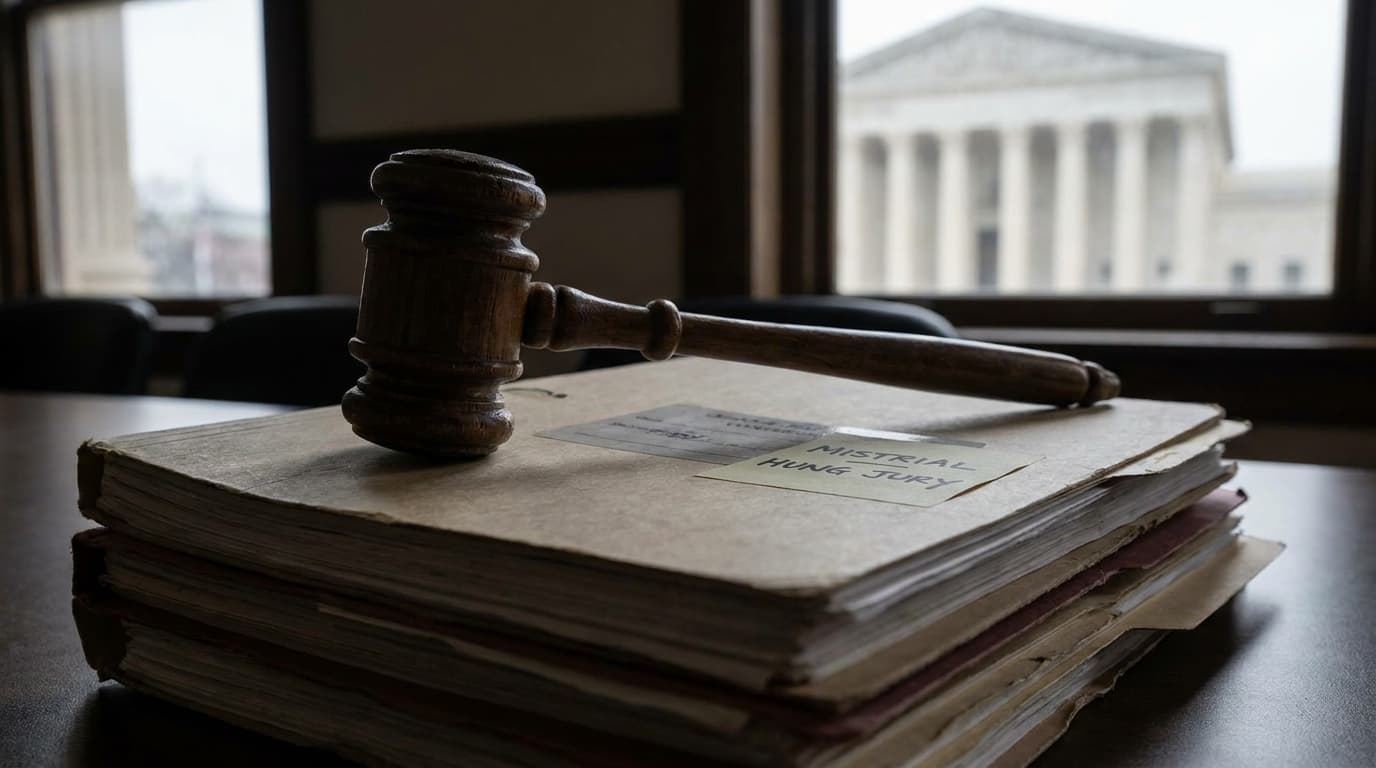
When a jury cannot reach a unanimous verdict, the judge declares a mistrial. For anyone typing hung jury what happens next, the answer is that the trial ended and the case did not. There is no acquittal and no conviction. Your case returns to a pretrial posture, and the prosecutor decides whether to try you again.
That is the abstract version. The concrete version played out in Plymouth County, Massachusetts, on Friday, September 4, 2026, when Superior Court Judge William Sullivan discharged a jury of nine women and three men that had deliberated roughly seven days, about 40 hours, and could not agree. Their note to the court read: "It is with a heavy heart that we report we are unable to come to a unanimous decision, and we will not be able to." WBUR reported the mistrial in Commonwealth v. Lindsay Clancy, a case where the deadlock was not about who did what. Clancy admitted the acts. The jury could not agree on whether she was criminally responsible for them.
The headline case is unusual. The procedure is not. Most hung juries happen in ordinary files: a multi-count assault case, a fraud count, a domestic violence charge where one witness carried the state's proof. What follows is the same sequence whether the courtroom has cameras in it or not.
A deadlock does not start with a mistrial
Juries send notes. A note saying the panel is split is not the end of anything, and judges almost never discharge a jury on the first one. The usual response is to send them back with an instruction to keep working, sometimes after rereading a portion of the legal instructions or replaying testimony the jury asked for.
Your lawyer should be tracking every note, because the note history is a record of where the disagreement sits. A jury that asks three times about one element of one count is telling you something about the state's proof on that element.
The deadlock instruction, and what Massachusetts calls it
When the notes keep coming, the judge reaches for the instruction most lawyers call the Allen charge. It comes from Allen v. United States, 164 U.S. 492 (1896), which approved telling jurors in the minority to ask themselves whether their doubt is reasonable when so many equally honest jurors see it differently. That language pressures holdouts, and states have spent a century adjusting it.
Massachusetts uses the Tuey-Rodriguez instruction, drawn from Commonwealth v. Tuey (1851) and Commonwealth v. Rodriguez, 364 Mass. 87 (1973). Judge Sullivan gave it on Wednesday, September 2, two days before he declared the mistrial. As Boston 25 News described it, the charge tells jurors to keep deliberating with candor and respect for one another's views and to reconsider their own positions, while making clear that no juror should surrender an honestly held conviction just to produce unanimity. The Rodriguez version deliberately removed the sharper edge of Allen. The judge also does not tell jurors this is their last chance.
Practical read for a defendant: the deadlock instruction is normally the last step before discharge. When you hear it, the trial is close to over one way or the other.
Partial verdicts, the piece defendants overlook
A general verdict has to be unanimous. But a jury stuck on one count is not necessarily stuck on all of them. [Massachusetts Rule of Criminal Procedure 27](https://www.mass.gov/rules-of-criminal-procedure/criminal-procedure-rule-27-verdict) requires unanimity and also allows the court to take verdicts on the counts the jury has agreed upon, declaring a mistrial only as to the counts it cannot resolve. Most states have an equivalent.
This matters enormously in a stacked indictment. If you are charged with assault and battery and a more serious aggravated count, a jury that acquits on the aggravated count and hangs on the lesser one has permanently removed your worst exposure. An acquittal on any count is final. The state cannot retry that count, ever. Ask your lawyer whether a partial verdict was requested and whether the jury was polled. In the Clancy case, no partial verdicts came back on the three counts.
Does double jeopardy stop a second trial? No.
This is the single most common misunderstanding after a mistrial. The Fifth Amendment bars trying you twice for the same offense, and a defendant who has just sat through a full trial reasonably assumes that is what happened. The Supreme Court decided otherwise. In Richardson v. United States, 468 U.S. 317 (1984), the Court held that "the failure of the jury to reach a verdict is not an event which terminates jeopardy," and that "retrial following a 'hung jury' does not violate the Double Jeopardy Clause." Richardson went further: the rule holds even where the defendant argues the evidence at the first trial was legally insufficient.
The idea behind it is called manifest necessity. Jeopardy attaches when the jury is sworn, and ordinarily the state gets one shot. But when something makes it genuinely impossible for that jury to finish, a deadlock being the classic example, the law treats the proceeding as never having reached a resolution. The clock resets rather than stops.
The narrow exceptions are worth knowing. If the prosecution provoked the mistrial to escape a trial that was going badly, a retrial can be barred. And an actual acquittal, on any count, is untouchable. Short of those, plan on the case continuing.
Who decides whether you are retried
The prosecutor. Not the judge, not the jury, not the victim's family, and not public opinion. In Plymouth County, District Attorney Timothy Cruz said a decision would come "soon, but not today," and that he would not be swayed by public sentiment.
ABC News laid out the four options a prosecutor has after a deadlock. In the order defendants most often see them:
-
Retry as charged. Same counts, new jury, usually months later.
-
Retry on reduced charges. The office keeps the case but drops its exposure to a second hung jury.
-
Offer a plea. Defense attorney Peter Elikann described the common pitch as breaking the charges down "to something much lesser."
-
Dismiss. Least common, most likely where the deadlock followed thin proof and the office does not want to spend another three weeks on it.
Understand why the deadlock is leverage. The state has now shown you its entire case, every witness, every exhibit, every theory. You have seen the cross-examinations that worked. And the prosecutor knows that at least one juror, sitting through all of it, was not convinced. A second trial costs the office money and carries the same risk again. That combination is what turns a lot of hung juries into reduced-charge offers.
What a status hearing is
After a mistrial the court puts a date on the calendar. In the Clancy case, that date is Tuesday, September 29, 2026, at 9 a.m. in Plymouth Superior Court. Judge Sullivan has indicated he would want any retrial to happen in the fall.
A status hearing is short and administrative. The lawyers and the judge are in the room, and the state says what it intends to do. If the answer is a retrial, the court starts setting jury-selection dates and deadlines. If the answer is a negotiated resolution, that gets put on the record or continued while terms are worked out. Nothing about guilt is decided at a status hearing, no evidence is taken, and no jury is present. Your presence is usually required, but your job there is to sit and listen.
What does not change while you wait
A mistrial does not alter your custody status by itself. Whatever bail or release conditions were in place carry over until someone asks the judge to revisit them, and either side can ask. Clancy remains held at Tewksbury State Hospital, where she has been since 2023, unchanged by the mistrial.
The charge also remains pending. A hung jury creates no record of conviction, and you are entitled to say you have not been convicted. But the case is open, which means it still shows on a pending-charges check, and any conditions attached to it, no contact orders, travel restrictions, monitoring, stay in force.
What to do before the status date
The window between a mistrial and the status hearing is the most useful few weeks your case will have. Concrete steps to raise with your lawyer:
-
Get the note history and any jury polling. It is the closest thing you will have to a map of where the state's proof failed.
-
Order the trial transcript. Every witness is now locked into sworn testimony. At a second trial, any change becomes impeachment material.
-
Ask whether a partial verdict was taken. Any count resolved in your favor is closed permanently and should be off the table in every conversation that follows.
-
Treat this as your best negotiating moment. The prosecutor's decision is not yet public or committed. After the office announces a retrial internally, positions harden.
-
Ask about revisiting release conditions. A deadlock is a reasonable basis to argue conditions should be loosened while the case sits.
How often juries actually hang
Rarely, but not exotically. The most rigorous multi-jurisdiction data comes from a National Institute of Justice and National Center for State Courts study by Hannaford-Agor, Hans, Mott and Munsterman, published in September 2002. It found an average hung jury rate of 6.2% in state courts, with wide variation by jurisdiction, against 2.5% in federal criminal trials from 1980 to 1997.
The same study identified what hung cases tend to share: weak evidence, difficult deliberation dynamics, and jurors who perceived something unfair about the proceeding. That is genuine information about the state's case. It is not a prediction about the second one. A different twelve people hear a tightened presentation from a prosecutor who now knows exactly which parts did not land.
Why this particular jury deadlocked
The Clancy deadlock turned on a question most cases never reach: criminal responsibility. Under Commonwealth v. McHoul, 352 Mass. 544 (1967), a defendant is not criminally responsible if, because of mental disease or defect, they lacked substantial capacity either to appreciate the wrongfulness of the conduct or to conform it to the requirements of the law. The defense here was postpartum psychosis.
Massachusetts places an unusual burden on the state. As WBUR explained, once the defense is properly in the case, the Commonwealth must prove criminal responsibility beyond a reasonable doubt, unlike most states, which put the burden on the defendant. The defense is raised in roughly 1% of felony cases nationally and succeeds about a quarter of the time when it is raised. It is also not a release valve: a verdict of not guilty by reason of insanity results in commitment to a state hospital with periodic review.
Before the mistrial, the defense asked the Supreme Judicial Court to remove or further question a juror the foreperson had described as unwilling to follow the instructions on reasonable doubt. The SJC held a hearing and denied the request. The mistrial followed. Defense attorney Kevin Reddington said afterward that the prosecution "doesn't have a case" and raised the prospect of appellate litigation.
The short version
A hung jury is a stop, not an ending. Your trial is over, your case is not, double jeopardy will not save you, and the person deciding your next twelve months is the prosecutor. Spend the gap before your status hearing getting the transcript, reading the notes, and making the strongest possible offer, because the state's uncertainty is at its peak on the day the jury walks out.
Related reading
Sources
-
Judge declares mistrial in Clancy case after jurors, with 'heavy heart,' fail to reach verdict, WBUR
-
Lindsay Clancy trial declared a mistrial. What happens next?, ABC News
-
Lindsay Clancy's murder trial ended in a mistrial. Here's where her case goes next., Yahoo News
-
What is the Tuey-Rodriguez instruction that Lindsay Clancy's judge gave the jury?, Boston 25 News
-
Richardson v. United States, 468 U.S. 317 (1984), Cornell Legal Information Institute
-
Allen v. United States, 164 U.S. 492 (1896), Cornell Legal Information Institute
-
Are Hung Juries a Problem? Executive Summary, National Institute of Justice, 2002
-
As Clancy jurors remain deadlocked, what to know about the 'insanity defense', WBUR
-
Massachusetts Rules of Criminal Procedure, Rule 27: Verdict, Mass.gov
Note: This article contains AI-assisted content and has been reviewed by our editorial team.
IMPORTANT NOTICE: GavelDaily.com is an advertising and information service, not a law firm. Submitting this form does not create an attorney-client relationship. The information you provide will be shared with licensed criminal defense attorneys in your area who may contact you about your inquiry. All submissions are treated as confidential by our service, but attorney-client privilege does not attach until you formally retain an attorney. Any attorney you connect with through this service is independently responsible for their legal advice and representation. Free consultations are subject to individual attorney availability. If you are facing an immediate legal emergency, contact your local public defender's office or call 911.