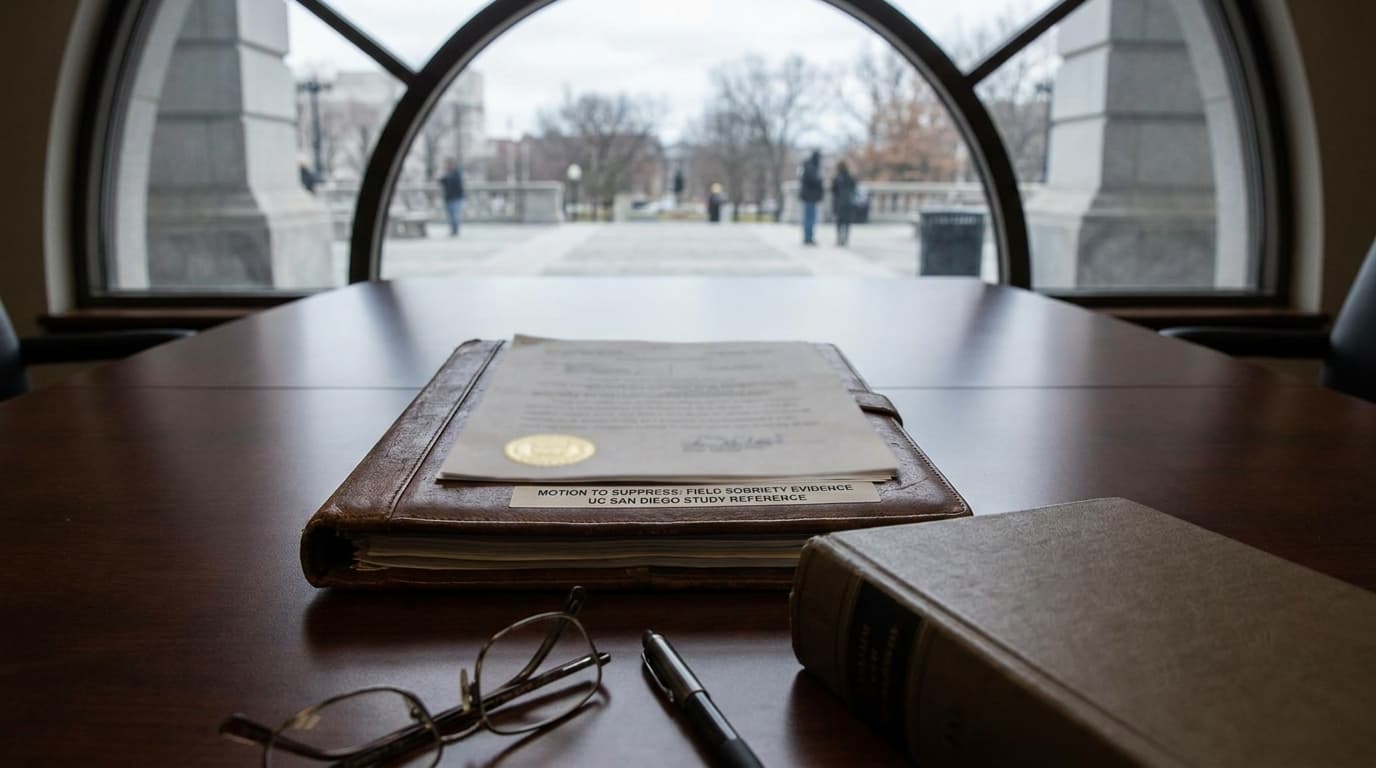
Nearly half of drivers who had smoked nothing more potent than a placebo were still rated impaired on the roadside tests that police use to build marijuana DUI cases. That is not a defense-attorney talking point. It is the finding of a federally cited, double-blind clinical trial, and it is now surfacing in courtrooms as a reason to keep field sobriety evidence away from juries.
The number comes from a randomized, placebo-controlled study by researchers at the University of California, San Diego, published in JAMA Psychiatry on August 2, 2023. Trained officers evaluated 184 participants using the standard field sobriety battery. They classified 81.0% of the group that had actually consumed THC as impaired. They also classified 49.2% of the placebo group, people who had received no active cannabis, as impaired. Roughly one in two sober-at-test participants failed.
For anyone facing a cannabis DUI charge, that gap between what the test claims to measure and what it actually detects is becoming central to the defense. Here is what the science says, how the law is catching up, and where the field evidence is starting to fall apart.
What the roadside test battery actually is
When an officer suspects impaired driving, the typical roadside evaluation is the Standardized Field Sobriety Test, or SFST. It has three components: the horizontal gaze nystagmus test, which looks for a jerking motion in the eyes as they track a moving object; the walk-and-turn; and the one-leg stand. A driver's performance across those tasks becomes part of the officer's basis for an arrest and later for testimony.
The critical historical fact is that this battery was developed and validated for alcohol. Research puts the SFST at roughly 88% accuracy for identifying alcohol impairment. The horizontal gaze nystagmus test in particular is characteristic of alcohol and other central nervous system depressants. Cannabis generally does not produce that eye movement, which removes one of the three pillars before the evaluation even begins.
The tests were never built to detect THC. The current wave of research is measuring what happens when officers apply an alcohol tool to a cannabis question.
The science gap, in detail
The UC San Diego trial was a double-blind, placebo-controlled randomized study, the same design used to test pharmaceuticals. Neither the participants nor the evaluating officers knew who had received active THC. That structure is what makes the 49.2% placebo figure so difficult to explain away: those participants were sober at the time of testing, and nearly half were still judged impaired.
The same cohort produced a companion analysis in Clinical Chemistry in July 2023. It found no correlation between THC concentration in blood, oral fluid, or breath and driving performance. The authors concluded that THC concentration cannot be used as a sole indicator of impairment.
The National Institute of Justice, the research arm of the U.S. Department of Justice, reached a parallel conclusion. In its summary of the work, the NIJ reported that the one-leg stand, walk-and-turn, and modified Romberg balance tests were not sensitive to cannabis intoxication for any of the study participants. It also noted that participants showed decreased cognitive and psychomotor functioning even when their measured THC levels were low, which cuts both directions: the tests miss real impairment and flag its absence.
Other work points the same way. An observational study indexed in PubMed in 2023 found the standard SFST had limited sensitivity to cannabis, with only about two-thirds of cannabis-dosed participants meeting the suspicion criterion, and detection improved only when officers added observations like finger-to-nose and head movement that are not part of the standardized battery.
Why a blood THC number is not a BAC number
With alcohol, a blood alcohol concentration maps reasonably well onto impairment, which is why numeric limits like 0.08 hold up. Cannabis has no equivalent. THC moves through the body differently. It can remain detectable in blood and oral fluid for hours or even days after any psychoactive effect has ended, especially in frequent users. In those same frequent users, tolerance can mask the very deficits the field tests are supposed to catch.
That pharmacology is the heart of a growing defense argument: a positive THC result proves prior use, not present impairment. The Clinical Chemistry data reinforce the point. Requiring a 2 ng/mL blood-THC cutoff in addition to positive field sobriety tests dropped the placebo false-positive rate from 49.2% to 13.8% at 90 minutes. In other words, the field tests alone are the weak link, and toxicology alone is insufficient too. Neither piece of evidence carries the weight of a BAC reading on its own.
The legal patchwork
States handle marijuana-impaired driving in fundamentally different ways, and where a case is filed shapes the defense. According to the National Conference of State Legislatures, five states use per se THC blood limits, meaning a driver is legally impaired at or above a set concentration regardless of actual driving: Ohio, Illinois, Montana, Washington, and Nevada, with thresholds in the range of roughly 2 to 5 ng/mL. Colorado uses a 5 ng/mL permissible inference, which lets a jury infer impairment from that level without treating it as automatic.
Most states, including California, Texas, Florida, and New York, use an effect-based standard. There is no numeric THC limit. Prosecutors must prove the driver was actually under the influence. That is where field sobriety evidence carries the most weight, and where the new science bites hardest.
The per se states face a different collision. If blood THC does not correlate with impairment, as the research indicates, then a per se threshold can convict a driver who was not impaired at all, only recently exposed. That tension between the statute and the pharmacology is exactly what defense attorneys are pressing.
The suppression strategy
Defense attorneys in states with legal cannabis are using this research to attack field sobriety evidence directly. The moves fall into a few categories. First, motions to suppress or exclude the field test results on grounds of scientific unreliability, citing the placebo false-positive rate and the NIJ findings that the balance tests are not sensitive to cannabis. Second, expert testimony from pharmacologists explaining THC pharmacokinetics and why a blood level does not establish impairment. Third, admissibility fights over whether an officer's field-test-based opinion should reach a jury at all.
The strategy does not claim the driver was sober. It argues that the specific evidence the state is offering does not reliably prove impairment, which is a different and often stronger position.
Refusal rights, framed carefully
There is an important distinction between field sobriety tests and chemical tests, and it varies by state. Field sobriety tests are generally voluntary. In most jurisdictions, refusing them is not admissible as evidence of guilt and carries no license penalty. Chemical tests of blood or breath are different. They fall under implied-consent statutes, and refusing them typically does trigger license consequences.
This distinction is state-specific and is not legal advice. Some defense practitioners, including Arizona attorney Jeremy Huss, frame declining field sobriety tests as a strategic choice, but that framing comes from an advocacy source and the rules on voluntariness and admissibility differ across jurisdictions. Anyone weighing whether to perform or decline a roadside test should confirm the law in their own state, ideally with a local attorney, before a stop rather than during one.
What prosecutors have left, and where this is heading
When the field sobriety evidence is weak and the blood THC number proves only prior use, prosecutors are left leaning on officer observations, driving behavior, and drug recognition experts, each of which is itself open to challenge. That is prompting interest in alternatives: performance-based screening apps such as DRUID-style tools that measure reaction and coordination, roadside oral-fluid devices, and expanded drug-recognition programs. None has yet delivered a cannabis equivalent of the BAC number, and the underlying pharmacology problem, that THC concentration does not track impairment, does not disappear just because the measuring device changes.
Practical takeaway
-
What a field sobriety test can show: that a driver had difficulty with balance and coordination tasks at the roadside. What it cannot reliably show, based on the current research, is that cannabis caused it. Nearly half of sober placebo participants failed.
-
Confounding factors matter: the balance and coordination tests are affected by age, weight, footwear, road surface, weather, injury, fatigue, and the stress of a roadside stop, all unrelated to any drug.
-
Know your state's model: per se THC limit (Ohio, Illinois, Montana, Washington, Nevada), permissible inference (Colorado), or effect-based (most states, including California, Texas, Florida, New York). The model shapes both the charge and the defense.
-
Blood THC is not a BAC: it can indicate prior use rather than present impairment, especially for frequent users.
-
Consult counsel early: the science supporting suppression motions is recent and technical, and using it well requires a lawyer familiar with the research and your jurisdiction.
Related reading
-
[The Broken Taillight Stop Is Dying: Los Angeles Moves to Ban Pretextual Traffic Stops, and It Changes How Drug and Gun Cases Begin](/news/los-angeles-pretextual-traffic-stops-ban-drug-gun-cases)
-
[Two DUIs and You Lose Your Guns: Washington's Top Court Upholds Recidivist Disarmament Law 5-4 in McLellan v. Brown](/news/mclellan-v-brown-washington-dui-firearm-ban-upheld)
-
Convicted of Domestic Assault in Virginia? You Now Have 24 Hours to Hand Over Every Gun You Own
Sources
Note: This article contains AI-assisted content and has been reviewed by our editorial team.
IMPORTANT NOTICE: GavelDaily.com is an advertising and information service, not a law firm. Submitting this form does not create an attorney-client relationship. The information you provide will be shared with licensed criminal defense attorneys in your area who may contact you about your inquiry. All submissions are treated as confidential by our service, but attorney-client privilege does not attach until you formally retain an attorney. Any attorney you connect with through this service is independently responsible for their legal advice and representation. Free consultations are subject to individual attorney availability. If you are facing an immediate legal emergency, contact your local public defender's office or call 911.