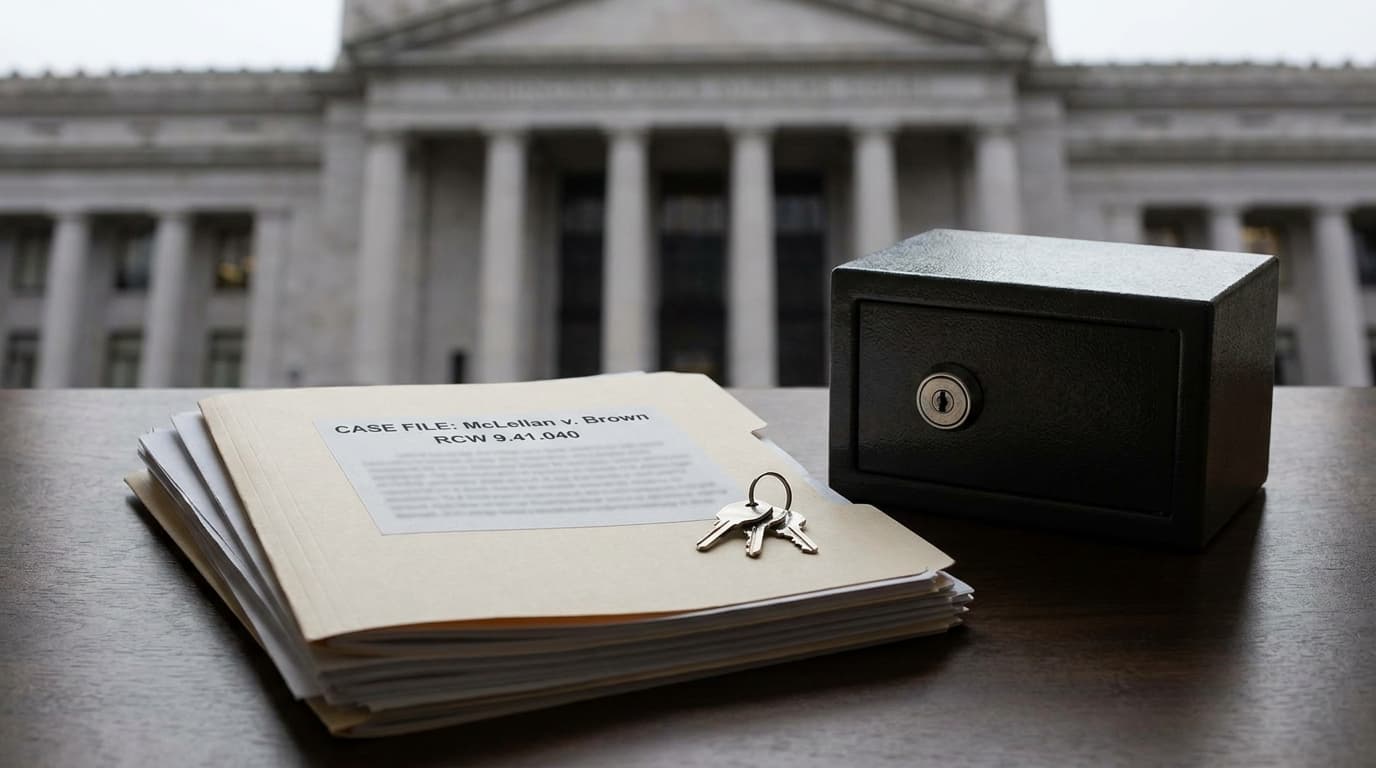
On June 11, 2026, the Washington Supreme Court ruled that the state can strip firearm rights from people who rack up multiple DUI convictions, and it can do so without ever asking whether a specific person is actually dangerous. The 5-4 decision in McLellan v. Brown, No. 103799-6, upheld RCW 9.41.040, a 2023 amendment that bars firearm possession for anyone with two or more qualifying DUI-related convictions inside a seven-year window.
The takeaway for anyone facing repeat impaired-driving charges in Washington is direct: a second qualifying conviction can now cost you the legal right to own a gun, and getting that right back is a separate court fight that cannot even begin for five years.
The two men who challenged the law
The case was brought by two petitioners denied concealed pistol licenses under the statute. Geoffrey McLellan had three DUI convictions within seven years. Jackson Holloway had two. Neither was accused of any violent act or any crime involving a firearm. Both argued that a blanket, automatic ban tied to their driving records violated their Second Amendment rights.
They lost. Writing for the majority, Justice Steven González held that the categorical prohibition is constitutional as applied to people in their position.
How the seven-year lookback works
The statute operates on a lookback window. It counts qualifying DUI-type convictions that fall within a seven-year period. Reach two of them inside that window and the firearm-possession bar attaches. The prohibition follows the convictions themselves. It is triggered by the criminal record, not by any prosecutor's prediction about what a person might do next.
Because the two-conviction threshold is what activates the ban, the law sweeps in both people applying for concealed pistol licenses, as McLellan and Holloway were, and existing firearm owners who cross the threshold. Washington DUI-defense practitioners have flagged that the practical reach depends on exactly which offenses count as qualifying convictions, a point worth confirming against the statute and the opinion in any individual case. A defense firm overview of the counting mechanics is available from Blanford Law.
The majority's reasoning: convictions, not accusations
The core of González's opinion is a distinction between accusation and conviction. The court held that the state may categorically disarm recidivist DUI offenders without an individualized finding of dangerousness precisely because the bar attaches to criminal convictions rather than to mere charges. In the majority's view, a person who has been convicted twice has already been proven, through the criminal process, to have engaged in a pattern of dangerous, intoxicant-related recklessness.
The court analyzed the question under the framework the U.S. Supreme Court set in N.Y. State Rifle & Pistol Ass'n v. Bruen (2022), which asks whether a firearm regulation fits the nation's historical tradition of gun regulation. The majority found that it does. It pointed to a tradition of limiting firearm rights both for people convicted of serious crimes and for people with a history of dangerous intoxicant use, and it placed repeat drunk drivers within that class.
The state supported that conclusion with a behavioral argument: people who repeatedly engage in reckless, dangerous conduct with vehicles are more likely to do the same with firearms.
The dissent: preemptive disarmament
Four justices disagreed. The dissent, led by Justice G. Helen Whitener, described the law as preemptive disarmament untethered from any violent or firearm-related conduct. Its central objection was that the statute authorizes taking away a constitutional right based on predicted risk before a person has committed any violent or weapon-related act.
Whitener anchored that critique in United States v. Rahimi (2024), the U.S. Supreme Court decision addressing firearm restrictions after Bruen. In the dissent's reading, Rahimi requires a nexus between the individual's own conduct and a firearm-related danger. Repeat DUI convictions, the dissent argued, do not supply that link, because impaired driving is not itself firearm-related conduct.
Getting gun rights back is possible, but not automatic
The ruling does leave a path back. A disarmed person may petition a court to restore firearm rights after five consecutive years of law-abiding conduct with no new qualifying offense. That restoration is a separate legal proceeding, and it is not automatic. The five-year clock and the clean-conduct requirement are prerequisites just to file, and a court still decides whether to grant the petition. Reporting on the decision, including the restoration mechanics, appears in The Spokesman-Review.
What comes next
Because the decision turns on the still-developing post-Bruen and post-Rahimi framework, it is unlikely to be the last word. Firearms-law analysts expect continued challenges testing how far states can go in disarming people based on categories of prior conviction rather than case-by-case dangerousness, and the split between the majority's conviction-based reading and the dissent's conduct-nexus reading is exactly the kind of division that can draw federal attention. A specialist analysis situating the case within that doctrine is available from The Reload, and local coverage of the ruling's practical effect on license applicants is available from Axios Seattle.
For now, the holding stands: in Washington, two qualifying DUI convictions within seven years can cost a person the right to possess a firearm, with restoration available only after a five-year wait and a separate court petition. The court decided that question 5-4, and it decided it on the record of convictions before it, not on any judgment about the men who brought the case.
Related reading
-
Convicted of Domestic Assault in Virginia? You Now Have 24 Hours to Hand Over Every Gun You Own
-
[The Fraud Sentencing Overhaul Almost No White Collar Defendant Knows About: On November 1 the Federal Loss Table Collapses From 16 Tiers to 8](/news/fraud-sentencing-overhaul-loss-table-16-to-8-tiers-november-2026)
Sources
-
McLellan v. Brown, No. 103799-6, slip opinion (Washington Courts)
-
McLellan v. Brown, 2026 Washington Supreme Court Decisions (Justia)
-
Washington court says repeat DUI convictions can cost gun rights (Axios Seattle)
-
Washington high court: State will strip gun rights after two DUIs (The Center Square)
-
[Analysis: Where DUIs and the Second Amendment Stand (The Reload)](https://thereload.com/analysis-duis-and-the-second-amendment-member-exclusive/)
Note: This article contains AI-assisted content and has been reviewed by our editorial team.
IMPORTANT NOTICE: GavelDaily.com is an advertising and information service, not a law firm. Submitting this form does not create an attorney-client relationship. The information you provide will be shared with licensed criminal defense attorneys in your area who may contact you about your inquiry. All submissions are treated as confidential by our service, but attorney-client privilege does not attach until you formally retain an attorney. Any attorney you connect with through this service is independently responsible for their legal advice and representation. Free consultations are subject to individual attorney availability. If you are facing an immediate legal emergency, contact your local public defender's office or call 911.