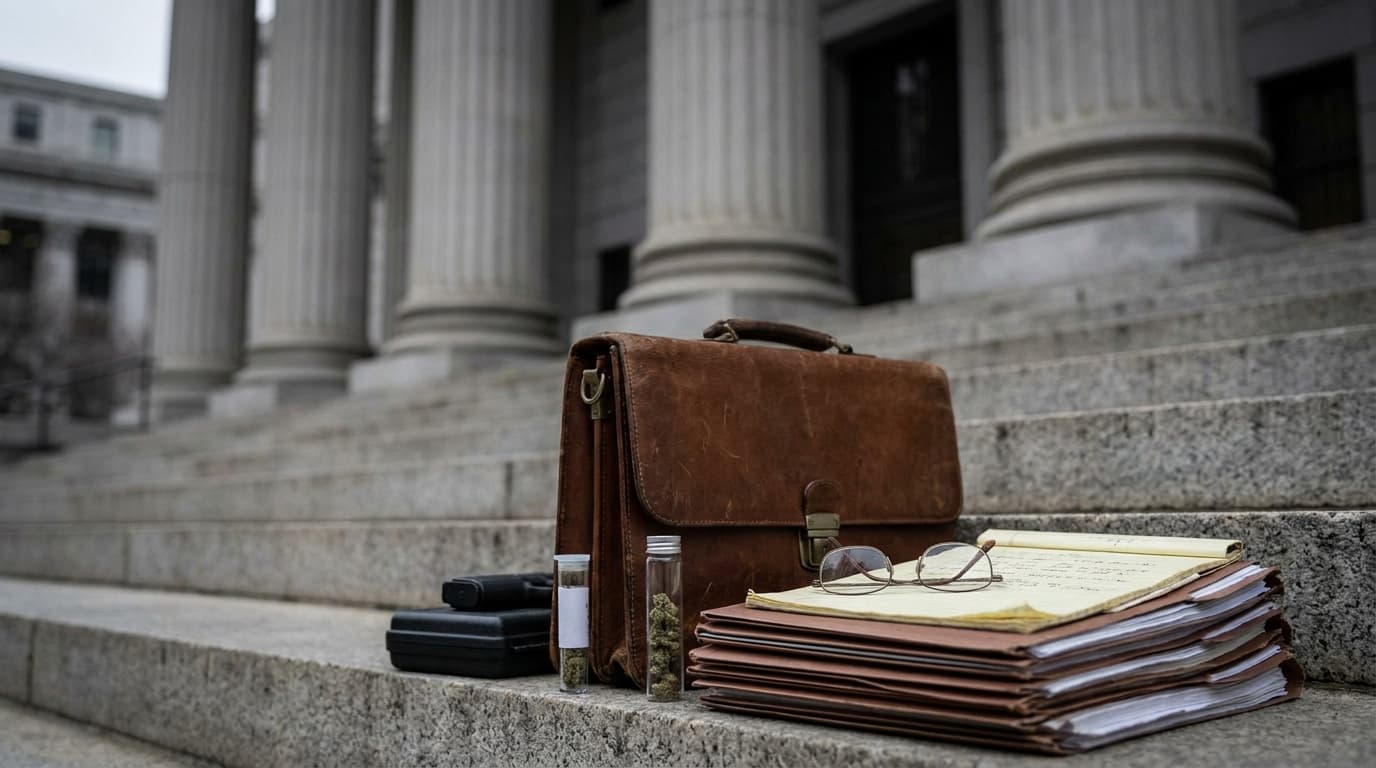
On June 18, 2026, the Supreme Court sided with a Texas man who was prosecuted for keeping a securely stored handgun in his home while using marijuana about every other day. In [United States v. Hemani](https://www.supremecourt.gov/opinions/25pdf/24-1234_g2bh.pdf), No. 24-1234, all nine justices agreed that his conviction under the federal drug-user gun ban could not stand. That is a real and important result for gun owners who use cannabis in states where it is legal.
But read the headlines carefully. This is not a ruling that erased 18 U.S.C. 922(g)(3) from the books. The Court decided a narrow, fact-specific question, and it deliberately left several doors open for the government to keep charging people. If you own a firearm and use marijuana, the difference between what the Court decided and what it declined to decide is the difference between staying out of a federal courtroom and ending up in one.
What the Court actually held
The statute at issue, 18 U.S.C. 922(g)(3), makes it a federal crime for anyone who is an "unlawful user of or addicted to any controlled substance" to possess a firearm. Because marijuana remains a Schedule I drug under federal law regardless of state legalization, cannabis users fall inside the statute even when their conduct is fully legal where they live.
Justice Gorsuch wrote the lead opinion. Applying the Second Amendment framework the Court set in New York State Rifle & Pistol Association v. Bruen (2022) and refined in United States v. Rahimi (2024), he concluded the government had not shown a historical tradition that would justify disarming an occasional drug user who was not shown to be dangerous and was not intoxicated while armed. As Gorsuch stressed, the decision was, in his words, "a narrow one."
The nuance the headlines skip: as-applied, not facial
Two distinctions matter here, and both get lost in quick coverage.
As-applied versus facial. When a court strikes a law down "on its face," the law is unenforceable against everyone. When a court finds a law unconstitutional "as applied," it means the law cannot be used against this particular defendant on these particular facts, while the statute itself survives. Hemani is an as-applied decision. Section 922(g)(3) is still valid law. The Court simply held it could not reach Hemani's conduct.
Unanimous in result, splintered in reasoning. All nine justices agreed the conviction could not stand, which is why you will see the case described as unanimous or 9-0. But that unanimity is about the judgment, not a single shared rationale. The Court fractured into separate concurrences: Justice Thomas wrote alone, Justice Jackson wrote joined by Justice Sotomayor, and Justice Alito wrote joined by Justice Kagan. A fractured Court speaking through multiple opinions produces a narrower, less predictable rule than a clean majority. For defendants and their lawyers, that means the reach of Hemani will be tested case by case.
The facts behind the case
The facts explain why the Court saw Hemani as a weak case for the government. In 2022, the FBI searched Ali Danial Hemani's family home in the Dallas area on suspicion related to terrorism. He was never charged in connection with that. According to the ACLU, which represented him, Hemani cooperated with agents, surrendered a handgun kept in the home, showed agents marijuana, and admitted using it roughly every other day.
More than six months later, the government charged him under 922(g)(3), and only under that statute, based on his own admission of drug use. There was no allegation that he was intoxicated when he had the gun, and no allegation that his firearm was anything but securely stored. The prosecution rested on the fact of use, not on any showing that he was dangerous.
The legal test and why the government lost
Under Bruen and Rahimi, the government does not need to point to an identical historical law, a "historical twin," to justify a modern gun regulation. It must show the modern rule is consistent with the principles behind the nation's historical firearm regulations.
The government's main analogy was to founding-era laws that disarmed "habitual drunkards." Gorsuch rejected the comparison. As the reasoning went, those historical laws targeted different people for different reasons. They aimed at frequent incapacitation rather than mere use, and they typically gave a person some process before stripping a right. An occasional user with a stored gun, sober at the relevant times, did not fit that tradition.
What still gets you charged
This is the part cannabis-using gun owners most need to understand. The Court expressly declined to address, and therefore left available to prosecutors, at least three categories:
-
Armed while intoxicated. If the government can prove a person was actually intoxicated or incapacitated while in possession of a firearm, Hemani does not protect them.
-
Genuine addiction. The statute reaches people "addicted to" a controlled substance, and the Court did not resolve whether disarming a genuine addict is constitutional. That question remains open.
-
Individualized dangerousness. If the government makes a specific showing that a particular person's drug use makes them dangerous, the ruling does not foreclose the charge.
In short, the Court protected the occasional, non-dangerous, sober-while-armed user on these facts. It did not announce that marijuana use and gun ownership can never coexist with a federal charge.
Practical fallout for the roughly 300 cases a year
The direct federal footprint is modest. The Department of Justice estimates about 300 people are charged under 922(g)(3) each year. Hemani reshapes how those cases must be charged more than it shrinks the statute.
Pending and future cases now split into two rough buckets. Prosecutions built on mere use, with no evidence of intoxication while armed and no dangerousness showing, look vulnerable after Hemani. Prosecutions that include proof the defendant was intoxicated while holding a gun, or that build an individualized dangerousness record, are far more likely to survive.
This is also the same legal question that surfaced in the Hunter Biden gun case. Several federal appeals courts, including the Fifth Circuit in its Daniels decision, had already found 922(g)(3) unconstitutional as applied to marijuana users, creating the split the Supreme Court resolved here.
Defense-counsel playbook
For defense lawyers, Hemani is now a front-line tool. Expect motions to dismiss in pending mere-user cases, and post-conviction relief efforts on behalf of people convicted solely on evidence of occasional use with a stored firearm and no dangerousness proof. The strongest arguments track Hemani's facts closely: occasional use, no intoxication while armed, secure storage, and a charge resting on an admission rather than conduct.
Prosecutors will adapt. Anticipate charging decisions that foreground intoxication facts, addiction, or a documented dangerousness theory, precisely because those are the paths the Court left open. The factual record, not the label of the statute, will increasingly decide these cases.
The Form 4473 problem nobody should ignore
Here is a caution that Hemani does not fix. When you buy a firearm from a licensed dealer, you complete ATF Form 4473, which asks in Question 21.e whether you are an unlawful user of marijuana or other controlled substances. As a plain-language explainer from Nolo notes, that question has not been repealed.
Answering that question falsely is a separate federal crime under 18 U.S.C. 922(a)(6) and 924(a), independent of 922(g)(3). Hemani did not touch it. So even a person the ruling protects from a possession charge can still face exposure for a false statement on the form. The safest reading is that Hemani narrowed one charge, not the entire web of federal firearm rules that a cannabis user can run into.
Open questions and what comes next
The ruling leaves plenty unresolved. It does not clearly say how it applies to users of harder drugs, to daily or heavy users, or to public carry rather than in-home possession. Because the reasoning splintered across several concurrences, lower courts will spend the next several years mapping its boundaries. Watch for follow-on litigation testing each of those edges, and for any guidance from DOJ or ATF on how they will charge these cases going forward.
The reader-facing bottom line
If you are a cannabis-using gun owner in a state where marijuana is legal, here is a fair summary. Hemani gives you meaningful protection against a federal prosecution built purely on the fact that you use marijuana while keeping a stored firearm and staying sober when armed. It does not give you a green light. Being intoxicated while in possession of a gun, being a genuine addict, or giving the government a reason to call you individually dangerous can still expose you. And lying on Form 4473 remains its own federal crime.
The accurate takeaway is not that the marijuana-user gun ban is gone. It is that the Supreme Court drew a narrow line for one man on one set of facts, and told the government it needs more than the fact of use to disarm someone. If you are facing a 922(g)(3) charge or worried about one, the details of your case will decide everything, and this is a moment to talk to a criminal defense attorney rather than to guess.
Related reading
Sources
-
[United States v. Hemani, No. 24-1234, slip opinion (U.S. Supreme Court, June 18, 2026)](https://www.supremecourt.gov/opinions/25pdf/24-1234_g2bh.pdf)
-
Court sides with challenger to law banning drug users from possessing guns (SCOTUSblog)
-
Supreme Court sides with a marijuana user who was barred from owning guns (NPR)
-
Supreme Court sides with Texas man who challenged law barring drug users from having guns (CBS News)
-
Supreme Court rules government can't restrict gun rights for casual drug use (NBC News)
-
Supreme Court Rejects Prosecution of Gun Owner Who Uses Marijuana (ACLU)
-
U.S. v. Hemani: Casual Marijuana Users Don't Lose Gun Rights (Nolo)
Note: This article contains AI-assisted content and has been reviewed by our editorial team.
IMPORTANT NOTICE: GavelDaily.com is an advertising and information service, not a law firm. Submitting this form does not create an attorney-client relationship. The information you provide will be shared with licensed criminal defense attorneys in your area who may contact you about your inquiry. All submissions are treated as confidential by our service, but attorney-client privilege does not attach until you formally retain an attorney. Any attorney you connect with through this service is independently responsible for their legal advice and representation. Free consultations are subject to individual attorney availability. If you are facing an immediate legal emergency, contact your local public defender's office or call 911.