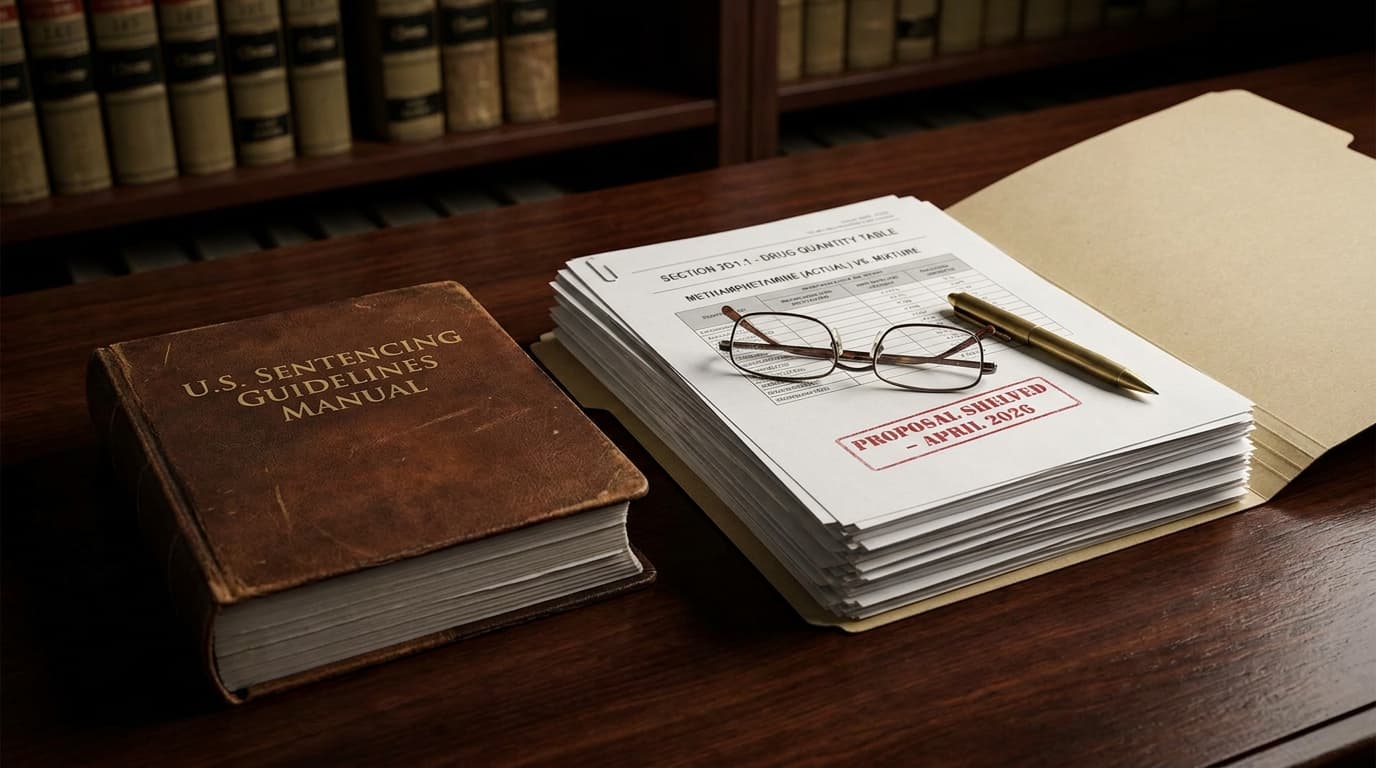
If you have read that the federal government is about to erase the methamphetamine "purity loophole" on November 1, 2026, here is the correction you need before anything else: it is not happening. The U.S. Sentencing Commission proposed a reform to the meth "actual vs. mixture" distinction in December 2025, took public comment through early 2026, and then declined to adopt it at its April 2026 meeting. Both versions of the proposal were abandoned without a stated reason. The purity split that can roughly double a defendant's exposure remains in force today, and nothing about it changes this November.
The underlying story is still worth understanding, because it explains why two people who possessed the same amount of meth can receive very different sentences, and because the reform effort is likely to return. This article walks through the mechanism, the history, why the original rationale broke down, who gets hurt, exactly what the Commission floated, what it actually did, and the limit that Congress, not the Commission, controls.
What actually happened in 2026
The Commission published its proposed 2026 amendments in the Federal Register on December 19, 2025. Part A of the drug amendment addressed the methamphetamine purity distinction and offered two options. Public comment closed on February 10, 2026. The Commission then met and voted in April 2026 and submitted the amendments it adopted to Congress by early May.
The meth purity change was not among the adopted amendments. Reporting on the April 20, 2026 outcome from LISA Legalinfo described the result plainly: no changes to meth were adopted, and both options were dropped without explanation. You can confirm the absence by checking the Commission's own list of amendments that take effect November 1, 2026. The purity distinction is not on it. So the "actual vs. mixture" split does not collapse on that date. It stays exactly as it is.
How the sentence-doubling mechanism works
Federal drug sentences start with the Drug Quantity Table at guideline §2D1.1(c). For methamphetamine, that table contains three separate entries:
-
Methamphetamine: scored on the whole weight of the mixture, meaning the total weight of the substance seized.
-
Methamphetamine (actual): scored on the weight of the pure drug contained inside that mixture.
-
Ice: a mixture that is at least 80 percent pure d-methamphetamine hydrochloride.
The key is the ratio. It takes roughly ten times more mixture weight than pure (actual) weight to reach the same offense level, a 10:1 relationship documented in the Commission's own history of the structure (Filter). Because the guideline instructs courts to use whichever calculation produces the higher offense level, a defendant whose drugs were lab-tested and found to be highly pure is almost always scored under the harsher "actual" table. That single choice can move a base offense level up by several steps, which is where the "doubling" language comes from.
Where the rule came from
The framework dates to the late 1980s. The Anti-Drug Abuse Act of 1988 set the first meth mandatory minimums and established a mixture-versus-pure ratio in statute. The Commission's guideline "Ice" category, covering substances 80 percent pure or higher, was added to the guidelines around 1989 and 1990. The origin and reasoning are laid out in the Commission's 1999 methamphetamine working group report.
At the time, the logic had some real-world footing. Street meth in that era was often far less pure, so a batch that tested very high in purity plausibly signaled someone closer to the source, a manufacturer or high-level operator rather than a street-level courier. Purity, in other words, was used as a rough proxy for how deep in the supply chain a defendant sat.
Why the rationale no longer holds
That proxy has stopped working, because the market changed. Federally tested methamphetamine has averaged over 90 percent pure since roughly 2011. In fiscal year 2022 the average purity was about 93.2 percent, with a median around 98.0 percent, according to Commission data collected on its methamphetamine topic hub. When nearly every sample is near-pure, high purity no longer distinguishes a chemist from a courier. Almost everyone gets scored under the "actual" table regardless of their role in the offense.
Who this hits hardest
The people most affected are low-level participants: couriers, mules, and minor players who never touched the manufacturing side and had no control over quality. Because the drugs they carried are as pure as anyone else's, they are sentenced as though purity marked them as sophisticated operators. As reform advocates noted to the Commission, whether a given defendant lands under the harsher "actual" table can turn on an arbitrary fact, whether that particular batch happened to be sent for laboratory testing, rather than on anything about the person's culpability (Filter). Two similarly situated defendants can end up in very different places based on a testing decision they had no part in.
What the Commission actually proposed
The December 2025 proposal, in its reader-friendly text, contained two options that were not mutually exclusive:
Option 1 would have deleted all references to "methamphetamine (actual)" and set a single uniform threshold. Importantly, it did not simply say "score everyone on mixture weight." It offered four bracketed alternatives for what that single threshold should be: the current mixture level, the current actual level, or the levels used for fentanyl or for cocaine base. Sentencing everyone on mixture weight was only one of those four possibilities, not a settled plan.
Option 2 would have kept the mixture and actual distinction but reset the base offense level to a middle tier, comparable to cocaine base, and added adjustments for mitigating factors. Those factors included a minor role in the offense, eligibility for the statutory safety valve under 18 U.S.C. § 3553(f), and involvement driven by a family relationship or duress. Aggravating factors could push the level back up. This structure aimed to let purity matter less and role matter more.
The ceiling Congress controls
Even if the Commission had adopted one of these options, the relief would have been capped for many defendants, because mandatory minimums are set by statute, not by the guidelines. Congress fixes the trigger quantities. The commonly cited thresholds are 5 grams actual or 50 grams mixture for the five-year mandatory minimum, and 50 grams actual or 500 grams mixture for the ten-year minimum. A guideline change cannot lower a statutory floor. So for anyone above those statutory quantities, a guideline reform would have offered limited or no relief. That limit remains regardless of what the Commission does with its own tables.
It is also worth understanding the sequence of the amendment process, which the "about to disappear on November 1" framing gets backwards. As the Congressional Research Service explains in its overview of the process, the Commission votes first, typically in April, submits adopted amendments to Congress by May 1, and those amendments take effect the following November 1 unless Congress disapproves them. The November date is the end of the pipeline, not a trigger that fires on its own. Because the Commission never voted the meth change through in April, there was nothing for November to enact.
What comes next
The Commission surveyed the problem, published detailed options, gathered comment, and then let the item die this cycle. That does not close the door. Sentencing amendment cycles run annually, and the empirical case that purity no longer signals culpability has not changed. Advocates are likely to press the issue again. For now, defendants and practitioners should plan around the status quo: the actual, mixture, and Ice entries all remain in §2D1.1, the 10:1 ratio still applies, and near-pure meth still routinely scores under the harsher "actual" table. Anyone facing a federal meth charge should assume the current framework governs their case and discuss role-reduction arguments, safety-valve eligibility, and departure or variance requests with counsel, since those remain the practical avenues while the guideline itself stands unchanged.
Related reading
-
[Half of Sober Drivers Fail the Roadside Marijuana Test: Why Courts Are Starting to Throw Out Cannabis DUI Field Evidence](/news/sober-drivers-fail-roadside-marijuana-test-cannabis-dui-field-evidence)
-
[The Broken Taillight Stop Is Dying: Los Angeles Moves to Ban Pretextual Traffic Stops, and It Changes How Drug and Gun Cases Begin](/news/los-angeles-pretextual-traffic-stops-ban-drug-gun-cases)
-
[Two DUIs and You Lose Your Guns: Washington's Top Court Upholds Recidivist Disarmament Law 5-4 in McLellan v. Brown](/news/mclellan-v-brown-washington-dui-firearm-ban-upheld)
Sources
-
LISA Legalinfo: Sentencing Commission Builds Us Up, Disappoints Again (April 20, 2026)
-
LISA Legalinfo: Sentencing Commission Finally Tackles Meth Guidelines (December 16, 2025)
-
Filter: Feds Seek Public Comment on Meth Sentencing, Untouched for Decades
-
Filter: Decades After It Set Meth Sentencing by Purity, USSC Surveys the Damage
Note: This article contains AI-assisted content and has been reviewed by our editorial team.
IMPORTANT NOTICE: GavelDaily.com is an advertising and information service, not a law firm. Submitting this form does not create an attorney-client relationship. The information you provide will be shared with licensed criminal defense attorneys in your area who may contact you about your inquiry. All submissions are treated as confidential by our service, but attorney-client privilege does not attach until you formally retain an attorney. Any attorney you connect with through this service is independently responsible for their legal advice and representation. Free consultations are subject to individual attorney availability. If you are facing an immediate legal emergency, contact your local public defender's office or call 911.