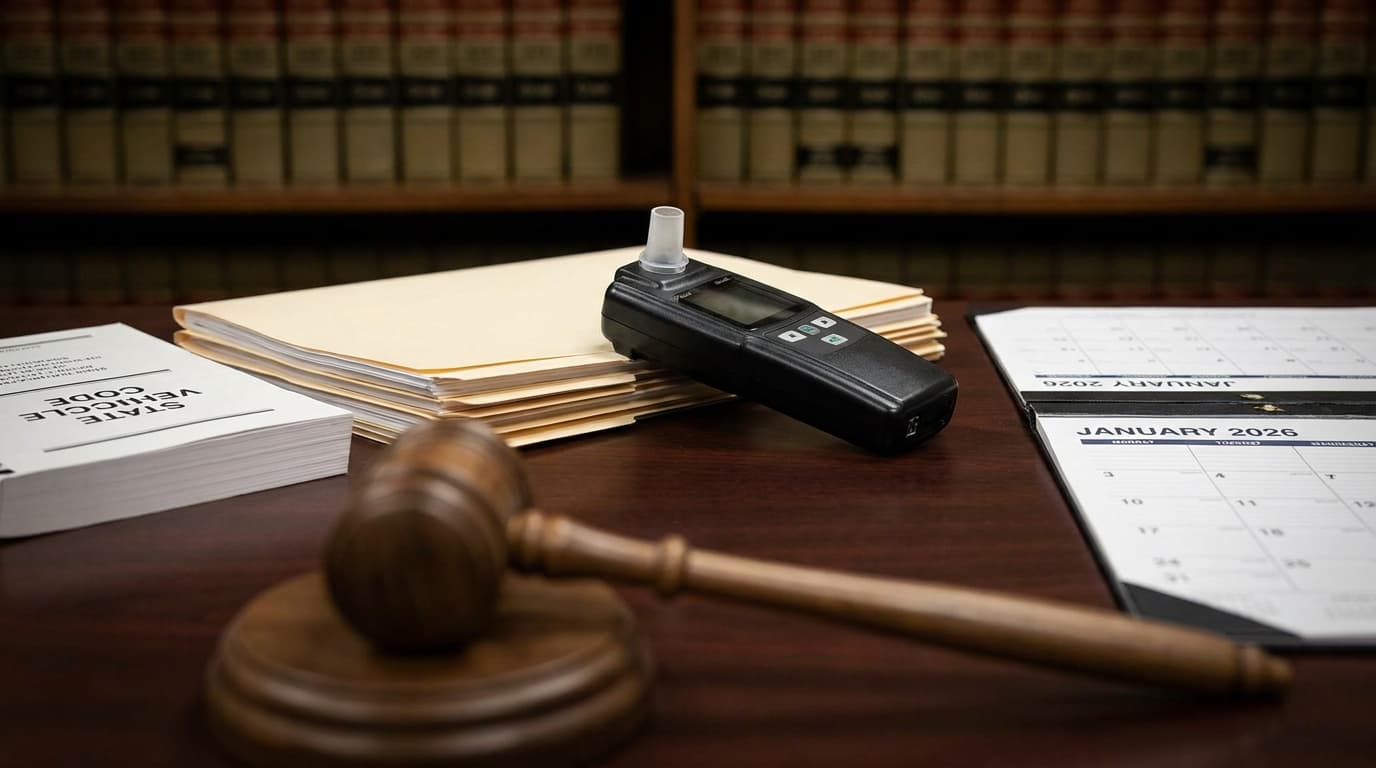
For decades the standard penalty for a first drunk-driving conviction was simple to describe: a fine, a suspended license, and a stretch of weeks or months without legal driving. That model is fading. Across most of the country, a first DUI now steers a driver toward an ignition interlock device, an in-car breathalyzer that prevents the engine from starting if it detects alcohol on the driver's breath.
Mothers Against Drunk Driving (MADD) counts 34 states plus Washington, D.C. as all-offender jurisdictions, meaning the law calls for an interlock on every DUI conviction, including a first offense. The number keeps climbing, and 2026 brought fresh activity in two big states. But the headlines around those changes have outrun the statutes. If you are facing a first charge, the details below decide whether an interlock is truly mandatory for you, whether you have a choice, and why your prior record now matters more than it used to.
What an 'all-offender' state actually means
An all-offender interlock law requires the device for every person convicted of DUI, not just repeat offenders or drivers caught with a high blood-alcohol concentration. MADD reports that New Jersey became the 34th such state in 2019, and the organization has pushed the all-offender standard as its central policy goal for years. MADD also credits interlocks with stopping more than 5.7 million attempts to drive at a BAC of .08 or higher between 2006 and 2025.
One caution on the count itself. The 34-states figure comes from MADD, an advocacy organization, and it reflects MADD's own classification. The Insurance Institute for Highway Safety (IIHS) keeps an independent state-by-state table and categorizes 'required for all offenders' more narrowly, so its tally is smaller. Both sources are useful, but the exact number depends on how you treat states that allow judicial discretion, offer interlocks as an alternative to suspension, or limit the mandate by BAC. When you read that a first DUI 'means' an interlock in 34 states, read it as the advocacy figure, not a settled legal fact in every one of those jurisdictions.
California's AB 366: an extension, not a new first-offense mandate
California drew attention heading into 2026 because its statewide ignition interlock program was set to expire. Assembly Bill 366, chaptered on October 13, 2025 as Chapter 689 of the Statutes of 2025, extended that program's sunset from January 1, 2026 to January 1, 2033. Without the bill, the framework would have lapsed.
Here is the part that gets misreported. AB 366 did not create a new first-offense interlock mandate. It carried forward the existing structure. For a first offender, installation remains discretionary rather than automatic, and the income-based sliding-scale fee that helps lower-income drivers cover the device was preserved. In practice, a California first offender generally chooses between two paths: install an interlock to keep full driving privileges, or accept a restricted license without the device. The 2026 change kept that choice alive for another seven years. It did not take it away.
If you are charged with a first DUI in California, the operative question is not whether a 2026 law forced an interlock on you. It is which option the court offers and which one fits your commute, your budget, and your record.
Washington's 15-year lookback: aimed at repeat offenders, not first-timers
Washington's 2026 reform has been described in some coverage as extending the DUI lookback period to 15 years, with the implication that a single mistake can follow a driver for a decade and a half. That framing is misleading, and it matters because it changes how a person reads their own exposure.
The reform, effective January 1, 2026, extends the lookback period to 15 years only for felony DUI. In Washington, a DUI becomes a felony when a driver has three or more prior offenses within the lookback window. The change lengthens that window to 15 years for the purpose of counting those priors. For a true first offense, or a second, the charge remains a gross misdemeanor, and the lookback for that misdemeanor analysis stays at seven years.
In other words, the 15-year window does not, by itself, turn a first DUI into a felony. It threatens drivers who already carry two or more prior offenses and now face a third within a longer reach-back period. There is one wrinkle worth knowing: under RCW 46.61.5055, completed deferred prosecutions count as prior offenses for lookback purposes. So a deferred prosecution resolved up to 15 years ago can now count toward felony elevation, even though the driver may think of it as a case that was handled and put behind them.
Why a longer lookback changes the plea calculus
The population that should pay close attention to Washington's change is not first-timers. It is drivers with one or two priors. Before 2026, a prior that aged past the old window dropped out of the felony count. Now, with the felony lookback at 15 years and deferred prosecutions counting, an older case that a driver assumed was irrelevant can become the difference between a gross misdemeanor and a felony.
That shifts plea negotiations. A defendant weighing whether to fight a charge or accept a deal needs to know exactly how many countable priors sit inside the 15-year window, including any deferred prosecution. A charge that looks like a misdemeanor on its face can carry felony stakes once the full history is pulled. For anyone with a record, the practical advice is to confirm the lookback math before making any decision, because the reform rewards a clean record and punishes an unexamined one.
The practical first-offense reality: timelines, costs, and who pays
If your state does require an interlock for a first offense, the device is a real cost and a real inconvenience, but it is more manageable than many drivers expect. Required installation durations vary by state, by the number of offenses, and by BAC. MADD's recommended minimum is six months. Vendor figures show the range in practice: an industry source lists roughly 6 to 18 months in Alaska and about one year in Arizona, with longer terms for high-BAC readings and repeat offenders. Treat those as directional ranges, not legal advice for your jurisdiction.
On cost, MADD reports typical offender figures of roughly $70 to $150 for installation and about $60 to $80 per month for monitoring and calibration, which the organization frames as less than three dollars a day. The monthly fee covers regular calibration appointments and data downloads, which is how the court or licensing agency confirms compliance. Importantly, most states provide indigent-funding or reduced-cost options for drivers who genuinely cannot pay, and California's sliding-scale fee under the program AB 366 extended is one example of that approach. If cost is the barrier between you and legal driving, ask the court or the device provider about reduced-fee programs before assuming the interlock is out of reach.
The bottom line for a driver facing a first charge
The national trend is real: the penalty for a first DUI has moved from pure suspension toward a supervised return to the road through an interlock. But the trend is not uniform, and the 2026 headlines oversimplified it. Three things are worth holding onto.
First, the 34-states count is MADD's advocacy figure, and whether an interlock is truly mandatory for a first offense depends on your specific state's classification, which independent trackers like IIHS count differently. Second, California's AB 366 extended an existing program to 2033 and preserved both judicial discretion and the income-based fee for first offenders. It did not impose a new mandate. Third, Washington's 15-year lookback targets felony DUI built on three or more priors, not a first or second misdemeanor offense, and deferred prosecutions now count toward that felony math.
For most first-time drivers, the practical questions are narrow: Is an interlock required or optional where I am charged? If optional, does installing one restore more driving freedom than the alternative restricted license? And is there a reduced-cost program if I qualify? A clean prior record has never been worth more, and an old case you thought was closed has never been more worth checking. Confirm the details with a licensed criminal defense attorney in your jurisdiction before you make any decision about your case.
Related reading
-
[Rutherford v. United States Slams the Compassionate Release Door on Stacked Gun Sentences](/news/rutherford-v-united-states-compassionate-release-stacked-924c-sentences)
-
[Karen Read Walked on Murder but Lost on DUI: Why the Conviction That Stuck Just Quietly Expired](/news/karen-read-acquitted-murder-convicted-oui-probation-expired)
Sources
-
New Jersey Becomes 34th State With All-Offender Ignition Interlock Law — MADD
-
AB 366: Ignition interlock devices — CalMatters Digital Democracy bill tracker
-
Bill Text — AB-366 Ignition interlock devices (California Legislative Information)
-
Washington State Felony DUI Lookback Now 15 Years — DUI Heroes
-
What States Require Ignition Interlock Devices? — Smart Start
This article contains AI-assisted content and has been reviewed by our editorial team.
IMPORTANT NOTICE: GavelDaily.com is an advertising and information service, not a law firm. Submitting this form does not create an attorney-client relationship. The information you provide will be shared with licensed criminal defense attorneys in your area who may contact you about your inquiry. All submissions are treated as confidential by our service, but attorney-client privilege does not attach until you formally retain an attorney. Any attorney you connect with through this service is independently responsible for their legal advice and representation. Free consultations are subject to individual attorney availability. If you are facing an immediate legal emergency, contact your local public defender's office or call 911.