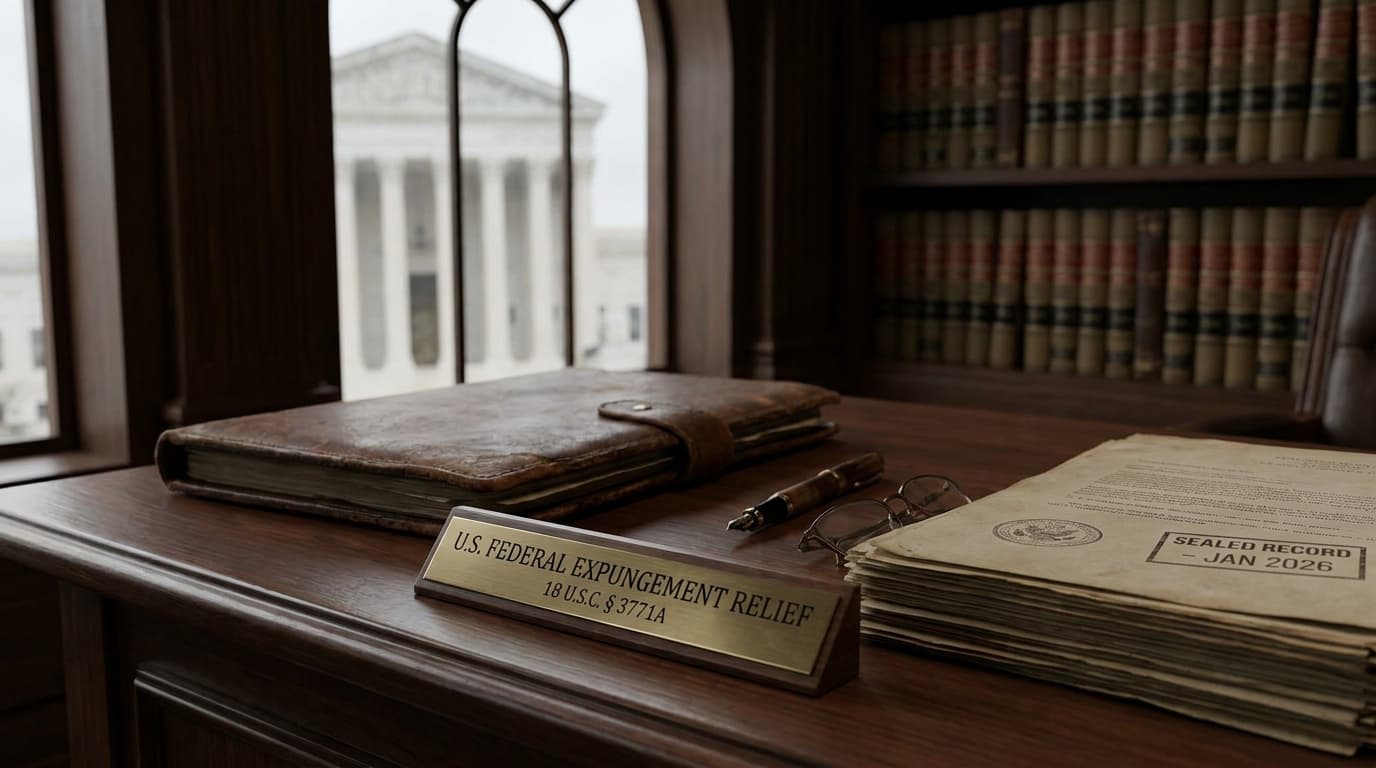
For years, the American federal system carried a hard rule that surprised almost everyone who ran into it: a federal conviction, once entered, generally could not be erased. States built dozens of paths to expungement and vacatur. Congress built almost none. That meant a survivor of sex or labor trafficking who was forced to commit a crime by the person exploiting them, what advocates call "forced criminality," could clear that record in state court but carried a matching federal conviction for the rest of their life.
That changed on January 23, 2026, when the Trafficking Survivors Relief Act (TSRA) became law. Passed as H.R. 4323 in the 119th Congress and codified at 18 U.S.C. § 3771A, it is, in the words of the Collateral Consequences Resource Center, "the first time in our Nation's history that expungement of a conviction record has been explicitly authorized in federal law."
What the TSRA actually does
The statute builds three distinct forms of relief for trafficking survivors, and they operate at different stages of a case.
Post-conviction relief. A survivor can move a federal court to vacate the judgment of conviction, set aside the verdict, and enter expungement of the arrest record. This is the headline power. It reaches back into a closed case and removes it, rather than merely sealing it from public view while it continues to exist.
An affirmative defense. The Act also gives survivors an affirmative defense to federal charges based on having been a victim of trafficking. That means the protection is not limited to people already convicted. Someone still facing prosecution can raise their trafficking victimization as a defense to the charge itself.
Sentence reduction. Finally, the law opens an avenue to reduce a sentence, including for some survivors convicted of certain violent offenses who would not qualify for full vacatur and expungement.
Taken together, the three remedies cover the arc of a criminal case: before conviction, at sentencing, and long after judgment.
Who qualifies, and the standard a court applies
Eligibility turns on the connection between the offense and the trafficking. The core question is whether the person committed the crime as a direct result of having been trafficked. The relief covers nonviolent federal offenses, and it also reaches arrest records for certain violent crimes that did not involve child victims.
The evidentiary standard is a preponderance of the evidence, the same "more likely than not" threshold used in most civil litigation, not the higher "beyond a reasonable doubt" standard of a criminal trial. A court may grant relief if it finds, by a preponderance of the evidence, that the person's participation in the offense was a direct result of being a victim of trafficking.
Just as important is how a survivor can prove that nexus. Trafficking victims frequently lack paperwork, police reports, or cooperating witnesses. The TSRA accounts for that. Credible testimony from an anti-trafficking service provider or a clinician can constitute sufficient evidence to grant relief when other documentation is unavailable. Relief can rest on the survivor's own affidavit or testimony, and no third party needs to have been convicted or even arrested first. In other words, a survivor does not have to wait for their trafficker to be caught to clear their own record.
Why the mechanics matter to a wide audience
The procedural design of the Act is unusually friendly to the people it is meant to help, and the details reveal the intent.
-
No fees. There are no filing or administrative fees to bring a motion.
-
Sealed from public view. All pleadings and orders are filed under seal and are not available for public inspection. A survivor does not have to publicly relive their exploitation to escape its legal aftermath.
-
No time bar. Motions may be filed at any time. There is no statute of limitations closing the window on relief.
-
Full retroactivity. The Act applies to convictions and arrests occurring before, on, or after the date of enactment. Survivors carrying decades-old records are covered.
Each of those choices lowers a barrier that has historically kept people from seeking relief: cost, exposure, deadlines, and the age of the case. Read together, they describe a deliberately low-friction, privacy-protective mechanism.
The precedent: a first crack in the federal wall
To understand why legal analysts are calling this historic, it helps to know what came before it, which was essentially nothing. Federal law had no general statutory expungement mechanism. Unlike the many state-level trafficking-survivor vacatur laws that predate the TSRA and set the template, the federal system offered survivors no statutory route to erase a conviction.
That is the significance of the "first federal statutory expungement authority" framing. For the first time, Congress has written into federal law an explicit power for a court to expunge a conviction record. Legal commentators at the CSE Institute have described it as a long overdue shift in how the federal system treats forced criminality.
The limits matter as much as the breakthrough. This is not general federal expungement reform. The relief is narrow, tied specifically to trafficking survivors and to offenses committed as a direct result of that trafficking. Anti-trafficking advocates have been clear-eyed about the scope. Freedom Network USA, a leading coalition, recognized the law as providing limited criminal record relief for survivors. The door is now open, but only a crack, and only for a defined group.
How it passed
The TSRA moved through Congress with bipartisan backing. In the House, the bill was led by Rep. Russell Fry (R-SC), joined by Reps. Ann Wagner (R-MO) and Ted Lieu (D-CA). The Senate companion, S. 2255, was led by Sens. Kirsten Gillibrand (D-NY) and Cindy Hyde-Smith (R-MS). The Senate passed the measure by unanimous consent before it was signed into law.
The signing came with a human-interest note that underscored why the statute matters. According to Sen. Hyde-Smith's office, trafficking survivor and congressional witness Hollie Nadel announced that she had received a presidential pardon the same day the law was signed. Pardons are rare and discretionary. The point of the statute is that the vast majority of survivors will never receive one, and now they will not have to. They will have a standing legal process instead.
Limits and open questions
Because the law is new, much of how it will work in practice is still unsettled. Several questions will shape its real-world reach:
-
How courts read "direct result." The nexus requirement is the heart of eligibility, and judges will have to decide case by case how tight the causal link between the trafficking and the offense must be.
-
Implementation and guidance. Federal prosecutors and the courts will need practical procedures, and Department of Justice guidance will influence how consistently the relief is granted across districts.
-
Whether it opens a broader debate. Having authorized expungement in one narrow context, Congress has established that federal expungement is possible. Whether that cracks the door to wider federal record-clearing debates is an open question.
Practical takeaway
If you or someone you know is a survivor of sex or labor trafficking who carries a federal record, the core points to understand are these, drawn from the statute and practitioner explainers such as Singleton Schreiber's:
-
Who qualifies: survivors of trafficking whose federal offense was a direct result of being trafficked, covering nonviolent federal offenses and certain non-child violent-crime arrest records.
-
How relief works: a survivor files a motion asking the federal court to vacate the conviction, set aside the verdict, and expunge the arrest record, proven by a preponderance of the evidence.
-
Proof: a survivor's own affidavit or testimony, or credible testimony from an anti-trafficking service provider or clinician, can be enough when other documentation is unavailable.
-
No fee. There is no cost to file.
-
Sealed. All filings and orders are kept under seal and out of public view.
-
File anytime. There is no deadline.
-
Retroactive. It applies to convictions and arrests from before, on, or after the law took effect.
For a system that spent its entire history telling survivors a federal record was permanent, that is a meaningful change. It is narrow, but it is real, and it is the first of its kind.
Related reading
-
[The Supreme Court's Chatrie Ruling Turns Google 'Geofence' Warrants Into a Search, and Into a New Suppression Argument](/news/chatrie-geofence-warrant-supreme-court-search-suppression-argument)
-
[The .05 Blood-Alcohol Line Is Spreading: Washington Eyed a July Cutover, and Utah Is No Longer the Only Bill on the Table](/news/05-bac-limit-spreading-washington-utah)
Sources
-
H.R. 4323 (119th Congress), Trafficking Survivors Relief Act, engrossed bill text
-
Federal Expungement for Survivors of Human Trafficking, Collateral Consequences Resource Center
-
Trafficking Survivors Relief Act Signed into Law, Sen. Cindy Hyde-Smith
-
FNUSA Recognizes Passage of Law Providing Limited Criminal Record Relief, Freedom Network USA
-
Historic Victory: Senate Unanimously Passes the Trafficking Survivors Relief Act, PACT
Note: This article contains AI-assisted content and has been reviewed by our editorial team.
IMPORTANT NOTICE: GavelDaily.com is an advertising and information service, not a law firm. Submitting this form does not create an attorney-client relationship. The information you provide will be shared with licensed criminal defense attorneys in your area who may contact you about your inquiry. All submissions are treated as confidential by our service, but attorney-client privilege does not attach until you formally retain an attorney. Any attorney you connect with through this service is independently responsible for their legal advice and representation. Free consultations are subject to individual attorney availability. If you are facing an immediate legal emergency, contact your local public defender's office or call 911.