
If someone you know was just booked in a Texas jail on a violent felony charge, the first question the family asks is when bail gets set. Since November 2025, that question has a different answer for a short list of charges. A person can now be denied bail in Texas outright, before trial, if the prosecutor asks for it and proves a specific case to a judge. The charge alone does not decide it. A hearing does.
Texas voters approved Proposition 3 on November 4, 2025, adding Section 11d to Article I of the Texas Constitution. The enrolled text of S.J.R. 5 is short: it adds the new section and sets the election date. What it does inside a courtroom is not short at all.
Who can be denied bail in Texas now?
Section 11d(a) reaches a person accused of one or more of nine offenses, and only those nine:
-
Murder
-
Capital murder
-
Aggravated assault, but only if the person caused serious bodily injury or used a firearm, club, knife, or explosive weapon during the commission of the assault
-
Aggravated kidnapping
-
Aggravated robbery
-
Aggravated sexual assault
-
Indecency with a child
-
Trafficking of persons
-
Continuous trafficking of persons
Read item three twice, because it is the one most readers in this category are living with. Not every aggravated assault is an 11d case. The constitutional text attaches a qualifier that a lot of coverage flattened: serious bodily injury, or one of four named weapon categories. An aggravated assault charged on a deadly weapon theory that does not involve serious bodily injury and does not involve a firearm, club, knife, or explosive weapon is not automatically inside the amendment. That is a factual question about what the state alleges you did, and it is worth putting in front of the judge early.
What is not on the list also matters. Plain sexual assault, a second degree felony, is absent. So is every other felony in the Penal Code. If the charge is not one of the nine, Section 11d has nothing to say about the case, though the older bail denial provisions discussed below may still apply.
What does the prosecutor have to prove?
Denial is not automatic on the charge. The state has to ask, and then the state has to carry a burden at a hearing. There are two separate theories, with two different standards of proof, and they are not interchangeable.
Theory one, flight. The prosecutor shows by a preponderance of the evidence that bail is insufficient to reasonably prevent the person's willful nonappearance in court. Preponderance means more likely than not, the everyday civil standard.
Theory two, danger. The prosecutor shows by clear and convincing evidence that bail is insufficient to reasonably ensure the safety of the community, of law enforcement, and of the victim of the alleged offense. Clear and convincing is a materially higher bar. It sits between more likely than not and beyond a reasonable doubt, and it asks the judge to hold a firm belief or conviction that the fact is true. It is a real hurdle, and the defense should make the state meet it rather than treating detention as a foregone conclusion.
The official bill analysis for S.J.R. 5 confirms both standards, along with the two protections described next. If the state does not request denial, or requests it and fails to prove its theory, bail gets set.
What happens at a bail denial hearing in Texas?
The accused has the right to be represented by counsel at the hearing. That right was written into the final version of S.J.R. 5, and it is not a formality. According to defense side practitioner accounts, these hearings often happen within days of arrest, frequently at magistration and frequently before indictment. That is a compressed window, and it is usually the moment when the record either gets built or does not.
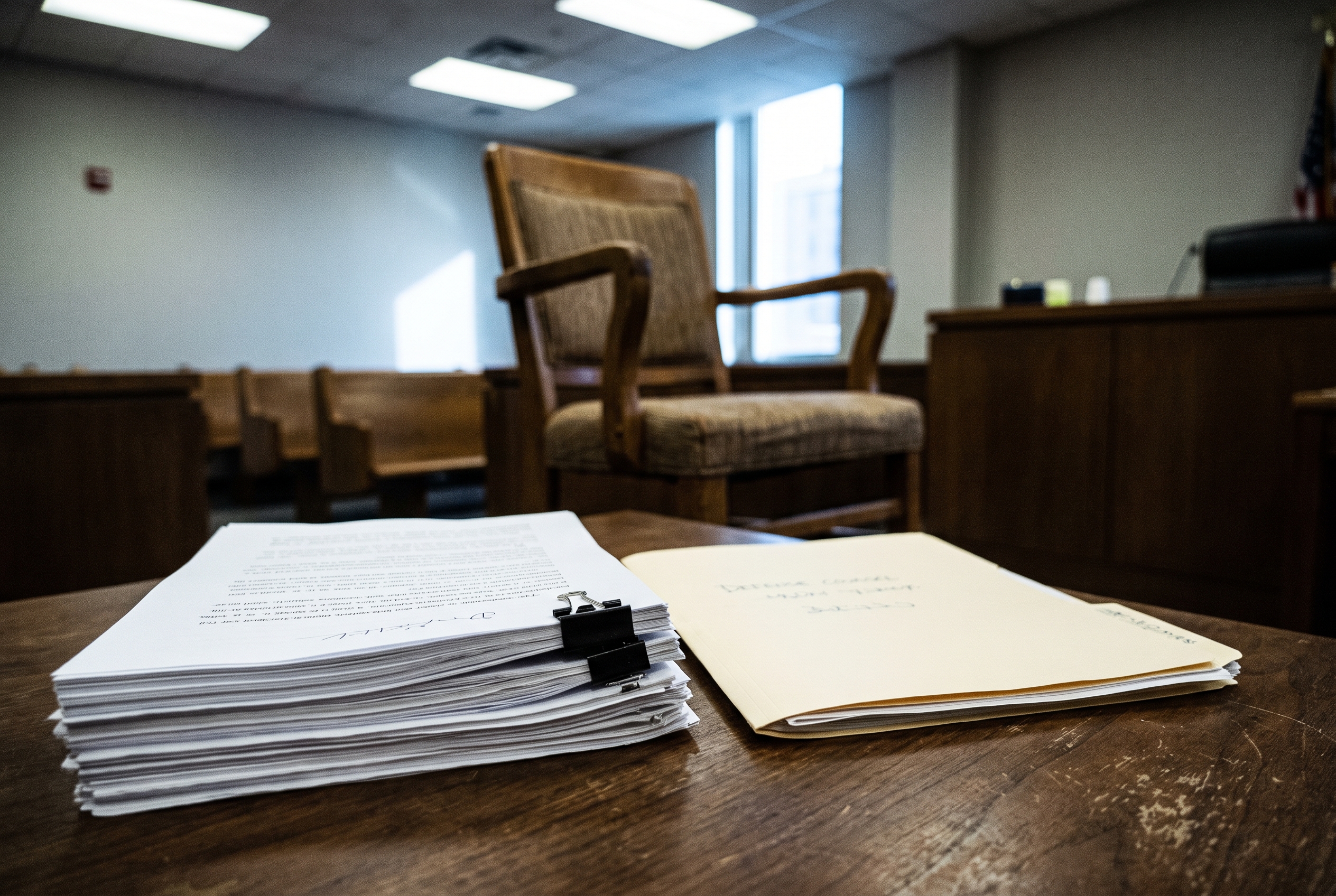
The court is directed to weigh the likelihood of nonappearance, the nature and circumstances of the offense, the safety of the community and the victim, and the person's criminal history. Under the companion statute, S.B. 9, the Public Safety Report is a mandatory consideration.
One practical warning. The constitutional text does not require live testimony. In practice the state commonly puts offense reports, affidavits, criminal history, and the Public Safety Report in front of the judge. There may be no witness in the room to cross examine, which means the defense argument often has to be built on the documents themselves, on what the reports do not actually establish, and on the gap between the charged label and the statutory trigger.
Does the judge have to explain the decision?
Yes, and the requirement runs both directions. A judge or magistrate who denies bail must prepare a written order containing findings of fact and an explanation of the reason for denial. A judge who grants bail in one of the nine covered cases must also issue a written order with findings and a justification for the decision.

For the defense, that written order is the whole ballgame on review. An appeal or a habeas application is built out of what the judge actually found, and a thin or conclusory order is itself something to attack. Get a copy of it.
Did Proposition 3 take effect on September 1, 2025?
This is where a lot of readers have been given the wrong information, so it is worth being precise.
The September 1, 2025 date, and the rule that the changes apply "only to an offense committed on or after the effective date of this Act," belong to S.B. 9, the statutory companion. They do not come from Proposition 3.
S.J.R. 5 itself contains no effective date section and no applicability clause. The official constitutional codification carries only the note "(Added Nov. 4, 2025.)" Separately, several news outlets, including CBS Texas, have reported Proposition 3 as taking effect January 1, 2026. That discrepancy is not resolved in the public sources.
What that means for a real case: because S.J.R. 5 has no applicability clause, whether Section 11d reaches conduct that predates November 2025 is an open question rather than settled law, and no Texas appellate decision resolving it appears in the sources reviewed here. The date of the alleged offense clearly matters for the S.B. 9 statutory machinery. It is contested for the constitutional amendment. If you are facing an 11d hearing, ask your lawyer to confirm on the record which set of rules the court believes it is applying and to preserve the objection if the answer is the amendment and the conduct predates it.
If bail is denied, what happens next?
A denial is reviewable. Habeas corpus and appellate review remain available, and the written findings requirement exists in part to make that review possible.
The traffic also runs the other way, and readers should know it. Under S.B. 9, the state has a right to appeal a bail decision it considers insufficient in essentially the same offense categories that Section 11d covers, through Article 44.01. That review is de novo, and the court of appeals has a 20 day deadline to rule. Prosecutors can also seek district court review as soon as the next business day. Winning a reasonable bond at magistration does not always end the fight over it.
Is denying bail new in Texas?
No. Section 11d widened an already qualified guarantee rather than inventing pretrial detention.
Article I, Section 11 has always excepted capital offenses where "the proof is evident." Section 11a, added in 1956 and amended in 1977 and 1993, covers repeat felons and people accused of an offense committed while already on bail. Section 11b, added in 2005 and amended in 2007, covers violation of a condition of release. Section 11c, added in 2007, covers violation of a family violence protective order. If you are charged with something outside the nine offense list, one of these older provisions may still be the route a prosecutor takes.
The S.B. 9 rules that affect more people than 11d does
For most defendants, the statute is going to matter more often than the amendment. S.B. 9 does several things that reshape the first 48 hours:
-
A magistrate cannot release a defendant charged with murder, capital murder, aggravated kidnapping, or aggravated sexual assault. A district judge has to make that call, which can mean waiting.
-
Personal bonds are barred in a list of violence related cases, so the release-without-money option disappears in those categories regardless of what a judge thinks of the individual.
-
The Public Safety Report System is expanded, and the report is a mandatory consideration.
The Texas District and County Attorneys Association published a practitioner walkthrough of the new framework, written for prosecutors, which is useful reading for the defense precisely because it shows how the state is being trained to build these motions.
What it looks like on the ground
The amendment passed comfortably. Reported approval varies by source, roughly 61 percent per The Texan and near 64 percent in Texas Tribune election night reporting based on early and mail returns. Final canvassed totals sit with the Secretary of State.
The county level effect is still being measured. Houston Public Media reported that Harris County commissioners were presented with a projection that the jail population could grow by more than 1,900 by the end of 2026 if defendants in the covered categories are held, and that roughly 2,400 defendants with a covered charge were released on bond during 2025. Those are projections and county figures rather than outcomes, and they are worth checking against the underlying county presentation.
The argument on both sides is worth understanding, because it shows up inside hearings. Supporters, including the amendment's author Sen. Joan Huffman, pointed to Crime Stoppers of Houston data counting more than 200 Harris County homicides since 2020 involving defendants out on felony or personal bonds. Opponents, including the ACLU, the defense bar, and Sen. Sarah Eckhardt, argued the framework cuts against the presumption of innocence and against research showing that pretrial detention itself is associated with worse outcomes and higher reoffending.
The legislative history is also useful. The House version would have made denial mandatory rather than discretionary. The final language rejected Gov. Greg Abbott's proposal to make the defendant prove he was not dangerous, and instead put the burden on the state, and added the right to counsel. S.J.R. 5 cleared the House 133 to 8. The burden sitting with the prosecutor is not an accident. It was the compromise.
A short checklist if this is your case
-
Get counsel before the bail hearing, not after. The hearing can happen within days of arrest and often before indictment.
-
Find out whether the state has actually filed for denial under Section 11d. If it has not, the hearing is a normal bail hearing.
-
If the charge is aggravated assault, check whether the allegation really meets the trigger: serious bodily injury, or a firearm, club, knife, or explosive weapon. A deadly weapon label alone is not the test.
-
Make the state name its theory and meet the right burden. Danger requires clear and convincing evidence, not a hunch.
-
Ask the court on the record which rules it is applying given the offense date, and preserve the objection.
-
Get the written order with findings, whichever way the judge rules. That document is what review is built on.
Related reading
Sources
-
Texas Constitution, Article 1 (Bill of Rights), official text
-
The dawn of a new day in Texas bail, Texas District & County Attorneys Association
-
Stricter bail rules in Texas Constitution approved by voters, Texas Tribune
-
Stricter bail rules approved by Texas Legislature, Texas Tribune
-
Texans Pass Ballot Proposition Allowing Judges to Deny Bail to Violent Suspects, The Texan
-
Texas' new bail laws could increase Harris County's jail population, Houston Public Media
-
Denial of Bail in Texas: Changes in Bail Rules for Certain Crimes, Versus Texas
Note: This article contains AI-assisted content and has been reviewed by our editorial team.
IMPORTANT NOTICE: GavelDaily.com is an advertising and information service, not a law firm. Submitting this form does not create an attorney-client relationship. The information you provide will be shared with licensed criminal defense attorneys in your area who may contact you about your inquiry. All submissions are treated as confidential by our service, but attorney-client privilege does not attach until you formally retain an attorney. Any attorney you connect with through this service is independently responsible for their legal advice and representation. Free consultations are subject to individual attorney availability. If you are facing an immediate legal emergency, contact your local public defender's office or call 911.