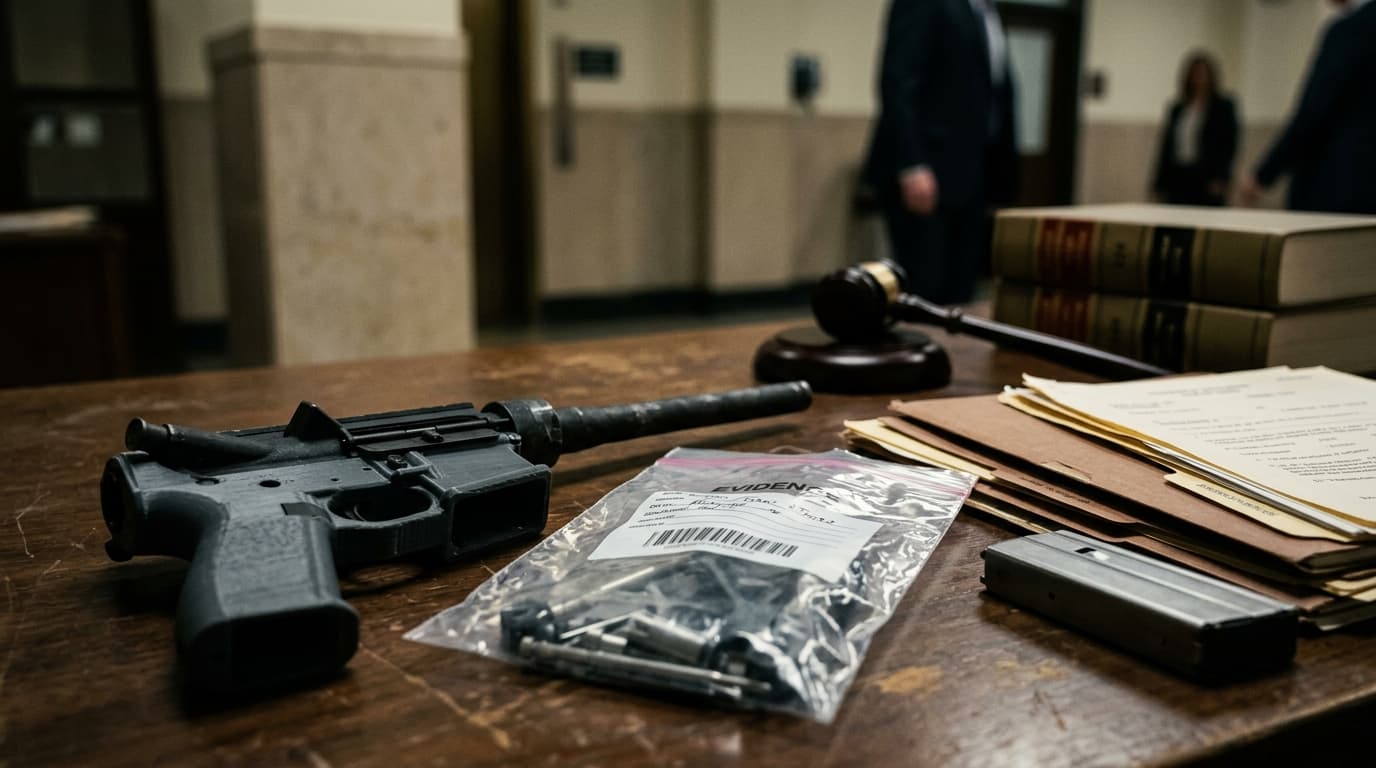
On March 26, 2025, the Supreme Court decided Bondi v. VanDerStok, 604 U.S. ___ (No. 23-852), 7 to 2. Justice Gorsuch wrote for the majority. The headlines said the Court had upheld the ATF rule covering so-called ghost guns. That is correct, but it is not the whole story.
The Court rejected only the facial challenge to ATF Final Rule 2021R-05F, 87 Fed. Reg. 24652. The majority noted that the challengers "do not challenge ATF's new rule as applied to particular products," preserving as-applied attacks on remand to the Fifth Circuit. As SCOTUSblog's post-decision summary put it, the holding is narrower than the result suggests. The fight has moved from whether the rule exists to what it covers, what a defendant knew, and how investigators built their case. Defenders are running that fight, and they are driving defense motions and at least some favorable rulings.
What VanDerStok actually decided
The 7 to 2 majority included Chief Justice Roberts and Justices Sotomayor, Kagan, Kavanaugh, Barrett, and Jackson. Justice Thomas and Justice Alito dissented separately on statutory text grounds. Justice Gorsuch's opinion (slip opinion) carved out a notable caveat: the rule may not reach a kit "so incomplete or cumbersome to assemble" or a product "so far from a finished frame or receiver" that it cannot fairly be so described. That passage is now the doctrinal hook for defense motions targeting partial 3D printed shells, unjigged sub-80% billets, and other items that are not Polymer80-style "Buy Build Shoot" kits.
Justice Kavanaugh's concurrence flagged a separate problem. He warned that fair notice and due process would be threatened if the government prosecuted defendants who did not realize their item qualified as a regulated firearm. He quoted the Justice Department's own oral-argument representation that DOJ would "likely decline to bring charges" in such cases. The SCOTUSblog case file preserves the briefs and argument transcript that Kavanaugh relied on, and defenders are now citing both the concurrence and the underlying DOJ representation in pretrial motions. The Cornell LII version of the opinion is the cleanest source for pull-quotes.
The prosecution stack, and where each charge breaks
Federal ghost gun cases typically run through one or more provisions of 18 U.S.C. § 922:
- § 922(a)(1)(A): engaging in the business of manufacturing or dealing in firearms without a federal license. Five-year statutory maximum.
- § 922(g): possession by a prohibited person, most often a felon. Now governed by Rehaif's knowledge-of-status element.
- § 922(o): machinegun possession, including auto-sears and Glock conversion switches. Ten-year statutory maximum.
- § 922(p): undetectable firearms, the provision most cited against fully plastic 3D printed designs.
The U.S. Sentencing Commission's firearms offenses primer sets out the elements and Guidelines treatment for each. After VanDerStok, the contested element in most ghost gun prosecutions is not whether the rule applies at all. It is whether the government can prove the defendant knew the item was a firearm within the post-VanDerStok regulatory definition.
Rehaif's reach into ghost gun cases
In Rehaif v. United States, 588 U.S. 225 (2019), the Court held that under § 922(g) the government must prove the defendant knew both that he possessed a firearm and that he held the disqualifying status. Defenders are pressing that logic one step further in ghost gun cases. They argue that the "firearm" element now incorporates the post-VanDerStok regulatory definition, and that the government must prove the defendant knew the partial frame, receiver blank, or 3D printed shell met that definition.
The argument shows up in motions in limine, requests for specific jury instructions, and challenges to the sufficiency of the indictment. As the Harvard Law Review case comment on VanDerStok notes, the facial holding left substantial daylight for these challenges. Practitioner analyses, including Faegre Drinker's post-decision client alert, read Gorsuch's caveat as an open door for the same arguments on the criminal side. Reporters covering this beat should chase circuit-by-circuit divergence on how district judges are handling Rehaif-extension instructions, because that is where the next conflict is forming.
The as-applied gray zone
Three categories matter at trial:
- Clearly covered: Polymer80-style kits with frame, jig, drill bits, and step-by-step instructions. The VanDerStok opinion treats these as the paradigm.
- Clearly outside: raw blocks of aluminum or polymer, with no machining, no jig, and no instructions. Gorsuch's "so far from a finished frame or receiver" language was written with these in mind.
- The gray zone: partially milled receivers without jigs, 3D printed shells lacking rails or fire-control pockets, and components purchased separately across multiple vendors. This is where defense experts work, and where the as-applied challenge lives.
The ATF's Privately Made Firearms program page and the agency's NFCTA Volume IV, Part V tracing data set the universe of recovered privately made firearms the ATF catalogs. Those documents describe the enforcement priority but do not resolve the legal question of which items satisfy the regulatory definition in a given case. The archived DOJ fact sheet on privately made firearms shows how the prior administration framed enforcement, useful for contrast with the current posture.
Suppression: printers, CAD files, and chat servers
A second front has opened on the Fourth Amendment side. Investigators routinely seek warrants for 3D printers, CAD and STL files stored locally or in the cloud, G-code prints, and chat communities on Discord or Telegram. Defenders are arguing that digital print files attract the heightened protection the Court described in Riley v. California (2014), and that boilerplate firearms warrants do not satisfy particularity when the search reaches an entire design library or cloud account.
Verified sources do not show a controlling appellate ruling on the exact question of warrantless inspection of seized CAD or STL files, or cloud-stored printer telemetry. That gap is a litigation opportunity. Suppression motions are pending in multiple districts, and the absence of binding circuit law makes the briefing posture favorable for thoughtful defense work.
The April 2026 DOJ rewrite, and a fresh fair-notice argument
In April 2026, the Justice Department publicly signaled that it is rewriting the frames-and-receivers rule. A rule in flux compounds Kavanaugh's concurrence. If the agency is mid-rewrite, what regulatory definition is the defendant on notice of at the moment of charge? Defense counsel are framing this as a due process question and as a statutory scienter question. The Congressional Research Service summary of VanDerStok sets out the statutory framework that the rewrite will sit on top of, and that framework is the same scaffolding defenders use to attack scienter at the indictment stage.
State law is filling the federal gap
While federal enforcement may scale back during the rewrite, state law is moving the other direction. The Duke Center for Firearms Law reports active PMF statutes or pending legislation in Michigan, Maine, Pennsylvania, North Carolina, and Virginia. Second Amendment challenges are pending in New York, Colorado, and Oregon. Practically, this means a client who walks out of a federal indictment may still face a state charge on the same conduct, and counsel should screen both jurisdictions at intake.
The pending federal bills
Two companion bills, H.R. 4143 and S. 2165, the "3D Printed Gun Safety Act of 2025," would criminalize internet distribution of CAD files that automatically program a 3D printer to produce a firearm. Both raise First Amendment and Fourth Amendment questions, and neither has become law. If either passes in its current form, the prosecution map will shift again, with the front line moving from possession of the printed item to distribution of the file.
What this means if you are facing charges
Several practical points follow from the current posture:
- The charging document matters. Whether the indictment tracks the post-VanDerStok regulatory definition, and whether it pleads knowledge of that definition, sets up the Rehaif-style motion.
- The physical product matters. A partially milled billet without a jig is legally different from a packaged kit. Defense experts can map an item against Gorsuch's caveat.
- The digital evidence matters. If the case turns on CAD files, print logs, or chat-server messages, the warrant scope is worth a hard look.
- The timing matters. Conduct that straddles the DOJ rewrite raises fair-notice arguments that did not exist a year ago.
None of this is legal advice. It is a map of the live arguments. A federal defender or retained criminal defense lawyer in the charging district is the right person to evaluate any specific case.
Where the law goes next
The Supreme Court resolved the facial validity question and almost nothing else. The next chapter will be written in district court suppression hearings, jury-instruction fights, and the eventual circuit splits on whether Rehaif's knowledge requirement reaches the regulatory definition. The chapter after that may be written by Congress through the 3D Printed Gun Safety Act, by DOJ through the new rule, or by the Court itself if a Second Amendment challenge reaches it on the merits.
For now, the headline that the Court upheld the ghost gun rule is accurate. The follow-on headline, that ghost gun prosecutions are simple, is not.
Related reading
-
Rahimi's Aftermath: Why Federal Domestic Violence Gun Prosecutions Are Splitting Circuits in 2026
-
United States v. Hemani: Why the Justices Sound Ready to Strike the Gun Ban on Marijuana Users
Sources
- Bondi v. VanDerStok, 604 U.S. ___ (2025) (Justia)
- Bondi v. VanDerStok (Cornell LII)
- Bondi v. VanDerStok, slip opinion (PDF)
- SCOTUSblog case file, Bondi v. VanDerStok
- Amy Howe, "Supreme Court upholds regulation of ghost guns," SCOTUSblog (Mar. 26, 2025)
- Congressional Research Service, LSB11325
- Harvard Law Review, Bondi v. VanDerStok case comment
- Faegre Drinker, "Supreme Court Decides Bondi v. VanDerStok" (Mar. 2025)
- Duke Center for Firearms Law, "How Are States Responding to VanDerStok?" (Aug. 2025)
- U.S. Sentencing Commission, Firearms Offenses Primer (2021)
- ATF, Privately Made Firearms
- ATF, NFCTA Volume IV, Part V (PMF updates)
- DOJ Fact Sheet, Privately Made Firearms (archived)
- H.R. 4143, 3D Printed Gun Safety Act of 2025
- S. 2165, 3D Printed Gun Safety Act of 2025
- 18 U.S.C. § 922
- Rehaif v. United States, 588 U.S. 225 (2019)
Note: This article contains AI-assisted content and has been reviewed by our editorial team.
IMPORTANT NOTICE: GavelDaily.com is an advertising and information service, not a law firm. Submitting this form does not create an attorney-client relationship. The information you provide will be shared with licensed criminal defense attorneys in your area who may contact you about your inquiry. All submissions are treated as confidential by our service, but attorney-client privilege does not attach until you formally retain an attorney. Any attorney you connect with through this service is independently responsible for their legal advice and representation. Free consultations are subject to individual attorney availability. If you are facing an immediate legal emergency, contact your local public defender's office or call 911.