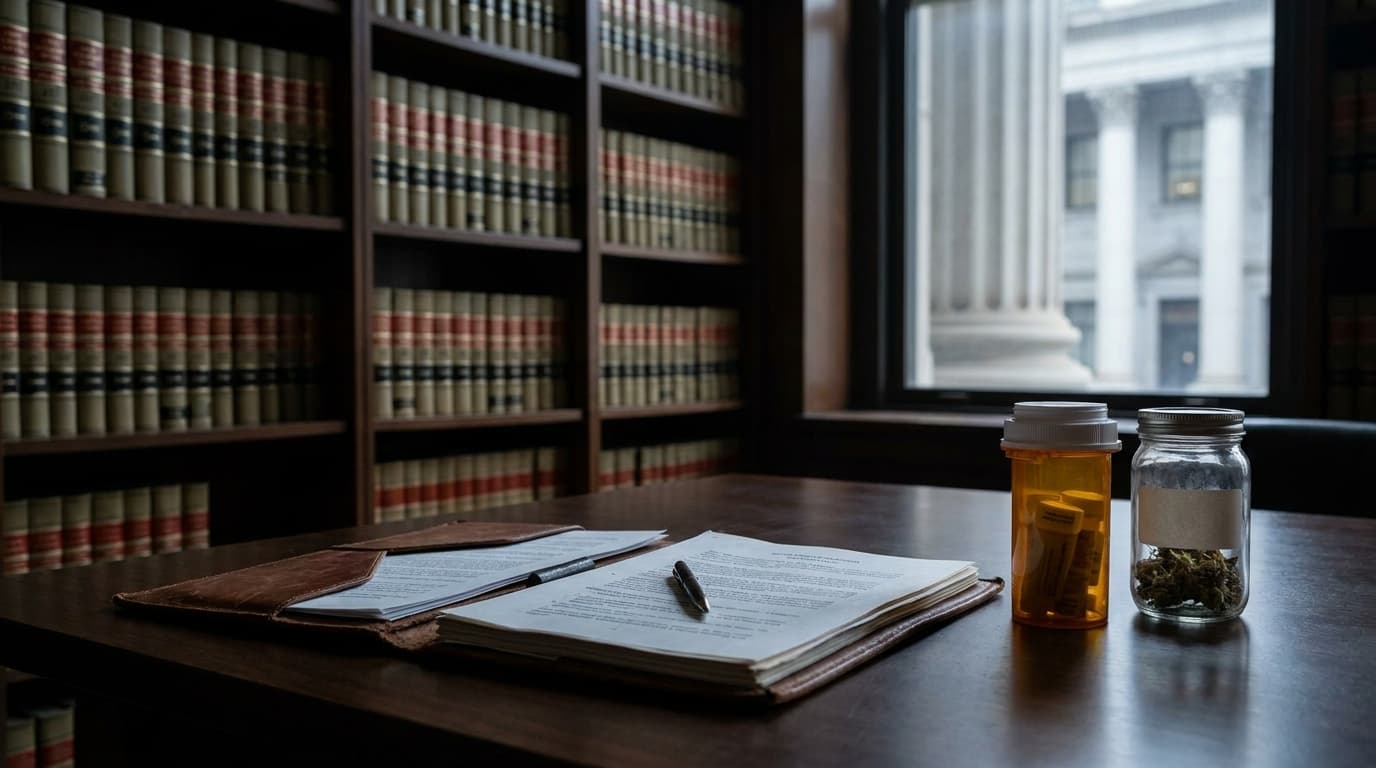
For the first time, federal drug law treats two jars of the same plant differently. On April 28, 2026, marijuana inside an FDA-approved drug product and marijuana grown under a qualifying state medical license became Schedule III substances. Everything else, including recreational cannabis, bulk marijuana, unlicensed crops, and derivatives outside those two lanes, stayed in Schedule I alongside heroin. That two-tier status is not settled law headed into the summer. A DEA administrative hearing opening June 29, 2026 will weigh whether all marijuana should drop to Schedule III, and how the government answers that question will shape exposure for people charged with marijuana offenses.
If you are facing a marijuana charge right now, the most important thing to understand is this: the April order is forward-looking and channel-specific. It rewards a licensed and medical path. It does not erase the Schedule I exposure that still attaches to possession and activity outside that path, and it offers no stated retroactive relief for prior convictions.
What actually happened in April
Acting Attorney General Todd Blanche signed the order on April 23, 2026. It took effect April 28, 2026, when it was published in the Federal Register. According to the Justice Department's announcement, the move places FDA-approved marijuana products and state-licensed marijuana into Schedule III while keeping strict federal controls on everything else.
The action did not come out of nowhere. It traces to President Trump's December 18, 2025 Executive Order on Increasing Medical Marijuana and Cannabidiol Research, and it finally resolved a rescheduling proceeding that had been stalled since a Notice of Proposed Rulemaking was published on May 21, 2024. The regulatory text lives in the Federal Register rescheduling rule (Doc. 2026-08177), with a companion action (Doc. 2026-08176) separately rescheduling FDA-approved products containing marijuana and adjusting the related permit requirements.
The two-tier map: what is Schedule III and what is still Schedule I
The order draws a narrow line. Two categories, and only two, moved to Schedule III:
-
FDA-approved drug products containing marijuana, meaning Δ9-THC derived from Cannabis sativa L., excluding mature stalks and seeds.
-
Marijuana subject to a qualifying state-issued medical marijuana license.
Everything outside those two lanes remains in Schedule I. That includes adult-use and recreational cannabis, unlicensed crops, bulk marijuana, and extracts or derivatives that do not fit the FDA-approved or state-licensed categories. As the legal analysis from Gibson Dunn confirms, the Schedule III scope is deliberately narrow, and the Schedule I default still governs the unlicensed, bulk, and derivative material that drives most marijuana prosecutions.
For a defendant, the schedule a substance sits in is not academic. Schedule I carries the harshest federal posture. The split means that the federal label on cannabis now depends on its source and its paperwork, not just on the plant itself.
Why a state medical card may matter federally for the first time
The order gives a measure of federal recognition to state medical certification, which has not been the case before. Under the framework, state medical documentation gains federal weight when it includes the patient's name and address, is dated and signed on the day it is issued, and identifies the issuing practitioner. No prescription is required.
That recognition has real limits. The Marijuana Policy Project's Q&A lays out what Schedule III does not do. It does not federally legalize adult-use cannabis. It does not deschedule cannabis, because full legalization would require Congress. It does not automatically confer protections under the Americans with Disabilities Act. And it provides no stated retroactive relief for prior convictions. Critically, the order is silent on unlicensed possession, which means people holding cannabis outside the licensed and medical structure get no federal cover from it.
The defendant's-eye view
Here is the practical core for anyone facing charges. Possession and activity outside the licensed channel still carry Schedule I exposure. The rescheduling is forward-looking. It does not announce relief for cases already charged or already resolved, and the order itself contains no retroactivity provision.
So a recreational possession case, an unlicensed grow, or trafficking in bulk marijuana sits in the same Schedule I posture it occupied before April 28. The change rewards a specific, documented, state-sanctioned medical path. It does not broadly soften the federal stance on cannabis for the general defendant.
Charging and enforcement reality
There is an important distinction between prosecutorial discretion and formal legal change. For years, DEA and FDA have historically declined to bring enforcement actions against marijuana manufacturers and distributors despite widespread federal violations. That is discretion, not formal charging immunity. A choice not to prosecute is not the same as a law that says the conduct is lawful, and discretion can shift.
The April order changes the schedule for two narrow categories. It does not, by its terms, hand defendants in pending or existing prosecutions a new legal shield outside those categories. Anyone relying on the headline that marijuana was rescheduled should be careful to confirm which lane their conduct falls into before assuming anything has changed for their case.
Collateral consequences: research, taxes, and banking
The rescheduling opened up several practical effects, concentrated in the licensed channel.
Research access. Practitioners can now research marijuana if they are DEA-registered for research and source the material from a state licensee that holds a valid federal registration. Schedule I marijuana outside those channels keeps its stringent research restrictions.
Tax relief. State medical license holders are no longer subject to the deduction disallowance under IRC Section 280E, which applies only to Schedule I or II activity. According to the tracking by Foley Hoag, Treasury and the IRS announced a transition rule and are weighing retrospective relief.
Registration mechanics. A Medical Marijuana Dispensary Registration Portal opened April 29, 2026, with a $794 application fee. Applications filed within 60 days of publication, roughly by June 27, 2026, are slated for processing within six months and may operate during the pendency of the application under a state license.
Banking. The banking picture remains unsettled, even within the licensed lane.
The June 29 hearing
The same April order launched an expedited DEA administrative hearing to consider whether all marijuana should drop to Schedule III. Per the DEA's June 25 press release, the hearing begins June 29, 2026 at 9 a.m. ET at the DEA Hearing Facility, 700 Army Navy Drive, Arlington, Virginia, and must conclude no later than July 15, 2026. The deadline to file a notice of participation was May 28, 2026. The proceeding carries forward the procedural posture inherited from the 2024 Notice of Proposed Rulemaking and is tied to the December 18, 2025 Executive Order.
If the hearing ultimately produces a full Schedule III move for all marijuana, it would broaden the lane considerably. It would still not, on its own, federally legalize adult-use cannabis or deschedule the plant, because those steps require Congress. The Congressional Research Service has published a neutral legal-sidebar analysis of the statutory mechanics and consequences in LSB11424, useful framing for the criminal-law and federalism questions the hearing raises.
Bottom line for defendants
Until the hearing resolves, the fault lines are clear. The licensed and FDA-approved medical channel now sits in Schedule III, with the research and tax consequences that follow. Recreational, bulk, unlicensed, and out-of-lane derivative marijuana stays in Schedule I with the same federal exposure it had before. The change is prospective, channel-specific, and silent on retroactive relief.
If you are charged with a marijuana offense, the question that matters is which lane your conduct fits, what documentation exists, and what your jurisdiction does with it. This is the cannabis-scheduling story, and it is separate from federal fentanyl scheduling coverage. Treat the headline carefully and confirm the specifics before drawing any conclusion about your own case.
Related reading
-
[Rutherford v. United States Slams the Compassionate Release Door on Stacked Gun Sentences](/article/rutherford-v-united-states-compassionate-release-stacked-924c-sentences)
-
[Karen Read Walked on Murder but Lost on DUI: Why the Conviction That Stuck Just Quietly Expired](/article/karen-read-acquitted-murder-convicted-oui-probation-expired)
-
[Refusing a Breathalyzer Is Now Its Own Crime in Florida, First Offense Included: Trenton's Law and the Suppression Fight Already Brewing](/article/florida-trentons-law-breathalyzer-refusal-crime-suppression)
Sources
-
DEA: Hearing on Proposed Marijuana Rescheduling Begins June 29 (June 25, 2026)
-
Justice Department: FDA-Approved and State-Licensed Marijuana Placed in Schedule III
-
Federal Register: Rescheduling of Marijuana (Doc. 2026-08177)
-
Federal Register: Rescheduling of FDA-Approved Products Containing Marijuana (Doc. 2026-08176)
-
Gibson Dunn: DEA Downschedules State Medical Marijuana to Schedule III
-
Foley Hoag: DOJ, Treasury, and DEA Updates Since the April 23 Order
-
Congressional Research Service: Department of Justice Eases Control of Medical Marijuana (LSB11424)
Note: This article contains AI-assisted content and has been reviewed by our editorial team.
IMPORTANT NOTICE: GavelDaily.com is an advertising and information service, not a law firm. Submitting this form does not create an attorney-client relationship. The information you provide will be shared with licensed criminal defense attorneys in your area who may contact you about your inquiry. All submissions are treated as confidential by our service, but attorney-client privilege does not attach until you formally retain an attorney. Any attorney you connect with through this service is independently responsible for their legal advice and representation. Free consultations are subject to individual attorney availability. If you are facing an immediate legal emergency, contact your local public defender's office or call 911.