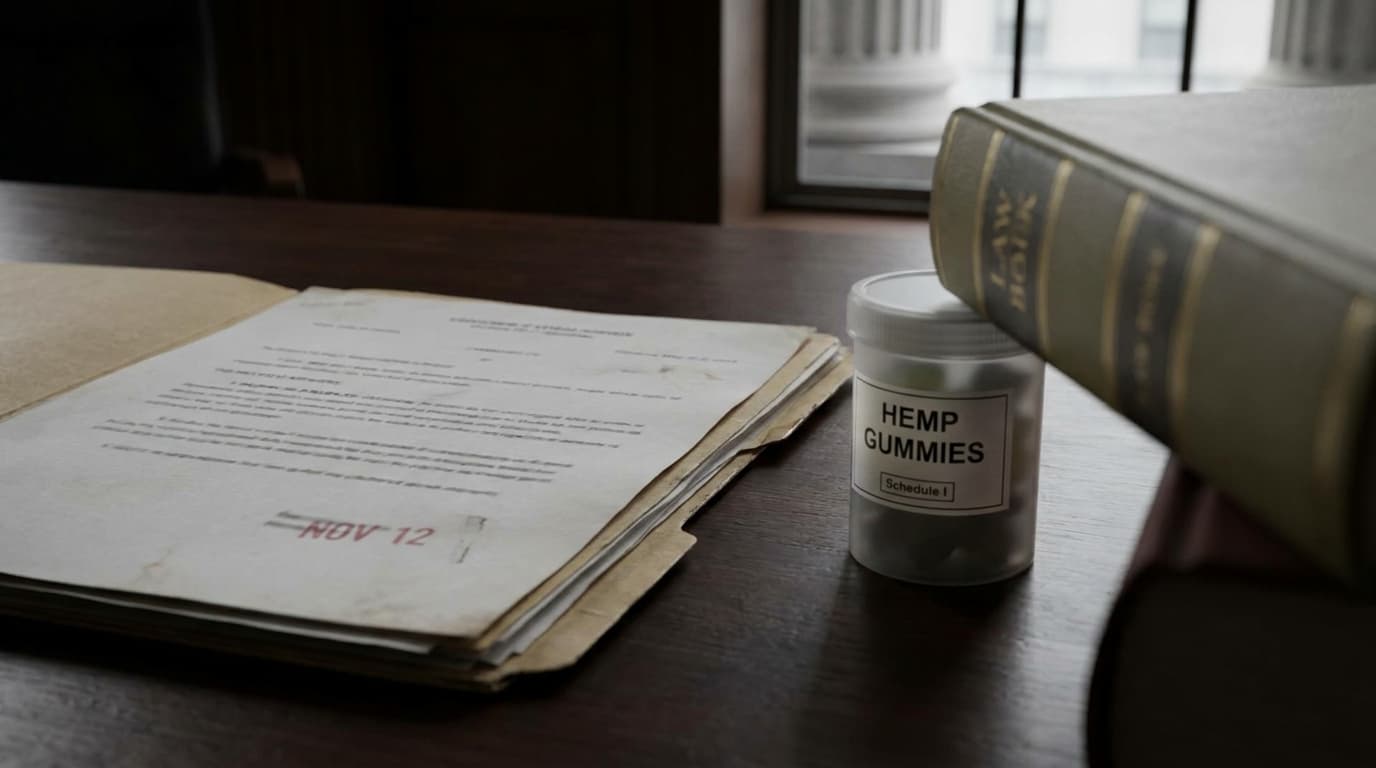
The hemp gummy sitting in a kitchen cabinet or a gas station cooler today is a lawful consumer product. On November 12, 2026, a large share of those same products can become the predicate for a federal Schedule I drug charge. The change does not require a new vote to schedule any substance. It flows from a single provision buried in a spending bill, and the fuse was lit a year in advance.
On November 12, 2025, President Trump signed H.R. 5371, the FY2026 appropriations package. Section 781 of that law narrows the federal definition of hemp, and Congress wrote a one-year delay into the statute. That delay is the reason the practical effect lands on November 12, 2026 rather than immediately. Understanding what shifts, and when, is the difference between a compliant purchase and possession of a controlled substance.
What actually changed
The 2018 Farm Bill legalized hemp by drawing a bright line: a cannabis plant was hemp, not marijuana, if it contained no more than 0.3% delta-9 THC on a dry-weight basis. That test looked only at delta-9, the compound most people associate with intoxication. An entire market grew inside the space that single-molecule test left open.
Section 781 replaces the delta-9-only test with a broader total THC standard. Under the new rule, a plant qualifies as hemp only if it contains no more than 0.3% total THC on a dry-weight basis, and total THC now counts THCA in addition to delta-9. It also adds a separate cap on finished products, and it excludes cannabinoids that the plant does not naturally produce or that are synthesized outside the plant. The Congressional Research Service, Congress's own nonpartisan analysts, lays out the redefinition and its enforcement implications in its briefing on the change (CRS IN12620).
The total-THC math
THCA is the acidic precursor to THC. It is not intoxicating on its own, but it converts to delta-9 THC when heated, which is what happens when a person smokes or vapes flower. Because the old test measured only delta-9, so-called THCA flower could show a low delta-9 number on a lab sheet while still delivering a full THC effect once lit. That gap is what the total THC standard closes.
Consider a simplified example. A flower product tests at 0.2% delta-9 THC but 20% THCA. Under the 2018 delta-9-only rule, it reads as compliant hemp because 0.2% is under the 0.3% line. Under the new total THC math, the THCA counts toward the limit, the product lands far above 0.3%, and it no longer meets the definition of hemp. The same logic reaches delta-8 and similar cannabinoids that are chemically converted from CBD, because the law also carves out cannabinoids synthesized or manufactured outside the plant. Law firm Troutman's regulatory team confirms the Section 781 thresholds and the closure of the delta-8 and THCA pathway in its analysis of the redefinition.
The 0.4 mg per-container cap
Even a product that starts from compliant plant material faces a second gate. Section 781 excludes a finished hemp-derived cannabinoid product from the definition of hemp if it contains more than 0.4 mg of total THC per container. The statute defines container as the innermost wrapping, packaging, or vessel that encloses the final retail product, whether that is a jar, bottle, bag, box, packet, can, carton, or cartridge.
That 0.4 mg figure is small. A single gummy is often dosed at several milligrams of THC, and a THC beverage or a full-spectrum tincture typically carries far more than 0.4 mg in its bottle or can. Under the new definition, those products fall outside lawful hemp. The law firm DLA Piper walks through the 0.3% total-THC standard, the 0.4 mg per-container cap, and the innermost-packaging container definition in its breakdown of the new restrictions.
How a definition change becomes a drug charge
The mechanism that turns a definition into a criminal exposure is a cross-reference. The Controlled Substances Act does not affirmatively legalize hemp cannabinoids. Instead, it excludes hemp from its reach by pointing to the definition of hemp in the Agricultural Marketing Act of 1946. When Congress narrows that agricultural definition, anything pushed outside of it loses the exclusion and reverts to its default status under the CSA, which for these cannabinoids is Schedule I.
No agency has to hold a scheduling hearing. No new rule has to designate delta-8 or THCA flower as controlled. Shrinking the hemp definition does the work automatically. The Congressional Research Service explains this CSA cross-reference mechanism and how excluded products revert to Schedule I in its legal-considerations brief.
Who is exposed, and how
Schedule I status changes the legal posture for everyone in the chain. For manufacturers and retailers, making or distributing these products can become a distribution or manufacturing offense, which carries the steepest federal penalties. For consumers, the exposure is simple possession. Federal simple possession can carry up to one year in prison and a fine of $1,000 or more for a first offense, and distribution penalties climb well beyond that.
The practical phrase to keep in mind is legal today, chargeable tomorrow. A product bought in good faith before the cutover does not automatically become safe to hold afterward. Once the definition narrows, possession of the excluded product is possession of a Schedule I substance under federal law, regardless of where or when it was purchased. Frier Levitt details the compliance risk this creates for retailers and manufacturers in its overview of the redefinition.
The roughly 95% figure and its caveat
Industry groups estimate that the redefinition renders roughly 90 to 95% of currently sold intoxicating hemp-derived cannabinoid products federally unlawful. That share reflects how much of the market was built inside the delta-9-only loophole and how low the 0.4 mg per-container cap sits relative to typical dosing. The cannabis-focused firm Vicente LLP cites the roughly 95% estimate and maps the affected product categories in its market-impact analysis.
Readers should treat the number as an industry estimate rather than an official government count. It measures intoxicating hemp products specifically, not the entire hemp economy, and different trade groups slice the category differently. The direction is not in dispute, but the precise percentage is a projection.
What survives
The law does not erase hemp. Non-intoxicating CBD that stays within the 0.3% total-THC plant limit and under the 0.4 mg per-container product cap remains inside the lawful hemp definition. Industrial hemp grown for fiber, grain, and other non-cannabinoid uses is unaffected. Products that already sit under both thresholds continue to qualify. The target of Section 781 is the intoxicating segment, not compliant CBD or agricultural hemp.
The state overlay and the compliance runway
The one-year delay is a compliance runway, not a grace period that erases the change. During that window, the FDA carries assignments of its own. Within 90 days of enactment, the agency is directed to publish lists of naturally occurring cannabinoids, THC class cannabinoids, and cannabinoids with similar effects, and to further define container. Those lists will shape how the line is drawn in practice. Perkins Coie ties the hemp provision to the broader appropriations package and summarizes the FDA cannabinoid-list mandate in its update on the new rules.
State law adds another layer. States regulate intoxicating hemp differently, and some restrictions or protections may not track the federal line, which leaves real enforcement uncertainty in the interim. As of mid-2026, industry groups are pursuing lobbying, legislative fixes, and litigation threats aimed at amending, delaying, or carving out portions of the ban before the November 12, 2026 cutover. None of that is guaranteed, and the statute remains on the books as written unless and until it is changed.
Practical takeaways before the deadline
For consumers, the useful step is to read labels for total THC and per-container content, and to understand that products relying on delta-8, delta-10, THC-O, HHC, or high-potency THCA flower are the ones most likely to fall outside lawful hemp after the cutover. For retailers and manufacturers, the runway is a window to review inventory, reformulate toward compliant thresholds, and document sourcing, because distribution exposure is heavier than possession exposure. Anyone who is uncertain about a specific product or a pending charge should speak with a licensed criminal defense attorney in their state rather than rely on a general timeline.
The date to circle is November 12, 2026. The definition changes on that day whether or not the market has caught up, and the criminal exposure follows the definition.
Related reading
-
[The Sentencing Guidelines Just Swept 'Fentanyl-Related Substances' Into the Drug Quantity Table, and It Takes Effect November 1](/news/fentanyl-related-substances-drug-quantity-table-november-2026)
-
[For the First Time in U.S. History, a Federal Conviction Can Be Erased: The Trafficking Survivors Relief Act Opens the Door](/news/trafficking-survivors-relief-act-federal-expungement-first)
Sources
-
CRS: Change to Federal Definition of Hemp and Implications for Federal Enforcement (IN12620)
-
DLA Piper: New federal restrictions on hemp and hemp-derived products
-
Troutman / Regulatory Oversight: Congress Narrows Federal Definition of Hemp
-
Vicente LLP: 2026 Federal Hemp Ban, What It Means for Consumable Hemp Products
-
Frier Levitt: Federal Hemp Redefinition, New THC Limits, Industry Impact and 2026 Compliance Risks
Note: This article contains AI-assisted content and has been reviewed by our editorial team.
IMPORTANT NOTICE: GavelDaily.com is an advertising and information service, not a law firm. Submitting this form does not create an attorney-client relationship. The information you provide will be shared with licensed criminal defense attorneys in your area who may contact you about your inquiry. All submissions are treated as confidential by our service, but attorney-client privilege does not attach until you formally retain an attorney. Any attorney you connect with through this service is independently responsible for their legal advice and representation. Free consultations are subject to individual attorney availability. If you are facing an immediate legal emergency, contact your local public defender's office or call 911.