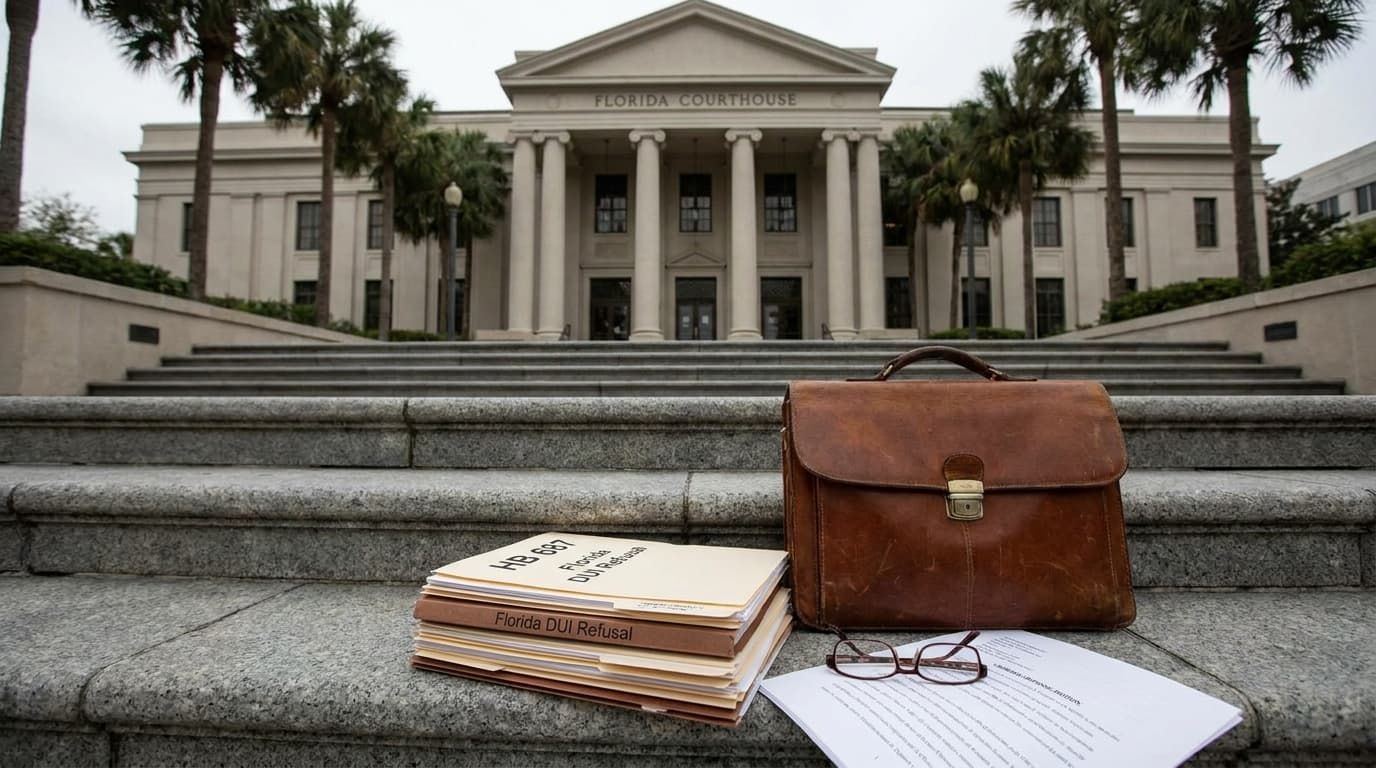
For years in Florida, the calculus at a DUI stop was simple to state, if not simple to make: refuse the breath test on a first arrest and you faced a license suspension, an administrative penalty, but not a criminal charge for the refusal itself. That rule has been inverted. As of October 1, 2025, refusing a lawful breath or urine test after a Florida DUI arrest is its own crime the first time you do it, stacked on top of the license suspension that already applied.
The change comes from House Bill 687, known as Trenton's Law. It is already reshaping how Florida defense attorneys approach refusal cases, and the suppression fight over how it will be enforced is brewing in 2026.
What Trenton's Law Is
HB 687 passed during Florida's 2025 legislative session and took effect October 1, 2025. The law is named for Trenton Stewart, an 18-year-old from the Jacksonville area who was killed in a wrong-way DUI crash in May 2023, as WFTV in Orlando reported.
Legally, the bill amends two parts of Florida's implied-consent framework: Fla. Stat. 316.1932, which governs implied consent, and Fla. Stat. 316.1939, which governs the penalties for refusal. Enforcement under the law began in October 2025, and Bay News 9 in Tampa documented officers applying it in the field within the first two weeks.
What Changed Versus the Old Regime
Before Trenton's Law, a first refusal of a breath or urine test was handled as a civil and administrative matter. The driver lost their license for a period of time, but the refusal itself was not a crime. Only a second or subsequent refusal carried criminal exposure. Cavanaugh & Co. describes the prior administrative-only structure and the shift the new law creates.
Here is the side-by-side, drawing on the penalty figures laid out by The Orlando Law Group:
-
First refusal is now a second-degree misdemeanor: up to 60 days in jail, up to a $500 fine, and up to 6 months of probation.
-
Second or subsequent refusal is a first-degree misdemeanor: up to 1 year in jail and up to a $1,000 fine.
The trigger for either charge is a lawful DUI arrest. That detail matters a great deal once you get to the defense strategies below.
The Penalty Stack
The criminal penalty does not replace the administrative license suspension. It runs alongside it. A first refusal still carries a one-year license suspension, and a second refusal carries an 18-month suspension. So a driver who refuses on a first DUI arrest now faces a criminal misdemeanor case and a one-year administrative suspension at the same time, two separate tracks moving in parallel.
The New Officer Warning Requirement
Trenton's Law did not only raise the stakes for refusing. It also added a new duty on the officer. Before requesting the test, police must now inform the driver that refusal is itself a criminal offense, a second-degree or first-degree misdemeanor depending on history. This is a warning beyond the older implied-consent advisory that told drivers refusal would cost them their license.
According to Musca Law, the warning duty is tied to Fla. Stat. 316.1932(1)(a)1.a. That warning is the linchpin of the first major defense argument, because a charge built on a missing or defective warning may not stand.
Suppression Fight #1: A Defective or Missing Warning
If the officer is now legally required to tell the driver that refusing is a crime, then failing to deliver that warning, or delivering it incompletely, can undercut the refusal charge. Defense attorneys are positioned to argue that a driver who was never properly told refusal was a criminal act cannot be convicted of the crime of refusing. Musca Law lists a defective warning among the suppression strategies available under the new statute.
Because the warning requirement is brand new, every refusal arrest after October 1, 2025 creates a fresh factual question: did the officer say the specific words the statute now demands, and can the state prove it?
Suppression Fight #2: No Probable Cause and the Unlawful Arrest
A refusal charge is only valid if the underlying arrest was lawful and supported by probable cause. That is the second pressure point. If the traffic stop lacked reasonable suspicion, or the arrest that followed lacked probable cause, the refusal that came after may be suppressed as fruit of the poisonous tree. The unlawful stop or arrest taints everything that flows from it, including the refusal.
Musca Law identifies an improper stop and an unlawful arrest as grounds to challenge the refusal, and The Orlando Law Group emphasizes that a lawful DUI arrest is the necessary trigger for the charge in the first place. Take away the lawful arrest and the refusal charge can fall with it.
Suppression Fight #3: The Fifth Amendment and the Confusion Doctrine
The most novel argument, and the one with the least settled answer, is constitutional. By making refusal automatically a crime, Trenton's Law arguably puts drivers in a position where every option points toward self-incrimination. Refuse, and the refusal is now a crime. Submit, and a test over the legal limit becomes evidence against you. Pumphrey Law frames this as making refusal "automatically incriminating," which revives a Fifth Amendment self-incrimination argument.
Layered on top is what Florida defense lawyers call the confusion doctrine. When an officer reads Miranda warnings, the driver is told they have the right to remain silent and the right to counsel. When the officer then reads the implied-consent warning, the driver is told they must submit to the test. The two messages collide: you may stay silent, yet you must comply. The defense argument is that this pairing is confusing and coercive, and that it is unreasonable to penalize a driver for a refusal made amid contradictory instructions.
Pumphrey Law notes that earlier case law, including Kurecka, limited this kind of argument when refusal was only a civil matter. Now that refusal is a crime, the defense bar is arguing that the constitutional calculus has shifted and the older limits should not control. Whether Florida courts agree is the open question.
What This Means for Drivers at the Roadside
The practical reality is that the decision a driver faces at a DUI stop has changed shape. Under the old rule, refusing traded a license suspension for the absence of breath evidence. Now refusing carries its own criminal charge in addition to the suspension. There is no longer a clean "administrative only" path on a first refusal. This is not legal advice and it is not a recommendation to refuse or to submit. It is a description of how the statute now treats each choice, so drivers understand that both paths carry consequences the law did not previously attach.
What Is Still Unresolved
Trenton's Law is new, and Florida courts have not yet resolved how the central defense challenges will play out. The defective-warning, fruit-of-the-poisonous-tree, and confusion-doctrine arguments are being raised, but as of 2026 there is no settled appellate guidance telling trial courts how to handle them, particularly the self-incrimination and confusion-doctrine questions that Pumphrey Law flags as unsettled. Expect early 2026 to bring suppression motions testing these theories, and watch for the first appellate rulings that will start to define the boundaries of the law. Until then, how a refusal charge holds up may depend heavily on the specific facts of the stop, the arrest, and exactly what the officer said before asking for the test.
Related reading
-
[Lange v. California Is Finally Killing Warrantless Home Entry for DUI: Why Misdemeanor Hot-Pursuit Suppressions Are Surging in 2026](/news/lange-california-warrantless-home-entry-dui-suppression-2026)
-
[Hunter v. United States Just Punched a Hole in Every Plea-Deal Appeal Waiver: The New 'Miscarriage of Justice' Exception Explained](/news/hunter-v-united-states-appeal-waiver-miscarriage-of-justice-exception)
-
[The HALT Fentanyl Act Made an Entire Class of Drugs Schedule I Forever. The 10-Year Mandatory Minimum Almost No One Saw Coming](/news/halt-fentanyl-act-class-wide-schedule-i-10-year-mandatory-minimum)
Sources
-
Florida Now Criminalizes First Refusal of DUI Breath or Urine Test, Cavanaugh & Co.
-
Florida's Trenton's Law (HB 687): DUI Refusal Penalties Explained, The Orlando Law Group
-
Florida DUI: The Confusion Doctrine and Trenton's Law, Pumphrey Law
-
Trenton's Law makes refusing a breathalyzer a crime in Florida, WFTV Orlando
-
Refusing a breathalyzer is now a crime in Florida, Bay News 9 Tampa
This article contains AI-assisted content and has been reviewed by our editorial team.
IMPORTANT NOTICE: GavelDaily.com is an advertising and information service, not a law firm. Submitting this form does not create an attorney-client relationship. The information you provide will be shared with licensed criminal defense attorneys in your area who may contact you about your inquiry. All submissions are treated as confidential by our service, but attorney-client privilege does not attach until you formally retain an attorney. Any attorney you connect with through this service is independently responsible for their legal advice and representation. Free consultations are subject to individual attorney availability. If you are facing an immediate legal emergency, contact your local public defender's office or call 911.