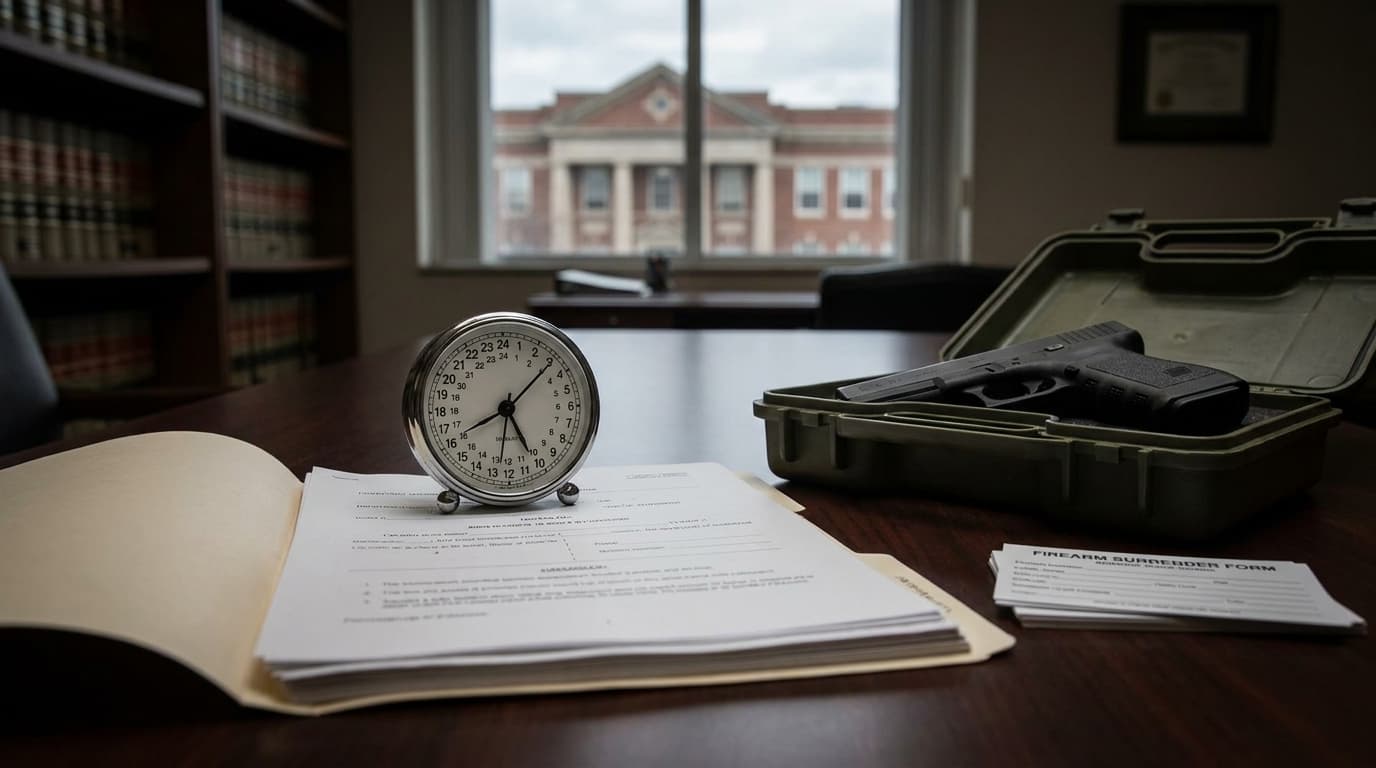
As of July 1, 2026, a misdemeanor domestic assault conviction in Virginia does more than close a criminal case. It starts a 24-hour clock to surrender every firearm you own. The change comes from a pair of new laws that erase what advocates long called the "intimate partner loophole," the gap that let a person convicted of assaulting a dating partner keep their guns when a person convicted of assaulting a spouse could not. That distinction is now gone.
If you have been convicted, or expect to be, the details below matter in hours, not weeks. This piece walks through what triggers the surrender duty, the exact deadlines, what continued possession costs, how the state track interacts with the permanent federal ban, and the limited routes back to your rights.
What changed, and why
Virginia's General Assembly passed two companion measures during the 2026 regular session: HB19, carried by Del. Adele McClure, and its Senate vehicle SB160, carried by Sen. Russet Perry. Gov. Abigail Spanberger signed them into law on April 10, 2026, with an effective date of July 1, 2026.
The core move is a definitional one. Virginia law attaches firearm consequences to offenses against a "family or household member." The new laws fold a person's "intimate partner" into that definition. An intimate partner is someone with whom the convicted person has been in a romantic, dating, or sexual relationship within the previous 12 months, judged by the length, nature, frequency, and type of the interaction. In plain terms, a non-cohabiting dating partner who never shared a home, a marriage, or a child now sits inside the same protected category as a spouse or a co-parent.
What triggers the surrender duty
The trigger is a misdemeanor conviction for assault and battery against an intimate partner or family or household member. Once that conviction is entered, Virginia bars the person from purchasing, possessing, or transporting a firearm for three years. This is the same treatment long applied to assault and battery of a family or household member, now extended to dating relationships.
It helps to separate two tracks that often get blurred:
-
Conviction-based bans flow from a guilty finding on the underlying misdemeanor. They run for a fixed three-year term.
-
Protective-order bans flow from a civil order, not a criminal conviction, and last for the duration of the order. More on how the two can stack below.
The 24-hour window, step by step
The clock starts at sentencing or, if the person is held, at release from custody. Within 24 hours, the person must do one of the following with every firearm they possess:
-
Surrender all firearms to a law enforcement agency.
-
Sell or transfer them to a licensed dealer.
-
Transfer them to an eligible person. An eligible person is an adult 21 or older who is not a prohibited possessor and does not reside with the convicted person.
Then a second deadline lands. Within 48 hours, the person must file a written certification with the court attesting that they no longer possess firearms. That certification must list the name, address, and signature of whoever now holds the guns, whether that is the transferee, the dealer, or the law enforcement agency.
The lawful transfer path is not left to guesswork. A separate companion bill, HB93 and its Senate counterpart SB38, signed the same day, authorizes the transfer mechanism to an eligible adult for both protective-order respondents and misdemeanor domestic violence convictions. According to the Giffords Law Center summary of Virginia law, this 24-hour surrender and 48-hour certification procedure is the operative compliance sequence.
What happens if you miss the window
Continued possession is not a paperwork problem. Knowingly and intentionally possessing, purchasing, or transporting a firearm while prohibited is a Class 1 misdemeanor in Virginia, punishable by up to 12 months in jail and a fine of up to $2,500.
Beyond the direct charge, there are practical consequences. A missed certification leaves the court with no record that you complied, which invites enforcement contact and complicates any later claim that you acted in good faith. If firearms are found in your possession or control after the deadline, that discovery becomes evidence in a new prosecution. The cleanest protection is a documented, timely transfer with a filed certification you keep a copy of.
How it interacts with protective orders
Protective orders run on a parallel track with nearly identical mechanics. A final family-abuse protective order already prohibits firearm possession and uses the same 24-hour surrender and 48-hour certification procedure. It also requires the respondent to surrender any concealed handgun permit for the duration of the order.
These tracks can layer. A person can be subject to a protective order and later convicted of the underlying misdemeanor, or the reverse. When that happens, the conviction-based three-year prohibition and the order-based prohibition operate independently. Complying with one does not satisfy the other, and the longer or later-ending restriction controls how long a person stays disarmed under state law.
The federal trap
Here is the point that catches people who focus only on the Virginia calendar. Federal law imposes its own bar. Under 18 U.S.C. 922(g)(9), a person convicted of a misdemeanor crime of domestic violence is permanently barred from possessing firearms, and the federal statute contains no built-in restoration mechanism.
That means Virginia's three-year term does not, by itself, erase federal exposure. A person generally may possess a firearm without violating federal law only once the state disability is actually lifted through the state's restoration process. Assuming that the passage of three years alone clears you at the federal level is a mistake that can turn into a federal firearms charge. Treat the state and federal questions as two separate locks on the same door.
Narrow paths back
State restoration comes in two forms. First, Virginia firearm rights automatically restore three years after the conviction date, unless the person picks up another disqualifier or a new protective order in the meantime. Second, a person may petition the circuit court in their jurisdiction to restore rights.
Restoration of state rights is meaningful, but it is not the whole picture. Because the federal ban under 922(g)(9) has no independent restoration route, the interaction between state restoration and federal disability is exactly where people get tripped up. Before treating your rights as returned, and certainly before touching a firearm, confirm your status against both the state and federal frameworks with counsel.
The constitutional footing
Virginia's reform did not arrive in a vacuum. It rides constitutional cover from [United States v. Rahimi, 602 U.S. ___ (2024)](https://supreme.justia.com/cases/federal/us/602/22-915/). In an 8-1 decision issued June 21, 2024, with Justice Thomas the lone dissenter, the Supreme Court upheld 18 U.S.C. 922(g)(8) and held that a person found to pose a credible threat to another's physical safety may be temporarily disarmed consistent with the Second Amendment.
As SCOTUSblog explained, Rahimi softened the demand from the Court's earlier Bruen decision. Rather than requiring a historical "twin" for a modern gun regulation, the Court asked whether the law is "relevantly similar" to historical practice. That reasoning is the doctrinal ground on which states have built disarmament measures aimed at credible-threat abusers, though live questions about the limits of the post-Bruen framework remain unsettled.
Practical takeaways for the newly convicted
-
Act inside 24 hours. The clock starts at sentencing or release, not when you get around to it.
-
Use a lawful transferee. Law enforcement, a licensed dealer, or an eligible adult who is 21 or older, not prohibited, and not living with you.
-
File the 48-hour certification and keep a copy. The written filing is your record that you complied.
-
Do not assume three years clears you federally. The 922(g)(9) ban is separate and permanent absent a lifted state disability.
-
Consult counsel before assuming rights have returned. Restoration timing and the federal overlay are where mistakes become new charges.
Virginia sits this reform among a slate of laws that took effect July 1, 2026. For anyone navigating a domestic assault case, it is among the most consequential, because it converts a misdemeanor outcome into a same-day duty with criminal penalties for getting it wrong.
Related reading
-
[The Fraud Sentencing Overhaul Almost No White Collar Defendant Knows About: On November 1 the Federal Loss Table Collapses From 16 Tiers to 8](/article/fraud-sentencing-overhaul-loss-table-16-to-8-tiers-november-2026)
Sources
-
Governor Spanberger Signs Bills Into Law to Enhance Public Safety (April 10, 2026)
-
Domestic Violence and Firearms in Virginia, Giffords Law Center
-
Supreme Court upholds bar on guns under domestic-violence restraining orders, SCOTUSblog
-
10 notable new Virginia laws taking effect July 1, Virginia Mercury
Note: This article contains AI-assisted content and has been reviewed by our editorial team.
IMPORTANT NOTICE: GavelDaily.com is an advertising and information service, not a law firm. Submitting this form does not create an attorney-client relationship. The information you provide will be shared with licensed criminal defense attorneys in your area who may contact you about your inquiry. All submissions are treated as confidential by our service, but attorney-client privilege does not attach until you formally retain an attorney. Any attorney you connect with through this service is independently responsible for their legal advice and representation. Free consultations are subject to individual attorney availability. If you are facing an immediate legal emergency, contact your local public defender's office or call 911.